

16 min read
Nicaragua’s low cost of living and relaxed pace draw thousands of expats every year — but let’s be honest, taxes in Nicaragua aren’t exactly the topic anyone daydreams about before a move. Still, the rules here are more manageable than you’d expect, and knowing them upfront beats an unpleasant surprise later.
……………………………..
Table of Contents
Ask ten expats what taxes you’ll actually owe in Nicaragua, and you’ll get ten different answers — because the honest answer isn’t a flat rate, it’s “it depends on what you’re doing here.”
Whether you owe income tax, property tax, import duties, or nothing at all depends entirely on your situation: are you living here, buying property, running a business, or bringing your car with you?
Each situation comes with its own rules — and, as plenty of expats living in Nicaragua have learned the hard way, it has it’s own way of going wrong.
This guide walks through nine common situations, one at a time, so you can find the exact one that applies to you especially if it’s living here as a resident, buying, or owning or selling property, running a business, owning a vehicle, moving your belongings, filing as an American, and eventually leaving. Each section covers the official rules, plus what actually tends to happen on the ground.
One note before diving in: tax law changes, and Nicaragua’s has shifted more than most recently. Treat this as a solid starting map, not a substitute for a Nicaragua accountant or immigration attorney who can look at your specific situation — or, if you’d rather skip straight to the numbers, jump ahead to the Taxes in Nicaragua Quick Reference Table for a quick side-by-side of every situation.
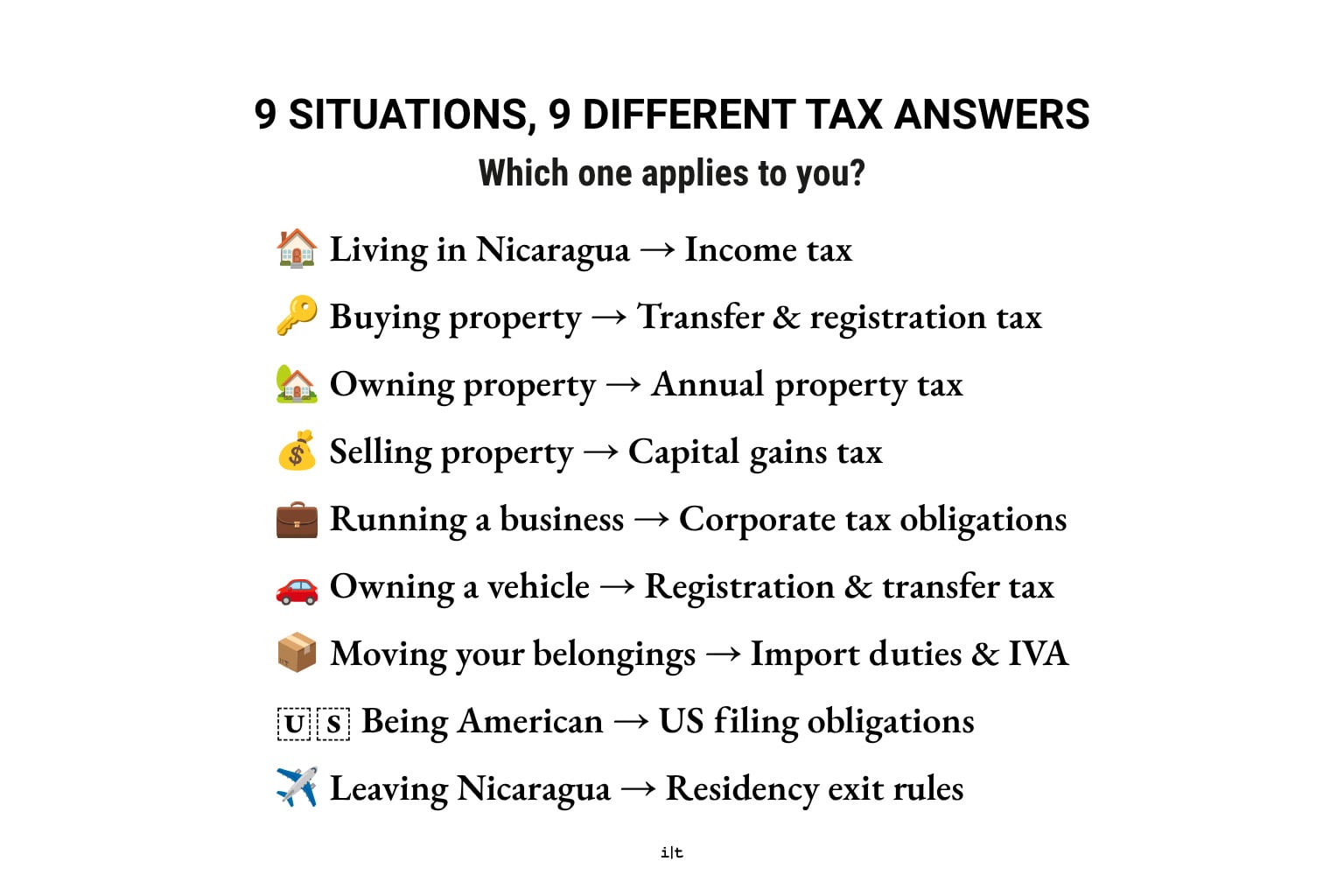
Taxes in Nicaragua depend entirely on your situation — here are the nine that matter most.
Income Taxes in Nicaragua: Do You Owe Tax?
Who Is Considered a Tax Resident in Nicaragua?
Whether you owe Nicaraguan income tax hinges on your residency status, the same status covered in detail in how to get residency in Nicaragua, since your visa category largely determines your tax obligations from day one.
Once you’re on the hook, filing runs through the Dirección General de Ingresos (DGI) – www.dgi.gob.ni and exactly how depends on your income type:
- Employed by a local company: your employer withholds tax automatically each month, and you generally don’t need to file anything yourself — unless you’re pulling income from two or more employers totaling over 100,000 córdobas a year.
- Independent professional or sole proprietor: clients typically withhold 10% on payments, and you’re responsible for filing an annual declaration through the DGI portal within 90 days of year-end.
- Running a company: obligations step up further — certified accounting records, annual corporate income tax returns, and monthly advance payments of 1–3% of gross income.
| Who | Obligation | Rate |
| Employed | Employer withholding | Automatic monthly |
| Independent/self-employed | 10% client withholding + annual filing | 10% |
| Corporate | CIT + advance payments | 1–3% monthly |
One tax applies regardless of category: Nicaragua’s 15% VAT (IVA), which touches nearly every purchase and resurfaces later when we get to import duties on your belongings.
How Taxes in Nicaragua Apply to Residents and Foreigners
This one’s mostly a straightforward compliance question rather than a pitfall-prone situation — check the PWC individual and corporate tax pages for the specific rates and thresholds that apply to your income type, and loop in a Nicaraguan accountant to confirm how they apply to your situation before you file.

Getting property paperwork right upfront avoids one of the most common tax traps in Nicaragua.
Buying Property in Nicaragua: Transfer and Registration Taxes
Property Transfer Tax and Registration Costs
Among the more complicated taxes in Nicaragua, this is the one that catches the most buyers off guard. Buying property in Nicaragua splits the tax obligation across both sides of the closing table.
Per the US Embassy’s guide to buying property in Nicaragua, the seller pays a transfer tax withheld on their gain from the sale, on a bracket scale — confirmed in DGI Notice No. 054-03-2026 — that starts at 1% for properties up to $50,000 and climbs as high as 7% or more at higher values.
The buyer covers a separate set of costs, laid out in InvestNicaragua’s first-time buyer’s guide: notary fees (roughly 1.5–2% of the sale price), a registry inscription fee, and municipal and cadastral certificate costs, typically adding up to 5–9% of the purchase price in total. The full purchase process is covered step-by-step in our upcoming buying a house or condo in Nicaragua.
The Property Purchase Costs Expats Often Overlook
Where buyers actually get tripped up isn’t the tax rate — it’s inherited liability. Property can pass through several unregistered “deeds” over the years, each representing a transfer that was never fully completed or taxed.
Buy one of these properties, and you may end up finishing every unpaid transfer before yours, not just your own. Protect yourself before closing, not after: request a ‘Solvencia’ confirming property taxes are current, and have your attorney check specifically for DGI liens, which can be attached to a property regardless of what the seller tells you. Some buyers go a step further and negotiate the risk directly into the contract, making the seller contractually responsible for clearing any back taxes before the sale closes.
| Who Pays | What | Rate |
| Seller | Transfer tax (capital gains withholding) | 1–7%+ bracket scale |
| Buyer | Notary + registration + closing costs | 5–9% total |
Owning Property in Nicaragua: Annual Property Tax
How Nicaragua Property Tax Is Calculated
This is one of the more reassuring taxes in Nicaragua for anyone comparing costs to home. According to TheLatinvestor’s 2026 breakdown of Nicaraguan property taxes, owners pay 1% annually on 80% of a property’s cadastral value — and cadastral values typically sit well below market price, so the effective rate lands even lower in practice.
The bill runs a year behind, so the tax due in 2026 covers 2025. Your municipality issues a Solvencia Municipal as proof of payment, the same document a future buyer’s attorney will check for.
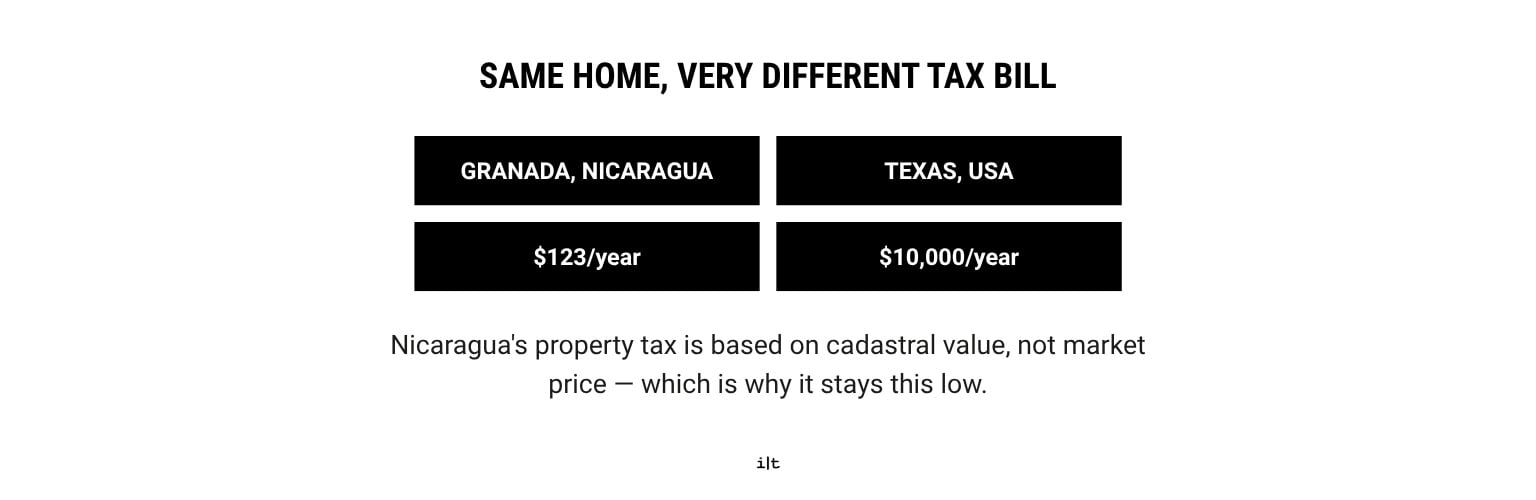
One of the more pleasant surprises among taxes in Nicaragua: property tax that barely registers compared to home.
What Property Owners Need to Know About Annual Tax
On a property in Granada, that formula can work out to roughly $123 a year — compare that to a similar-sized home in Texas, where annual bills of $10,000 or more aren’t unusual, and property tax quickly drops off the list of things to worry about here. The amount you actually pay varies by region, since it’s tied to cadastral value rather than a flat number, and it’s just one line in a bigger cost picture covered in the cost of living in Nicaragua guide.
The bigger practical risk isn’t the amount — it’s letting the Solvencia lapse, since an unpaid balance is exactly the kind of thing that surfaces as a lien when you eventually try to sell.
| Obligation | Rate | Basis |
| Annual property tax (IBI) | 1% | Of 80% of cadastral value |
Selling Property in Nicaragua: Capital Gains
How Capital Gains Tax Works in Nicaragua
When you sell, the same transfer tax withholding covered earlier applies to you as the seller. Nicaragua taxes the gain on a bracketed scale, starting at 1% for sales up to $50,000 and rising in steps as the sale value increases, reaching 7% or higher at the top brackets.
The tax is withheld at the time of transfer based on the registered sale value and applies whether you’re a resident or a foreign owner selling from abroad.
The Tax Implications of Selling Property as an Expat
How your original purchase price and any capital improvements factor into your actual taxable gain, how currency fluctuations between córdobas and dollars are treated, and whether the sale triggers additional obligations back in your home country are all specific to your situation — a Nicaraguan accountant should weigh in before you list, not after.
Worth handling ahead of time too: where the proceeds actually go which is covered in banking in Nicaragua for expats.
| Who Pays | What | Rate |
| Seller | Capital gains withholding | 1–7%+ bracket scale on sale value |
Still weighing Nicaragua against other options? Download our free Latin America Residency Map — a look at residency paths across the region, so you can see how the whole picture compares before you commit to one country’s tax rules.

Running a business here comes with its own set of tax obligations — from registration to monthly filings.
Running a Business in Nicaragua: Tax Obligations
What Taxes Do Businesses Pay in Nicaragua?
Opening a business in Nicaragua means registering as a legal entity — commonly a Sociedad Anónima (SA) — before any tax obligations even kick in.
Per NicaRealtors’ guide to doing business in Nicaragua, that registration process includes obtaining a RUC (tax ID) from the DGI, and from there the obligations mirror what any Nicaraguan corporation owes: certified accounting records, annual corporate income tax (CIT) returns, and monthly advance payments of 1–3% of gross income.
Businesses also collect and remit the standard 15% VAT (IVA) on applicable sales, with high-volume taxpayers filing on a monthly rather than quarterly basis.
Some designated business zones carry their own additional local tax requirements on top of the national baseline, so confirming your specific municipality’s rules before registering is worth the extra step.
| Obligation | Rate |
| Corporate income tax advance payments | 1–3% monthly (gross income) |
| VAT (IVA) | 15% |
Registering for Taxes in Nicaragua as a Business Owner
Running a business here in practice means staying connected to file and pay on schedule — worth keeping in mind alongside the practical realities covered in internet in Nicaragua, since reliable connectivity is its own factor in staying compliant when a chunk of this runs through the DGI’s online portal. Beyond that, the biggest practical variable is finding an accountant who actually knows your specific business type and zone, since requirements can shift by municipality and industry in ways a general guide won’t catch.
Buying a car here means understanding registration and transfer taxes in Nicaragua before you sign anything.
Owning a Vehicle in Nicaragua: Registration and Transfer Tax
Vehicle Registration and Taxes in Nicaragua
Buying a used vehicle in Nicaragua triggers a transfer tax of 1% of the vehicle’s assessed value, paid to the DGI as part of the sale process.
You’ll need a lawyer to draw up an escritura — a legal ownership document similar to what you’d get buying land in Nicaragua — and from there, registering the vehicle means a separate trip to pay for plates (placa), registration (matricula), and a circulation permit.
The process is covered in Latin American Cargo’s guide to shipping a vehicle to Nicaragua if you’re bringing a car in from abroad rather than buying locally. New vehicles work differently — dealerships build all applicable taxes into the purchase price upfront.
Taxes and Costs When Buying or Selling a Vehicle
The same deed-chain risk that trips up property buyers shows up with vehicles too: if a previous sale was never fully registered, that unfinished transfer — and its unpaid tax — can follow the car to you rather than disappearing.
Before buying used, per CarAgencia’s Nicaragua Buyer Guide, it’s worth asking directly how many prior deeds the vehicle has and whether each one was actually completed at DGI, not just signed. Expats in local community groups also report fines and even police seizure for vehicles that sit unregistered too long after purchase — the exact grace period varies by account, so confirm current timing with your lawyer rather than assume a fixed number of days.
| Who Pays | What | Rate |
| Buyer | Transfer tax | 1% of assessed value |
| Buyer | Registration/plate fees | Flat fee (varies) |
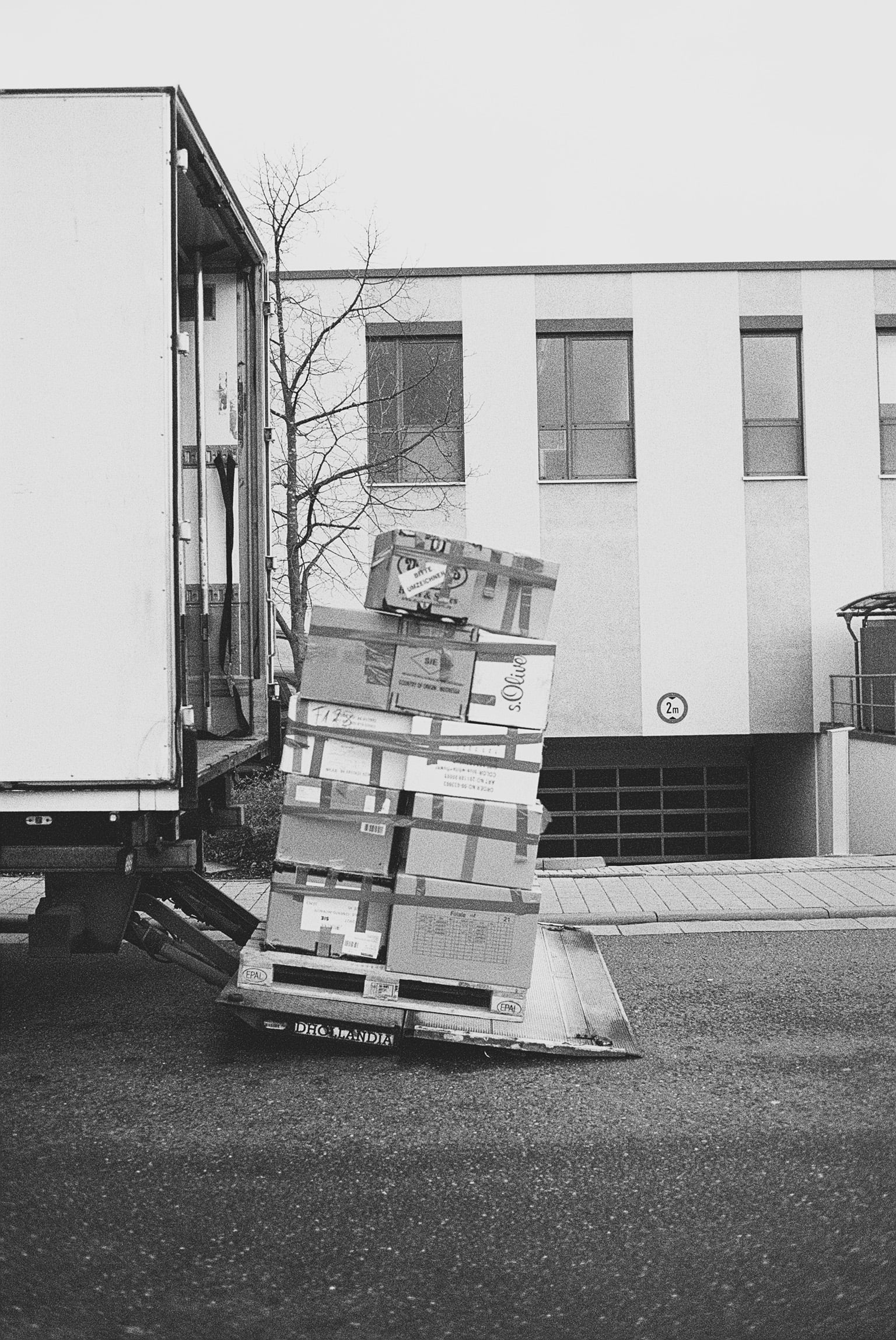
Moving your belongings? Import duties and IVA are part of the tax picture too.
Moving Your Belongings to Nicaragua: Import Duties and IVA
How Import Taxes in Nicaragua Apply to Household Goods
Import duties are one of the more unpredictable taxes in Nicaragua, since so much depends on what’s in the shipment. Bringing your household belongings into Nicaragua isn’t automatically duty-free, even as a soon-to-be resident.
Per Interwf’s guide to shipping a container to Nicaragua, items brought in outside normal traveler/visitor allowances are subject to import duties ranging from 0% to 45% depending on how customs classify each item, plus Nicaragua’s standard 15% VAT (IVA) and, on certain goods, an additional luxury tax.
Pets require a separate IPSA inspection fee, typically in the $10–15 per animal range.
Because duty rates depend entirely on item classification, there’s no single flat percentage to plan around — a shipment full of electronics and a shipment full of clothing and furniture can land at very different total costs.
| Obligation | Rate |
| Import duty | 0–45% (by classification) |
| VAT (IVA) | 15% |
| IPSA pet inspection fee | ~$10–15/animal |
The Customs Costs Expats Often Don’t Expect
In practice, enforcement is inconsistent — land border crossings tend to be more lenient than the airport, and how thoroughly your bags get inspected often comes down to how busy customs are that day. Expats commonly report packing strategies like avoiding original packaging, not bringing duplicates of the same item, and splitting valuables across multiple bags rather than concentrating them in one — all signals’ customs agents watch for when deciding whether something looks personal versus resale-bound.
None of that guarantees anything, though: some travelers report sailing through with several suitcases of gear, while others have had specific items assessed and taxed on the spot with little warning.
If you’re still deciding where to settle before shipping everything over, it’s worth reading best places to live in Nicaragua for expats first — your eventual city affects everything from what you’ll actually need to bring to how accessible customs offices and freight forwarders are once you land.
U.S. Filing Obligations for Americans Living in Nicaragua
Why Americans Still Have US Tax Filing Obligations
Moving to Nicaragua doesn’t end a US citizen’s relationship with the IRS. American citizens and green card holders are required to file a US federal tax return every year regardless of where they live, reporting worldwide income even if none of it was earned in the US.
The Foreign Earned Income Exclusion (FEIE) lets qualifying expats exclude a set amount of foreign-earned income from US tax each year, and self-employment income specifically remains subject to US self-employment tax even when it’s fully excluded from regular income tax under the FEIE. Americans with foreign bank accounts may also trigger separate FBAR reporting requirements once balances cross certain thresholds.
FBAR, Foreign Accounts and Other Reporting Requirements
This is one of the most persistent points of confusion in expat communities: the assumption that living abroad full-time automatically means no more US tax obligations. It doesn’t, and the rules involved — what qualifies for the FEIE, how self-employment tax applies, when FBAR kicks in — have enough moving parts that general information only goes so far.
Given how situation-specific this gets, and how costly getting it wrong can be, this is squarely a “work with a cross-border tax professional who handles US expats” topic rather than something to piece together from a blog post or a Facebook group.

Leaving Nicaragua has its own paperwork — and skipping it can carry real consequences.
Leaving Nicaragua: Residency and Exit Tax Consequences
What Happens to Your Tax Residency When You Leave?
This is where taxes in Nicaragua catch people who assume residency just quietly expires. Nicaraguan residency doesn’t simply expire quietly when you decide to leave. Formally giving up resident status is a documented process requiring written notice and returning your cédula, per the Reglamento to Ley No. 761 (Nicaragua’s General Migration and Foreigners Law, available in full via the National Assembly of Nicaragua).
One important distinction for anyone researching this: older posts and forum threads sometimes reference special tax exoneration benefits tied to rentista or pensionado residency, including reduced import duties. Those benefits existed under Law 694, which was repealed on July 31, 2024.
If you obtained residency and those exonerations before the repeal, Article 33 of Ley 761 spells out your exit obligation directly: renouncing or losing rentista/pensionado status requires presenting the Dirección General de Migración y Extranjería with documentation proving the previously exonerated taxes have been paid. If you’re applying for residency now, those specific exonerations no longer exist, so there’s nothing to claw back on exit.
Tax Obligations That Can Continue After Departure
Immigration attorneys in expat communities don’t always agree on this — some tell clients residency can simply be left to expire with no further action required, while others insist the formal written renunciation is required regardless.
Given the law’s own fine schedule for irregular status, the written notice is clearly the safer default rather than betting on informal guidance. Anyone holding legacy Law 694 benefits specifically should confirm their Article 33 documentation with an immigration attorney well before departure, since gathering proof of paid taxes can take longer than expected if it’s left until the last minute.
Nicaragua Tax Quick Reference: Every Situation at a Glance
If you’ve skipped ahead or just wanted the short version, here’s every situation from this guide side by side — use it to see where your own circumstances land, then jump back to the relevant section for the full picture.
| Situation | Tax/Obligation | Rate or Basis | Notes |
| 🏡Living in Nicaragua | Income tax (via DGI) | Employer withholding; 10% independent contractor withholding; 1–3% corporate advance payments | Filing depends on employment type; 15% VAT applies broadly |
| 💰Buying property | Transfer tax (seller) + registration costs (buyer) | Transfer: 1–7%+ bracket scale; buyer closing costs: 5–9% | Verify prior deeds are fully registered before closing |
| 👌Owning property | Annual property tax (IBI) | 1% of 80% of cadastral value | Billed a year behind; keep Solvencia current |
| 🔑Selling property | Capital gains withholding | 1–7%+ bracket scale on sale value | Consult an accountant for specifics |
| 👩💼Running a business | Corporate income tax + VAT | 1–3% monthly advance payments; 15% VAT | SA registration and RUC required first |
| 🚗Owning a vehicle | Transfer tax + registration fees | 1% of assessed value + plate/registration fees | Confirm all prior deeds were completed |
| 🚚Moving belongings | Import duty + VAT | 0–45% duty + 15% VAT + possible luxury tax | Enforcement varies by entry point |
| 🌐US citizens | Continued US filing | Worldwide income; FEIE may apply | Work with a cross-border tax professional |
| 🙋♂️Leaving Nicaragua | Exit/renunciation requirements | $2/day fine for irregular status (residents) | Legacy Law 694 holders have added clawback documentation to file |
Taxes in Nicaragua: Frequently Asked Questions
Do I still have to pay US taxes if I live in Nicaragua full-time?
Yes. Taxes in Nicaragua don’t cancel out your US filing obligations — citizens and green card holders must file a federal return every year regardless of where they live, though the Foreign Earned Income Exclusion may reduce what’s owed.
How much is property tax in Nicaragua?
Among taxes in Nicaragua, property tax is one of the more pleasant surprises — roughly 1% of 80% of a property’s cadastral value annually, often just over $100 a year on a mid-range home.
Do I owe tax on a property I sell in Nicaragua?
Yes. Capital gains are one of the more overlooked taxes in Nicaragua for property owners — a withholding tax applies on a bracketed scale based on sale value, typically the seller’s responsibility rather than the buyer’s.
What happens if I don’t formally give up my residency before leaving?
You risk being classified in irregular status, which carries a daily fine under Nicaraguan law rather than a clean, automatic exit — one of the more avoidable consequences among taxes in Nicaragua if you plan ahead.
Are import duties unavoidable when moving to Nicaragua?
Not entirely. Import duties are among the more variable taxes in Nicaragua — normal personal effects within reasonable limits are typically fine, but larger shipments and higher-value items can trigger duties, IVA, and sometimes a luxury tax depending on classification.
Final Thoughts: Taxes in Nicaragua Don’t Have to Be a Guessing Game
The pattern across all nine situations is the same: Nicaragua’s tax rules themselves are fairly modest and predictable, but the risk almost always lives in what happens around them — an unregistered deed, a missed renunciation notice, an assumption that living abroad quietly cancels a US filing obligation. Knowing which situation applies to you, and getting the paperwork right the first time, matters far more than the rates themselves.
If your situation touches more than one of these — buying property and running a business, say, or approaching residency renewal while planning a future exit — that’s exactly when a Nicaraguan accountant or immigration attorney earns their fee. Treat this guide as the map, not the final word.
Feeling like your tax situation depends on more than just Nicaragua?
Download the Free interactive Latin American Map — a side-by-side look at residency paths across the region, so you can compare before you commit.
✔ No Spam
✔ Instant Access
✔ Free Download
Disclaimer: This article is for general informational purposes only and does not constitute tax, legal, or financial advice. Nicaraguan tax law and immigration regulations change, and individual circumstances vary — always consult a licensed Nicaraguan accountant or immigration attorney before making decisions based on this information.