

14 min read
Internet in Paraguay tells a quieter story than most Latin American connectivity narratives — a country that leapfrogged straight past landlines into a fast, affordable, mobile-first network, without the fanfare. Reliability here has less to do with speed and more to do with what happens on your specific street when the power grid, not the connection, is put to the test.
……………………………..
Table of Contents
If you’re about to relocate to Paraguay, chances are you’re not asking, “does Paraguay have internet?”
You’re asking something more specific: will it hold up during a client call, a bank login that needs a one-time code, or a video call home when it actually matters?
That’s the real question this guide answers — not with marketing language, but with real numbers and what residents actually experience day to day.
Most posts about internet in Paraguay lean on the same vague line: “it’s improved dramatically.” That’s true, but it doesn’t tell you anything useful.
The more accurate — and more useful — framing is this: speed was never really the problem here.
Fiber in the cities is fast and cheap.
What determines whether your connection is reliable comes down to two things: the infrastructure on your specific street, and what happens to your power grid when a storm rolls through.
This guide breaks down both, with the real numbers behind them. For the bigger picture on settling in here, start with the living in Paraguay for expats guide.
Quick Answer: the internet in Paraguay
Internet in Paraguay is reliable in major cities like Asunción, with fiber speeds often reaching 200 Mbps–1 Gbps — but coverage and consistency drop off outside urban areas. Plans typically run $16–$86/month, making Paraguay one of the more affordable internet markets in Latin America. The real risk to reliability isn’t speed or price — it’s power outages, which can knock out even a strong fiber connection anywhere in the country.
Reality check: Internet in Paraguay is fast and cheap — but it’s not “set and forget.” Your exact location, your building’s infrastructure, and whether you have a backup plan matter more than which provider you pick.
The Real Numbers — Speed and Coverage of internet in Paraguay
Marketing pages love the word “improved.” Here’s what that actually looks like in measured data.
According to Ookla’s Speedtest Global Index, Paraguay’s average fixed-broadband download speed is 160.59 Mbps, ranking 51st internationally, while upload speed lags further behind at 55.63 Mbps. That fixed-broadband number reflects fiber and cable connections concentrated in cities — it’s not what someone relying on mobile data alone should expect.
Mobile internet tells a different story: Paraguay ranks 98th for mobile download speed at 27.43 Mbps, a gap that matters if your daily connection is a phone plan rather than a home fiber line.
Individual providers can beat the national average by a wide margin in the right neighborhood.
Independent speed-test data for the past year from SpeedGeo — Internet Speed in Paraguay shows Claro delivering the fastest broadband in Paraguay, averaging 181.8 Mbps download and 141.0 Mbps upload — proof that “up to 300 Mbps” fiber plans aren’t just advertising copy, at least for well-served addresses.
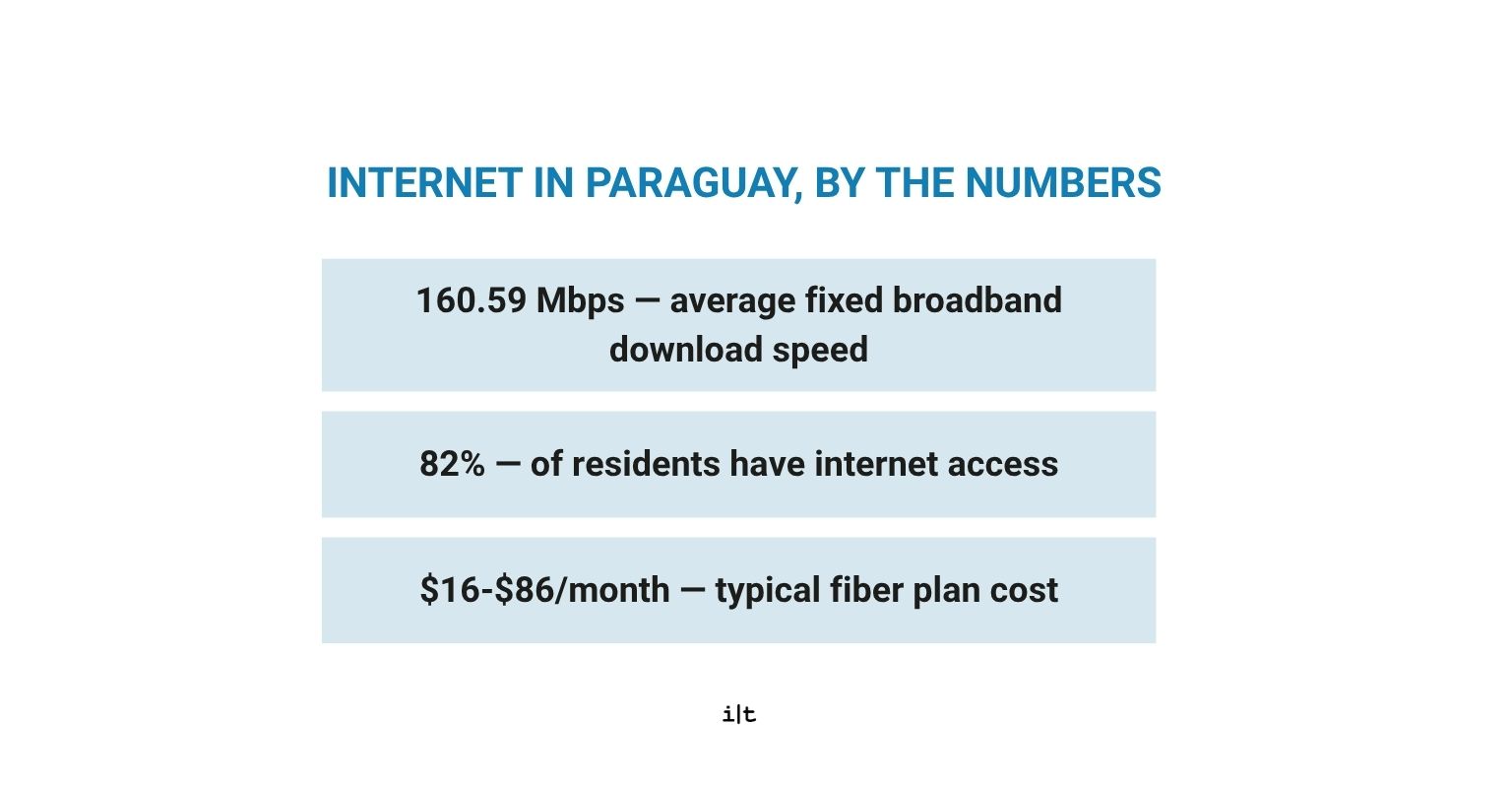
Internet in Paraguay by the numbers — speed, access, and cost at a glance.
The bigger story is coverage, not speed.
Only around 82% of residents have internet access at all, and fixed broadband penetration sits at roughly 13 subscriptions per 100 people — one of the lower fixed-line rates in the region as reported by WorldData.info —Mobile communications and Internet in Paraguay.
That’s the coverage gap in plain numbers: fast where fiber has been built, thin everywhere else.
| Metric | National Average | Leading Urban Provider |
| Fixed broadband download | 160.59 Mbps | Up to 600 Mbps–1 Gbps (Claro/Personal, well-served areas) |
| Fixed broadband upload | 55.63 Mbps | Up to 300 Mbps |
| Mobile download | 27.43 Mbps | Varies by neighborhood and tower density |
| Internet access (any type) | ~82% of residents | — |
| Fixed broadband penetration | ~13 per 100 people | — |
The takeaway: if you’re on fiber in Asunción or another well-covered city, these numbers work strongly in your favor. If you’re not, plan around the national averages — not the advertised maximums — and treat the next section on backup options as required reading, not optional.
Why Paraguay Went Mobile-First (And What It Means for Your Internet)
To understand why your mobile connection in Paraguay is often more reliable than you’d expect, it helps to know a bit of telecom history — briefly, and only because it explains what you’re working with today.
Paraguay’s fixed-line network was never built out the way neighboring countries were. The state-owned Copaco has held a monopoly on all fixed-line voice service — local telephony, long-distance, even VoIP — for decades, and underinvestment in that network left the country with low teledensity for the region.
That legacy still shows up in the numbers from the previous section: roughly 13 fixed broadband subscriptions per 100 people.
Mobile took a completely different path. The mobile market opened to real competition back in 1998, decades before Copaco’s fixed-line grip loosened at all, and operators moved fast to fill the gap left by weak landline infrastructure.
The result is a mobile-first country almost by default — Paraguay has one of the highest ratios of mobile phones to fixed lines in Latin America. (Developing Telecoms — Paraguay Telecoms Market Report)
The practical takeaway: mobile data in Paraguay isn’t a fallback for when home internet fails — for most residents, it’s the primary connection, and always has been.
That’s worth keeping in mind if you’re weighing how connectivity fits into Paraguay’s residency and relocation process more broadly — a setup that treats mobile data purely as backup is thinking about it backwards. (Electronic Frontier Foundation — Paraguay Telecom Companies Overview)

Choosing an internet provider in Paraguay comes down to your exact block, not the brand name.
Which Internet Provider in Paraguay Should You Choose? (Hyperlocal Reality)
Ask ten expats in Paraguay which internet provider is best, and you’ll get ten different answers — sometimes from people living five blocks apart.
That’s not indecision.
It’s the actual reality of home internet here.
The three main providers — Personal, Tigo, and Claro — all offer fiber plans, and fiber availability has expanded significantly across Asunción and other cities in recent years.
But “available” doesn’t mean “consistent.”
Coverage and performance depend heavily on how recently the infrastructure in your specific area was built out, not on which brand’s name is on the router.
What Residents Actually Experience
The pattern shows up constantly in expat community discussions: someone raves about Personal fiber running flawlessly for over a year, while a neighbor a few streets away reports the same provider dropping signal regularly.
Someone with Claro in one part of Villa Morra loves the price-to-performance ratio; someone else with Claro nearby says they’d never sign up again. Newer buildings and recently upgraded areas tend to get noticeably better, more consistent service — infrastructure age matters more than provider loyalty.
Key takeaway: Choosing a home internet provider in Paraguay before checking your exact address is guesswork. Online reviews won’t help much either — they average out experiences across an entire country when what actually matters is your block.
The one method that consistently works: ask the neighbors, or ask your building, before you sign a contract.
If you’re still deciding where to live, this is worth factoring in alongside the other trade-offs covered in renting vs buying in Paraguay — a building with modern fiber already installed can matter as much as the neighborhood itself.
Provider information: Personal · Tigo · Claro
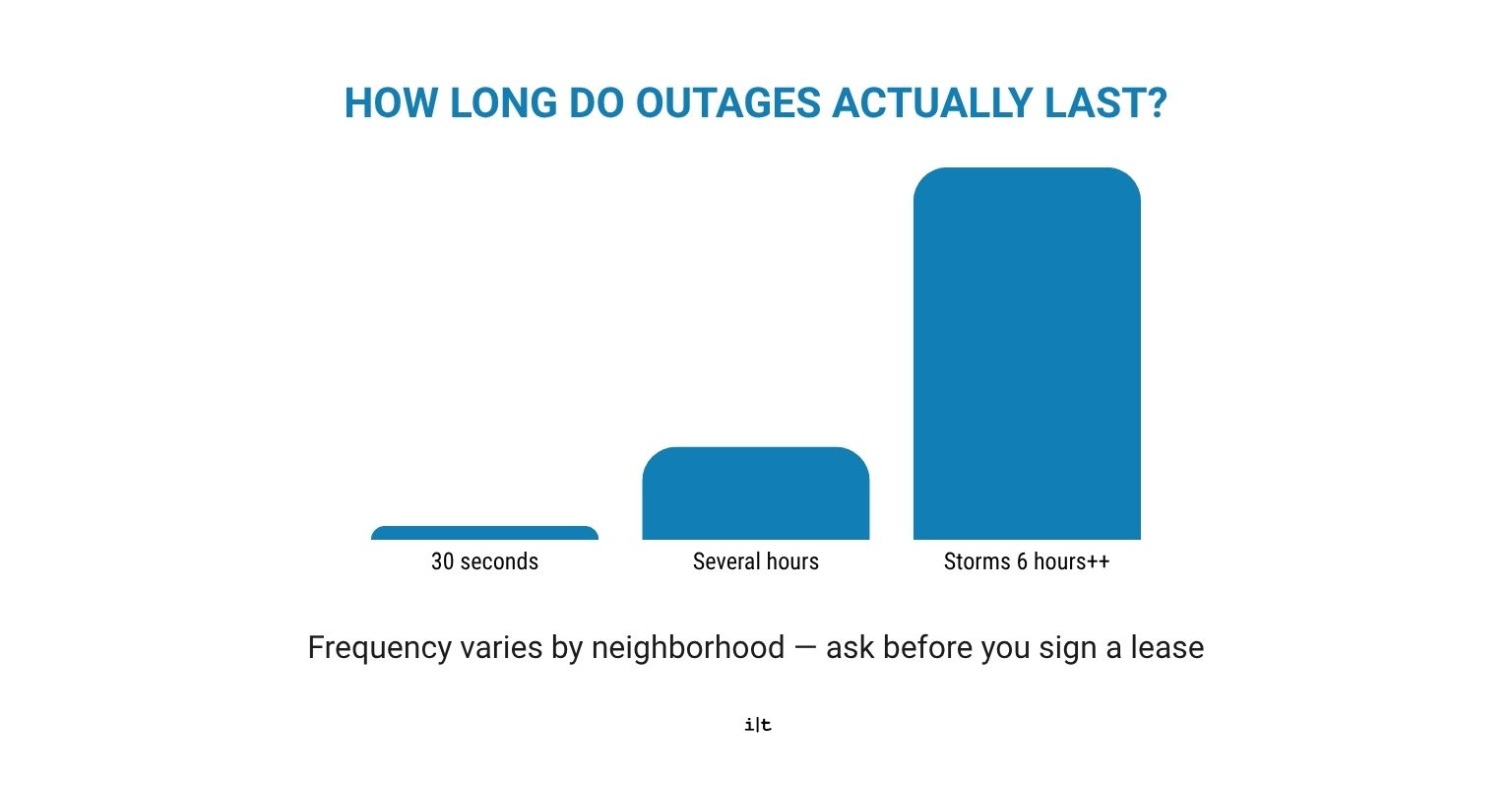
The real threat to internet in Paraguay isn’t speed — it’s how long the power stays out.
What Actually Breaks Internet Reliability in Paraguay — Storms and Power Outages
Here’s what most “internet in Paraguay” guides skip entirely: the connection itself usually isn’t the weak point.
The power grid is.
Ask anyone who’s lived here more than a few months, and the story is remarkably consistent — outages happen, they range from a 30-second blip to six or more hours during a bad storm, and how often they hit depends heavily on your specific neighborhood. Some residents go most of the year without a notable outage.
Others report several in a single month, especially in areas where the electrical lines haven’t been upgraded recently. Wealthier neighborhoods aren’t automatically safer from this — what matters is whether the local grid infrastructure has been redone, not the price of the real estate.
Why Internet Fails During Outages
This trips people up because it seems counterintuitive: fiber-optic cable doesn’t carry electricity, only light signals to transmit data. However, everything on either end of that fiber line — the equipment at your provider’s local node, and the router sitting in your home — absolutely does need power to function.
When the grid goes down, your fiber connection typically goes down with it, unless your provider’s local equipment has its own battery backup (some do, for a few hours; not all).
That’s the real reliability question to ask before committing to a plan: not “how fast is it,” but “what happens to my connection when the power goes out.”
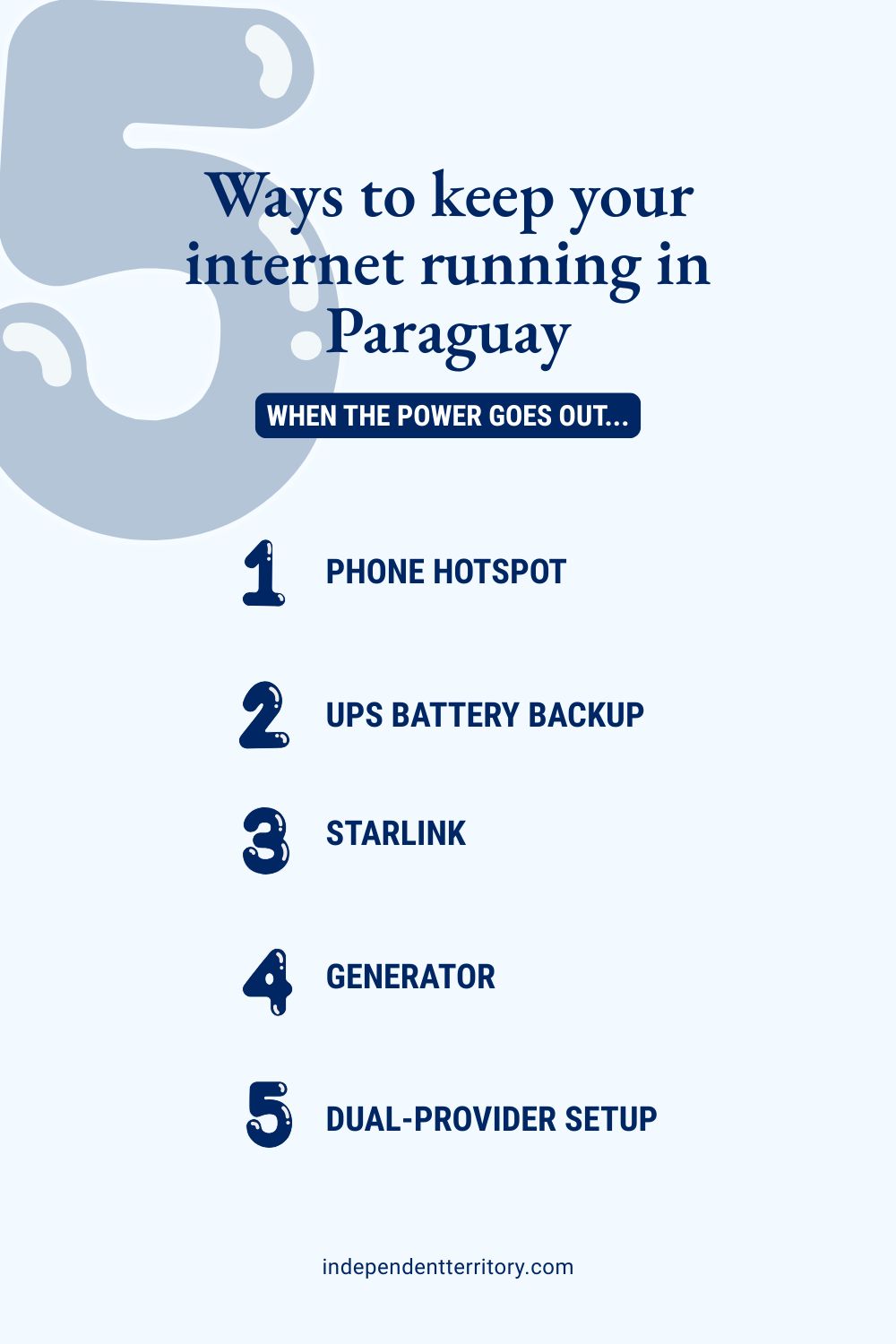
Backup Internet Options in Paraguay, Ranked by Commitment
None of these need to be complicated. Pick based on how much disruption you can actually tolerate.
- Phone hotspot — the simplest option, and often enough on its own. Works for short interruptions, costs nothing extra if you already have a solid mobile data plan and require zero setup in advance.
- UPS (battery backup) for your router — a small investment that keeps your router and modem powered through short-to-medium outages, typically a few hours depending on the unit. Won’t help if your provider’s own equipment loses power but solves half the problem cheaply.
- Starlink — a genuinely strong option for rural properties and areas with weak fixed infrastructure since it sidesteps local grid and cable issues entirely. However, although a Starlink setup would avoid any land-based internet provider outages it would still require an off-grid power solution. One caveat worth knowing: some users in dense urban settings report interference from nearby wifi and Bluetooth devices affecting performance, so it’s a stronger fit outside the city than in it.
- Generator — the most complete solution and the most effort: fuel, noise, and maintenance are ongoing responsibilities, not a one-time purchase.
- Dual-provider setup — running two separate internet providers into one property. Overkill for casual use, but a reasonable move for anyone whose income depends on never dropping a call.
Decision Triggers:
Working remotely? Treat fiber + a mobile hotspot as the minimum, not a nice-to-have.
Living rurally? Starlink often ends up as your primary connection, not a backup.
Casual, low-stakes use? A phone hotspot alone is usually enough to get through most outages.
Budgeting for backup equipment is worth factoring into your broader planning — it’s a small but real line item alongside the rest of your cost of living in Paraguay.
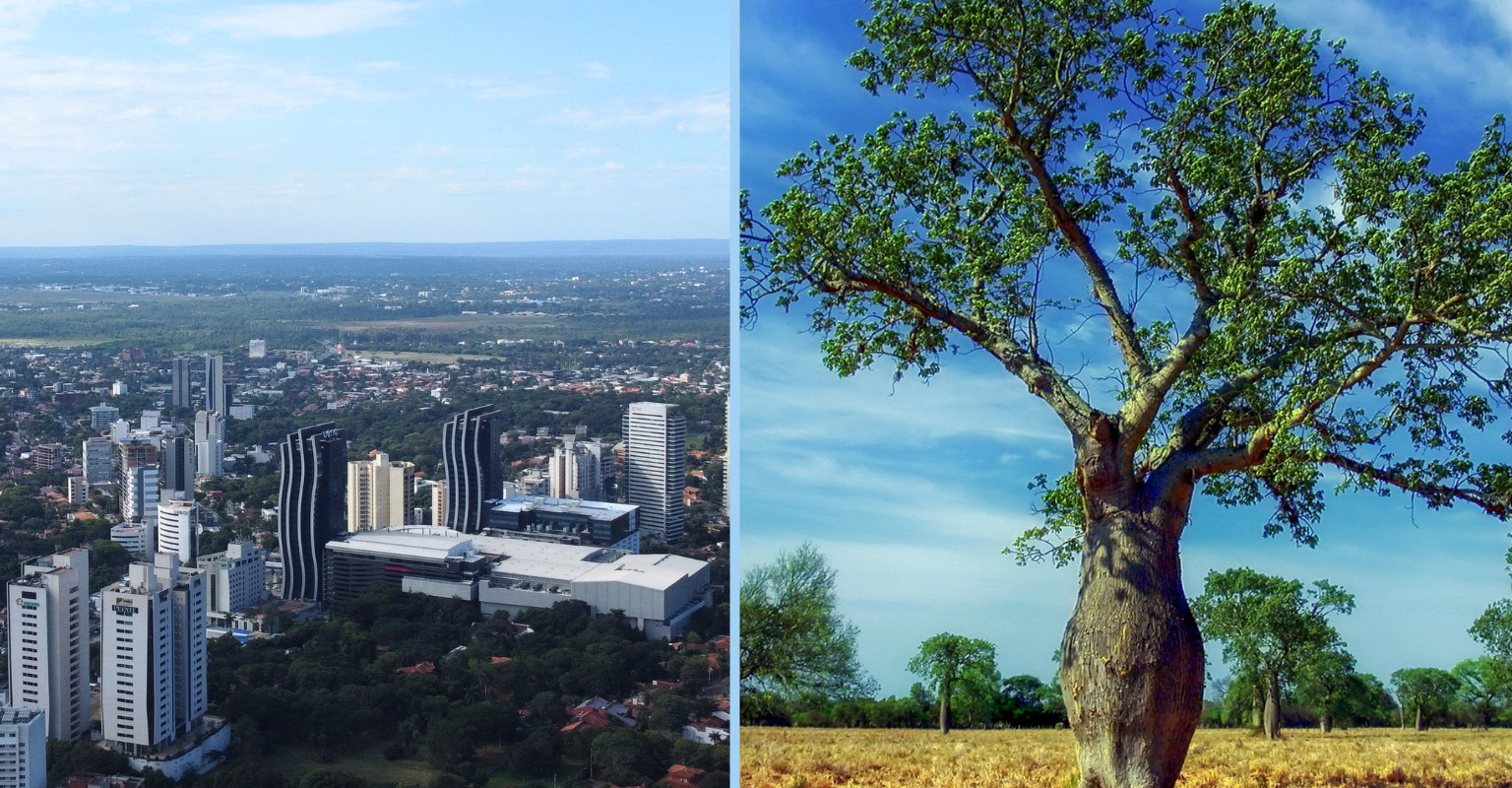
Internet in Paraguay looks very different depending on whether you’re in the city or the countryside.
City vs. Countryside: Internet in Paraguay by Region
The honest answer to “is internet reliable in Paraguay” depends heavily on your location in Paraguay.
In Asunción, Ciudad del Este, and Encarnación, the picture is genuinely good: fiber is widely available, plans are inexpensive by regional standards, and — outside of storm-related outages — service is generally reliable. This is where the fast, cheap numbers from earlier in this guide actually apply.
Move to smaller towns, and the story shifts. Internet is usually available and workable, but expect more inconsistency — fewer provider options, older infrastructure in some areas, and a higher chance that “fiber” means DSL or a slower connection in practice. It’s usable, not something to take for granted.
The Chaco region is its own category entirely. Low population density and vast distances mean traditional fixed infrastructure is limited, and for many residents there, satellite internet isn’t a backup option — it’s the only realistic one.
None of this is a sales pitch for one location over another — it’s simply what to expect so you can plan around it rather than be surprised by it. If connectivity is a deciding factor in where you settle, it’s worth weighing alongside everything else in the best places to live in Paraguay, since the towns and neighborhoods that score well on cost or lifestyle don’t always score the same way on infrastructure.
Home Internet vs. Mobile Data — What Do You Actually Need?
For most people relocating to Paraguay, the real question isn’t “which is better, fiber or mobile” — it’s which one should carry the weight of your daily life, and which one backs it up.
In the cities, fiber is the natural choice for a home base: it’s fast, it’s affordable, and it handles the heavy lifting — video calls, large uploads, streaming, multiple devices at once. Mobile data fills in around it, covering you when you’re out, when the power’s out, or when you simply need a second connection that doesn’t depend on the same grid as your router.
Outside the well-covered areas, that relationship can flip. Where fixed infrastructure is thin or nonexistent, mobile data often becomes the primary connection by necessity, not preference — which is exactly the mobile-first pattern this guide covered earlier. In that case, getting your mobile setup right isn’t optional groundwork, it’s the main event.

When the power goes out, a mobile hotspot is often the simplest backup for internet in Paraguay.
What This Means for Remote Work
Short answer: yes, internet in Paraguay is good enough to work remotely full-time — but “good enough” assumes you’ve planned for it, not just signed up for the fastest plan advertised.
Speed was never the real obstacle, as the numbers earlier in this guide show. The obstacle is redundancy. A single fiber connection with no backup plan is fine right up until a storm knocks out power for a few hours during a client call.
The remote workers who never think about connectivity again after moving here are usually the ones who set up a backup — a UPS, a solid mobile data plan, or both — before they needed it, not after.
This guide has covered the infrastructure and reliability side of that equation. For the fuller picture on making remote work in Paraguay actually work — coworking spaces, café culture, community, and day-to-day logistics — see the complete digital nomad in Paraguay guide.
What This Means for Banking and Staying Connected
Connectivity in Paraguay isn’t just about work — it’s also what keeps you connected to your money and the people you left behind.
Most banks still rely on SMS-based two-factor authentication to confirm logins and transfers, which means a stable, working phone number matters more here than people expect before they move.
An unreliable connection at the wrong moment isn’t just an inconvenience — it can mean a locked-out banking session or a missed verification code with a short expiry window.
The same goes for staying in regular contact with family: WhatsApp calls and messages are the default communication method for most of daily life in Paraguay, and they depend on the same mobile and internet reliability this guide has walked through.
Frequently Asked Questions About Internet in Paraguay
Is internet in Paraguay reliable for daily use?
In cities like Asunción, generally yes — fiber connections handle daily use well. The primary trouble isn’t the connection signal but weather-driven grid blackouts, which means a simple backup strategy remains more important than just upgrading to faster options.
Is internet in Paraguay fast enough for video calls?
Yes. Urban fiber speeds regularly reach 100–300 Mbps, far more than video calls require. The real question isn’t speed, it’s whether your connection stays up during the call — which comes back to power reliability, not bandwidth.
Does Paraguay have 5G?
5G coverage exists but remains limited and concentrated in major urban areas. 4G/LTE is the more consistent standard nationwide and covers the vast majority of the population.
How often do power outages affect internet in Paraguay?
It varies significantly by neighborhood — some residents go most of a year without a notable outage, others experience several in a single month. Areas with older electrical infrastructure tend to see more frequent and longer outages, regardless of income level.
Is rural internet in Paraguay usable?
Yes, but expect a different experience than in the cities — thinner fixed-line coverage and more reliance on mobile data or satellite options like Starlink, especially in areas like the Chaco.
Does fiber internet work during a power outage?
Not reliably, in most cases. Fiber cable itself doesn’t need electricity to transmit data, but the equipment on both ends does — so unless your provider’s local node has battery backup, your connection typically goes down with the grid.
Are coworking spaces a good backup if home internet fails?
Often yes, particularly in Asunción, where several spaces run on generator backup during outages. It’s a solid fallback for a scheduled call, though not a substitute for having your own backup plan day to day.
Final Verdict: Is Internet in Paraguay Reliable Enough?
The honest version of “is internet in Paraguay reliable” comes down to this: the connection itself is fast and affordable — some of the best value in Latin America, by the numbers.
What determines whether it actually holds up for you isn’t the provider you pick or the plan you pay for. It’s your specific address, and whether you’ve planned for what happens when the power grid, not the internet, is the thing that fails.
That’s a solvable problem, not a reason to worry. A hotspot, a UPS, or a Starlink setup costs little and buys real peace of mind — the residents who never think twice about connectivity here are usually the ones who prepared for outages before they needed to, not after.
Reliable connectivity also underpins something easy to overlook until it breaks: your ability to bank, verify your identity, and manage money from abroad. If you haven’t looked into how that side of relocating works yet, banking in Paraguay for foreigners is a good next read.
If You’re Comparing Paraguay against other options in the region…
Get a side-by-side look at residency routes across all of the countries we cover in this series.
Download The FREE Latin American Residency Map
✔ No Spam
✔ Instant Access
✔ Free Download
Disclaimer: The internet costs mentioned in this article are current estimates only. Actual rates can change depending on where you live and what deals are running