
20 min read
Paraguay offers something increasingly rare—simplicity, affordability, and the freedom to build a different kind of life. For expats looking beyond the West, it remains one of the most accessible countries in Latin America to establish a base. But that opportunity comes with tradeoffs, especially when it comes to banking in Paraguay for foreigners. What works here isn’t always obvious, and getting it right early can save you serious time, money, and frustration.
……………………………..
Banking in Paraguay for foreigners is straightforward on paper—but inconsistent in practice.
If you’re planning to open a bank account in Paraguay, the biggest mistake is assuming the process works like the US, Europe, or offshore banking hubs.
It doesn’t.
Paraguay’s banking system is conservative and compliance-driven. Approval isn’t just about submitting documents—it’s about how clearly your financial profile can be understood and verified.
That’s why some foreigners open accounts quickly, while others face delays, repeated requests, or rejection. Understanding how banking in Paraguay for foreigners actually works early on will prevent most of the common mistakes people make.
For a complete breakdown of living, residency, and lifestyle, explore the living in Paraguay guide to see how everything fits together.
If you’re still comparing Paraguay to other countries in the region, the Latin America Residency Map gives you a clear, side-by-side view of which residency pathways might work best.
Table of Contents

Banking in Paraguay can be confusing at first—understanding the system makes all the difference.
How Banking in Paraguay for Foreigners Works (System, Limits & Reality)
When banking in Paraguay for foreigners, systems are smaller, more conservative, and more compliance-focused than most Western systems.
All banks operate under the oversight of the Banco Central del Paraguay, enforcing strict anti–money laundering and financial transparency standards.
For foreigners, this creates a simple reality:
- Banking access is determined more by risk profile than by eligibility.
Banks are primarily trying to verify three things:
- Where your money comes from
- Whether it is consistent and traceable
- Whether your activity fits their internal risk thresholds
This is why outcomes vary so much between applicants—even with similar documentation.
What this means in practice:
- Approval is conditional, not guaranteed
- International transfers are compliance-dependent
- Account functionality improves with history
- Different banks—and even branches—can produce different outcomes
Paraguay is not an offshore banking hub. It’s a stable, locally focused system that prioritizes control over convenience.
Bottom Line: If your finances are simple and well-documented, banking works. If they’re complex or unclear, expect friction. This is the core reality of banking in Paraguay for foreigners, and it shapes every part of the process.
Banking in Paraguay doesn’t exist in isolation—it directly ties into how far your money goes compared to other countries in the region.

Successfully opening a bank account in Paraguay is possible with the right preparation.
Can Foreigners Open a Bank Account in Paraguay? (Banking in Paraguay for Foreigners Explained)
Yes—but approval is conditional.
Legal eligibility isn’t the main barrier.
What matters is whether your financial profile is clear, consistent, and verifiable. This is where many misunderstand banking in Paraguay for foreigners—eligibility doesn’t equal approval.
Legal Requirements vs Reality for Banking in Paraguay For Foreigners
On paper, banks typically request:
- Passport
- Proof of address
- Proof of income
- Basic financial background documentation
In reality, approval depends on:
- Source-of-funds clarity
- Income consistency
- Risk classification of your profile
These are the factors that determine whether banking in Paraguay for foreigners will be smooth or frustrating.
Residents vs Non-Residents (Key Difference for Foreigners)
Residency status is one of the strongest predictors of approval success.
With Paraguayan residency (cédula):
- Higher approval probability
- Access to more account types
- Smoother onboarding process
Without residency:
- Limited options
- Higher rejection risk
- Stricter compliance checks
Timeline Expectations for Banking in Paraguay for Foreigners
Banking in Paraguay is not a fast approval system. Delays are a normal part of banking in Paraguay for foreigners, especially when compliance checks are triggered.
Typical timelines:
- Fast cases: a few days (rare)
- Typical: 2–4 weeks
- Complex: several months
Delays usually come from:
- Income verification
- Compliance reviews
- Document clarification
- Clear, traceable income
- Consistent documentation
- Local address or residency
- Simple financial structure
- Organized, translated paperwork
What hurts:
- Unverifiable income
- Inconsistent documents
- No local presence
- Complex financial flows
- Incomplete applications
Your ability to open and use a bank account is closely tied to your legal status—understanding the Paraguay residency process makes a significant difference in approval outcomes.
Clear, organized documentation is one of the most important factors for approval.
Paraguay Banking Requirements for Foreigners (What Actually Matters)
Banks focus less on quantity of documents and more on clarity.
Typical requirements:
- Passport
- Paraguayan ID (if applicable)
- Proof of address
- Proof of income
- Bank statements (3–6 months)
What actually matters:
- Income traceability
- Financial consistency
- Alignment across documents
Source of Funds for Banking in Paraguay For Foreigners
The most important factor is source-of-funds verification.
Banks need to understand:
- Where your money originates
- Whether it can be verified
- Whether it matches your declared activity
Common acceptable sources:
- Employment contracts
- Business revenue records
- Freelance invoices
- Investment income
If you’re planning to invest in real estate in Paraguay, your banking setup becomes even more critical, especially when it comes to transferring funds and proving source of income.
Before You Apply for Banking in Paraguay for Foreigners
Before visiting a bank, ensure you have:
- Translated documents (Spanish if needed)
- Apostilled documents (if required)
- Local phone number
- Proof of Paraguayan address
- Clear explanation of your income

Choosing the right bank depends on your residency status and income setup.
Banking Options in Paraguay as a Foreigner (By Situation)
There is no single best bank in Paraguay for foreigners. The right choice depends on your residency status, income type, and how you plan to use the account.
Paraguayan banks operate under the same regulatory framework, but their onboarding processes, internal risk tolerance, and international capabilities vary in practice.
This means approval and usability are shaped more by fit than by the bank itself.
Digital Nomads / Short-Term Stays (Banking in Paraguay for Foreigners)
For short-term visitors or non-residents:
- Opening a local account is difficult without residency
- Approval rates are low for temporary stays
- Even approved accounts may have limited functionality
What works better:
- Employment contracts
- Business revenue records
- Freelance invoices
- Investment income documentation
Paraguay is not designed as a primary banking base at this stage.
New Residents (Recently Approved Cédula)
This is the entry point where banking in Paraguay for foreigners becomes realistic.
- You are eligible, but still “unproven” locally
- Banks may apply additional compliance scrutiny initially
- Documentation and clarity matter more than income level
Best approach:
- Start with a basic account setup
- Build transaction history gradually
- Expand banking relationships over time
Long-Term Expats / Business Owners
For full-time residents and local operators:
- Paraguayan banking becomes essential for daily operations
- Higher transaction volumes require more stable institutions
- Relationship history improves account functionality over time
At this stage:
- Approval is more predictable
- Account limits and flexibility improve with usage history
Remote Workers Paid in USD/EUR
This is one of the most common and misunderstood profiles.
Key reality:
- Foreign income is heavily scrutinised during onboarding
- International transfers are normal—but not always smooth
Recommended structure:
- One local bank for domestic expenses
- One international platform (Wise or similar) for inbound payments
Attempting to run all global income through a single Paraguayan account often creates unnecessary friction.
High-Net-Worth Individuals / Investors
For larger capital flows:
- Banks apply enhanced due diligence
- Documentation requirements increase significantly
- Relationship management becomes more important
However:
- Approval likelihood is generally higher with clear source-of-funds
- Private banking relationships can improve flexibility over time
Quick Decision Framework for foreigners
| Situation | Recommended Banking Approach |
| Digital nomad | Keep banking outside Paraguay |
| New resident | Start simple and build local banking history |
| Long-term resident | Establish a full local banking setup |
| USD earner | Use a hybrid setup (local bank + international platform) |
| Investor | Structure accounts around compliance clarity |
Align your banking strategy with your situation—not your expectations.
If you’re operating remotely, your banking setup will look very different from residents—a digital nomad life in Paraguay often relies on a hybrid or fully international approach.
Before you lock yourself into one country, it’s worth seeing how Paraguay compares to others. Download the free Latin America Residency Map to show where residency is actually easier depending on your situation.

Paperwork is part of the process—accuracy and consistency matter.
Step-by-Step: Banking in Paraguay for Foreigners (Opening an Account)
If you’re serious about banking in Paraguay for foreigners, there’s one thing you need to understand upfront:
- Banks are not just reviewing documents—they are assessing risk, intent, and financial behavior.
This is why two applicants with similar paperwork can receive completely different outcomes.
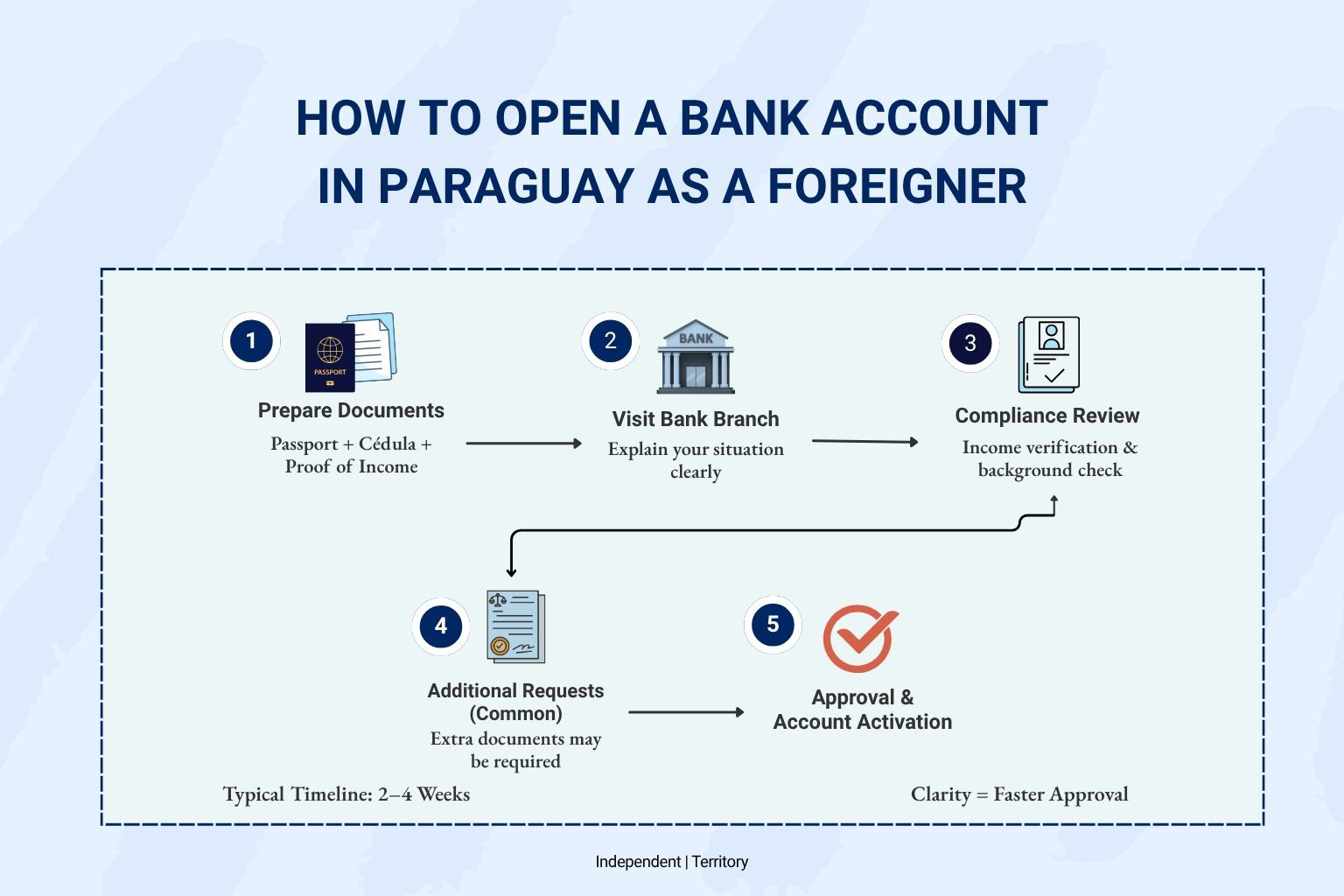
Step-by-step overview of how to open a bank account in Paraguay.
What Banks Are Actually Looking For
Before you walk into a branch, it helps to understand how Paraguayan banks actually evaluate applicants. In practice, they are trying to answer three core questions.
- Source of Funds Clarity: Banks need to clearly understand where your money comes from and whether it can be verified.
This typically includes:
• Employment contracts or income proof
• Business revenue documentation
• Consistent transaction history over time
If your income is unclear, irregular, or difficult to trace, expect delays or rejection. - Consistency of Your Financial Profile: Everything you present must align across all documentation.
That includes:
• What you declare verbally
• What your documents show
• What your bank statements reflect
Even small inconsistencies can trigger additional compliance checks. Clarity and alignment matter more than complexity. Approval rates are low for temporary stays. - Risk Assessment (Bank Perspective): This is where most foreigners misinterpret the process. Banks are not assessing your wealth—they are assessing your risk exposure. Under international compliance frameworks such as those guided by the Financial Action Task Force (FATF).
Banks are required to apply enhanced scrutiny to:
• Foreign clients
• Cross-border income flows
• Irregular or high-variance transactions
The more complex or opaque your financial situation appears, the higher your perceived risk level.
Key Takeaway: Successful applications in Paraguay are not about having “more documents”—they are about presenting a clear, consistent, and verifiable financial record that reduces perceived risk from the bank’s perspective.
Banco Itaú is one of the strongest options for USD accounts and international transfers.
Best Banks in Paraguay for Foreigners (By Use Case)
Paraguay’s banking system is small, conservative, and compliance-driven.
There is no “perfect” bank—only better alignment between your profile and the institution’s risk tolerance.
All banks operate under the same national regulatory framework, but execution differs significantly in practice.
How to Choose the Right Bank in Paraguay as a Foreigner
- USD accounts + international transfers → Banco Itaú
- Low-friction daily use → Ueno Bank
- Nationwide branch access → Banco Continental
- Business / structured finance → Sudameris
Most foreigners use a two-bank setup rather than relying on one institution.
Bank Comparison (2026 – Foreigners in Paraguay)
| Bank | Best For | USD Accounts | International Transfers | App Experience | Fees | Ease of Opening |
| Banco Itaú | USD, business, international transfers | Strong | Best overall | Good | Medium–High | Medium |
| Banco Continental | Daily use, nationwide access | Good | Moderate | Average | Low–Medium | Medium |
| Sudameris | Business, larger transactions | Very Good | Strong | Good | Medium | Medium–Hard |
| Banco GNB | Credit products, familiarity | Good | Moderate | Good | Medium–High | Medium |
| Ueno Bank | Daily spending, low-cost use | Limited | Limited | Excellent | Very Low | Easy |
| Smaller Banks | Basic local accounts | Limited | Weak | Basic | Low | Easy |
Best Banks by Use Case (Quick Summary)
- Best for USD and international transfers → Banco Itaú
- Best for daily spending → Ueno Bank
- Best for nationwide access → Banco Continental
- Best for business structures → Itaú or Sudameris
Most practical setup:
- Ueno → daily transactions
- Itaú or Continental → structure + USD + transfers
Most of Paraguay’s banking infrastructure is concentrated in Asunción, which is where you’ll find the widest range of banks and services.
Reality Check (What Foreigners Learn Quickly)
No single bank in Paraguay covers everything well.
This is the most important adjustment foreigners need to make:
- Digital banks are convenient but limited
- Traditional banks are capable but slower
- International transfers vary by profile, not just bank
The system works best when you combine institutions rather than relying on one. Choosing the right setup is one of the most important decisions when banking in Paraguay for foreigners.
Banking strategy becomes even more important when you manage your finances in Paraguay as a retiree—this is where a structured financial approach matters.

Choosing the right bank in Paraguay depends on your financial profile.
Ueno vs Banco Itaú: Which Is Better for Banking in Paraguay for Foreigners?
At first glance, comparing Ueno and Itaú can be confusing—because under the surface, they operate within the same regulatory framework.
All banks in Paraguay follow similar compliance standards shaped by international guidelines like those from the Financial Action Task Force.
That means international transfers, documentation requests, and account reviews can happen at any bank depending on your profile, transaction size, and history.
But this is where most foreigners get it wrong:
The difference isn’t the rules—it’s how each bank executes them.
Ueno Bank is optimized for speed and simplicity.
- Fast onboarding
- Excellent app and daily usability
- Works well for local payments and basic banking
It can handle international transfers—but typically with:
- More reliance on intermediary banks
- Manual compliance checks
- Less consistency for frequent or high-value transfers
Banco Itaú, on the other hand, is built for financial depth.
- Stronger correspondent banking network
- More experience handling foreign income and cross-border flows
- More predictable processing for USD accounts and international wires
The tradeoff:
- Slower onboarding
- Stricter compliance upfront
- More documentation required
What This Means in Practice:
- If you want speed and convenience → Ueno wins
- If you need reliability at scale (USD, business, transfers) → Itaú wins
Both follow the same system. But they are designed for completely different use cases.
Many of the frustrations foreigners experience in Paraguay come down to mismatched expectations—especially when it comes to systems like banking.
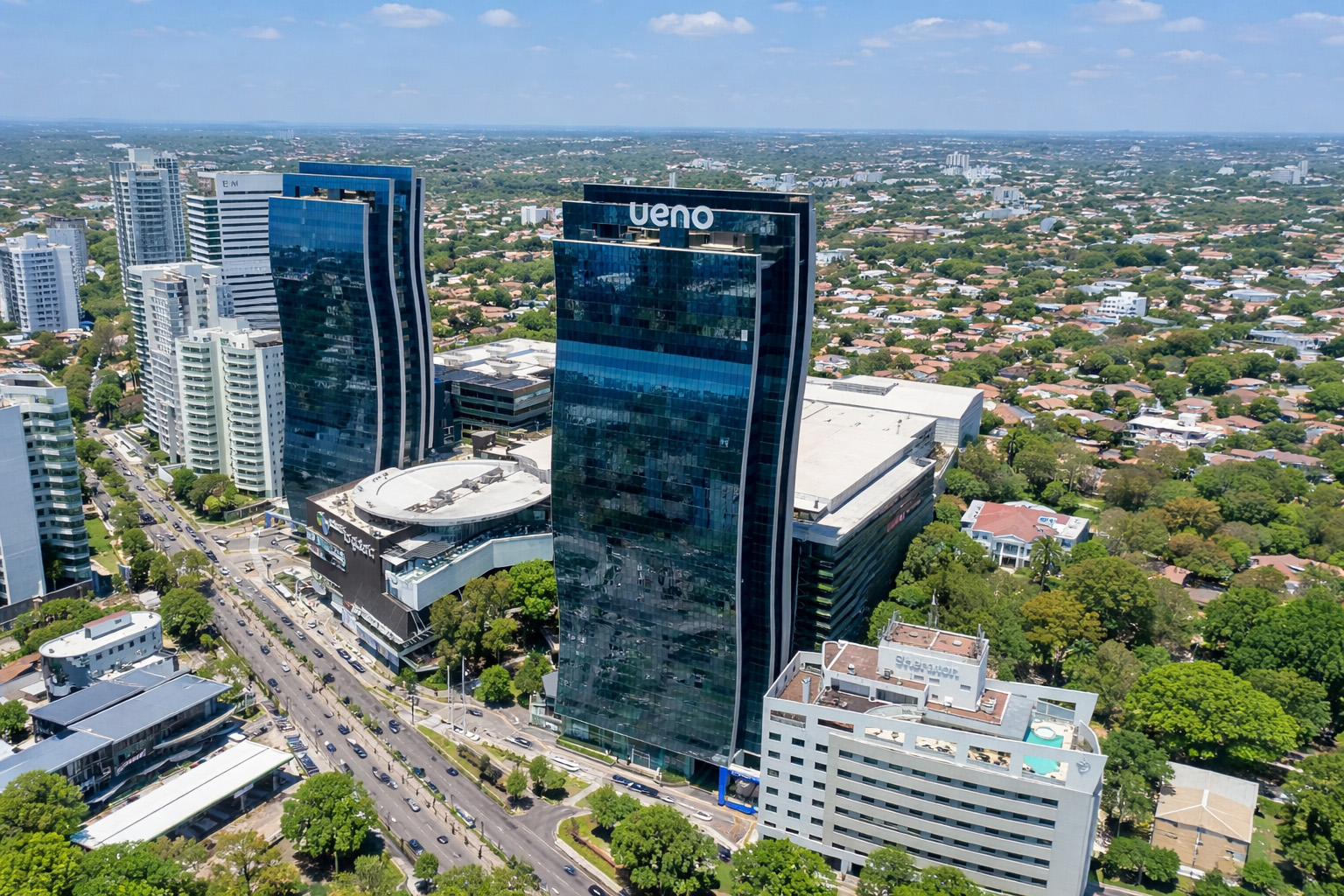
Ueno Bank is a popular low-cost option for everyday transactions.
Individual Bank Breakdowns
Best for: International transfers, USD accounts, remote professionals, business owners.
Pros:
- Strongest SWIFT/correspondent network in Paraguay
- Reliable USD account infrastructure
- Handles foreign income more consistently
Cons:
- Stricter onboarding and compliance
- Higher fees on wires
- More scrutiny on transfers
Closest thing to an “international-standard” bank locally.
Best for: Daily banking, nationwide access
Pros:
- Largest ATM and branch network
- Reliable for local currency (PYG) usage
Cons:
- Average digital experience
- Slower international transfers
Strong choice if you live outside Asunción or value in-person banking.
Best for: Business accounts, larger transactions
Pros:
- More flexible with structured financial activity
- Solid USD handling
- More responsive with complex transactions
Cons:
- Less suited for simple personal banking
- Smaller network
Better for investors than casual expats.
Best for: Credit products, familiarity
Pros:
- Professional platform and services
- Investment and credit options available
Cons:
- Residency required for most use cases
- Mixed feedback on transfers post-transition
- Higher fees relative to value
Solid—but rarely the top pick in 2026.
Best for: Easy approval, basic use
Pros:
- Lower barriers to entry
- Low fees
- Simple everyday banking
Cons:
- Weak international capabilities
- Limited USD functionality
- Basic apps and service levels
Useful as a backup account—not a primary solution.
UENO
Best for: Daily spending, fast setup
- Smooth onboarding
- Strong mobile app + QR code ecosystem
- Very low fees
Limitations:
- International transfers are possible—but inconsistent
- Often rely on intermediary banks
- Manual compliance checks still apply
Ideal daily driver—not a full banking solution.
WISE
Best for: International transfers and currency conversion
- Mid-market exchange rates
- Low fees and fast transfers
- Works well sending to Paraguayan accounts
Limitations:
- Not a full replacement for local banking
- Account/card availability depends on your residency status
Best used alongside a local bank (especially Itaú or Continental).
Quick Use-Case Recommendations (2026)
| Use Case | Recommended Bank(s) |
| USD + international transfers | Banco Itaú |
| Daily spending | Ueno |
| Nationwide access | Banco Continental |
| Business / investment | Banco Itaú or Sudameris |
Most effective setup:
- Ueno → daily spending
- Itaú or Continental → structure, USD, transfers
This pattern is also reflected in independent expat resources like WeParaguay’s banking guide, which highlights similar differences between traditional banks and newer digital options.
Reality Check: What Foreigners Learn the Hard Way
No single bank solves everything.
That’s the reality of banking in Paraguay for foreigners.
If you’re expecting a one-account solution like in the US or Europe—you’ll struggle.
If you build a simple, layered setup, everything works.
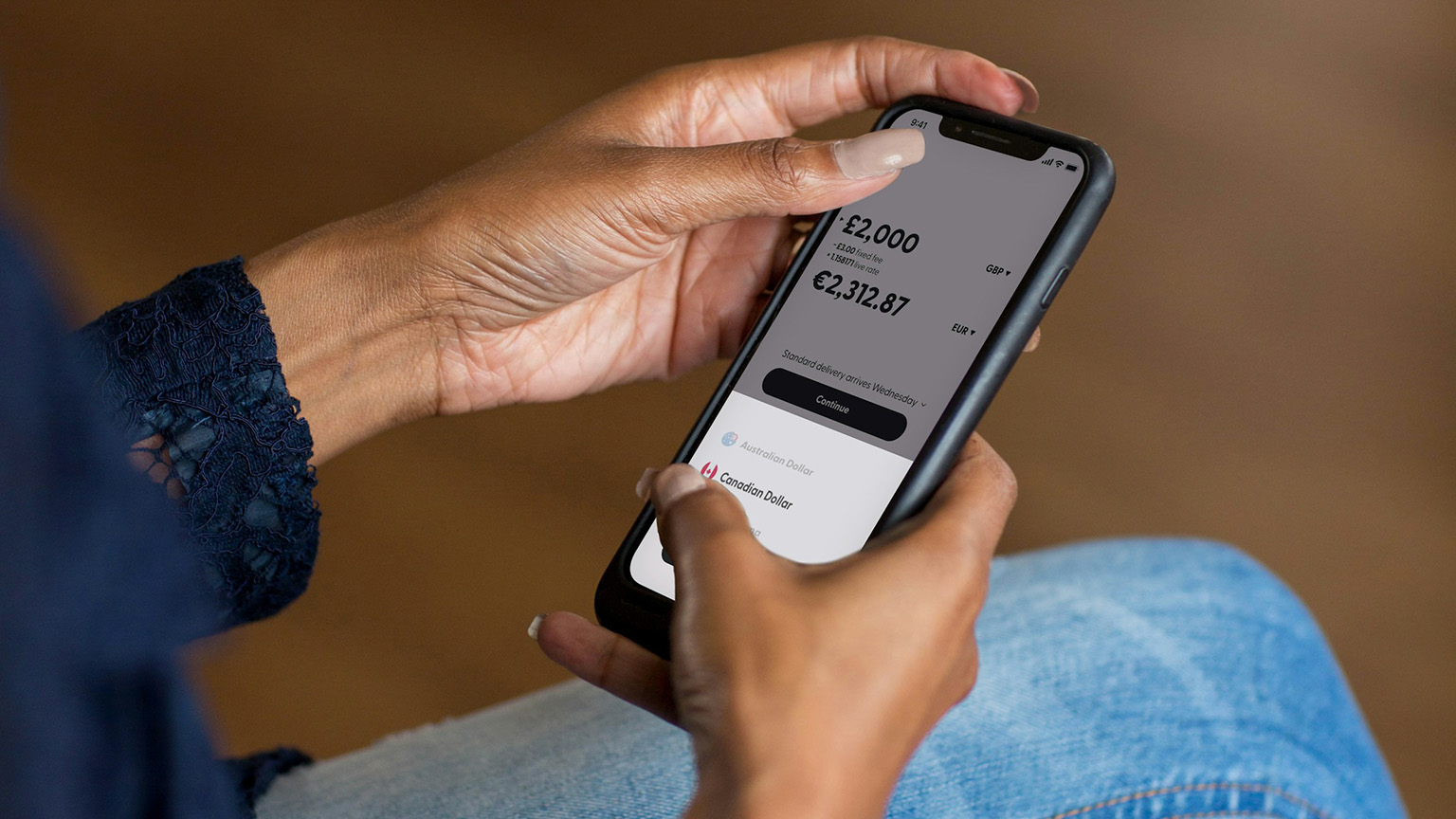
International transfers in Paraguay rely on SWIFT and correspondent banks.
International Money Transfers When Banking in Paraguay for Foreigners (Fees, Limits & Reality)
International money transfers are one of the most misunderstood parts of banking in Paraguay for foreigners. This is where banking in Paraguay for foreigners often becomes restrictive compared to other systems.
While most banks offer SWIFT transfers, USD accounts, and incoming international wires, the real experience varies significantly depending on your bank, account history, and compliance profile.
Paraguay does not operate within a fast-settlement system like SEPA in Europe. Instead, it relies on traditional SWIFT networks and correspondent banking relationships, meaning every transfer passes through one or more intermediary banks before reaching its destination.
This structure can introduce:
- Additional fees
- Processing delays
- Extra compliance checks depending on transaction size and origin
For technical reference, SWIFT operates as the global messaging network used by most international banking systems, including Paraguay’s financial institutions.
How international transfers work in practice
In most cases, the process follows this path:
- Funds are sent via SWIFT from your foreign bank
- Intermediary banks deduct processing fees
- Paraguayan banks review incoming compliance requirements
- Funds are credited in USD or converted to PYG depending on account setup
Each step can introduce variation in timing and cost.
What foreigners typically experience in reality
Based on common expat outcomes and on-the-ground usage patterns:
- Transfers usually take 1–5 business days
- Delays are common for first-time or high-value transfers
- Fees vary depending on correspondent banking routes
- Larger or unusual transactions often trigger additional verification
- Transfer speed improves once account history is established
In practice, “predictability” improves more with account maturity than with bank selection alone.
Banking decisions in Paraguay are directly influenced by tax structure, especially for foreign income—this becomes clearer once you understand how expat taxes actually work.
Which banks handle international transfers best
Across expat usage patterns and institutional structure, clear differences emerge:
- Banco Itaú → strongest SWIFT infrastructure and most consistent USD processing
- Sudameris → better suited for larger or structured business transfers
- Banco Continental → functional but generally slower for international wires
Important reality: No Paraguayan bank guarantees consistently fast or low-cost international transfers.
Performance depends on:
- Your account profile
- Transaction history
- Documentation clarity
- Correspondent banking routes used
For broader transparency on how SWIFT routing and international transfer costs vary by country and banking network, Wise provides publicly accessible breakdowns of Paraguay’s SWIFT structure.
Common Problems Banking in Paraguay for Foreigners
Even when banking in Paraguay for foreigners works successfully, the experience is rarely plug-and-play. Most issues don’t come from individual banks, but from expectations that don’t match how a compliance-heavy system actually operates.
Paraguay’s banking sector follows strict anti-money laundering (AML) and Know Your Customer (KYC) frameworks aligned with global standards set by organizations such as the Financial Action Task Force (FATF). This means banks must continuously assess risk, verify income sources, and review transaction behavior.
In practical terms, this affects everything from account approval to transfer limits and ongoing account activity.
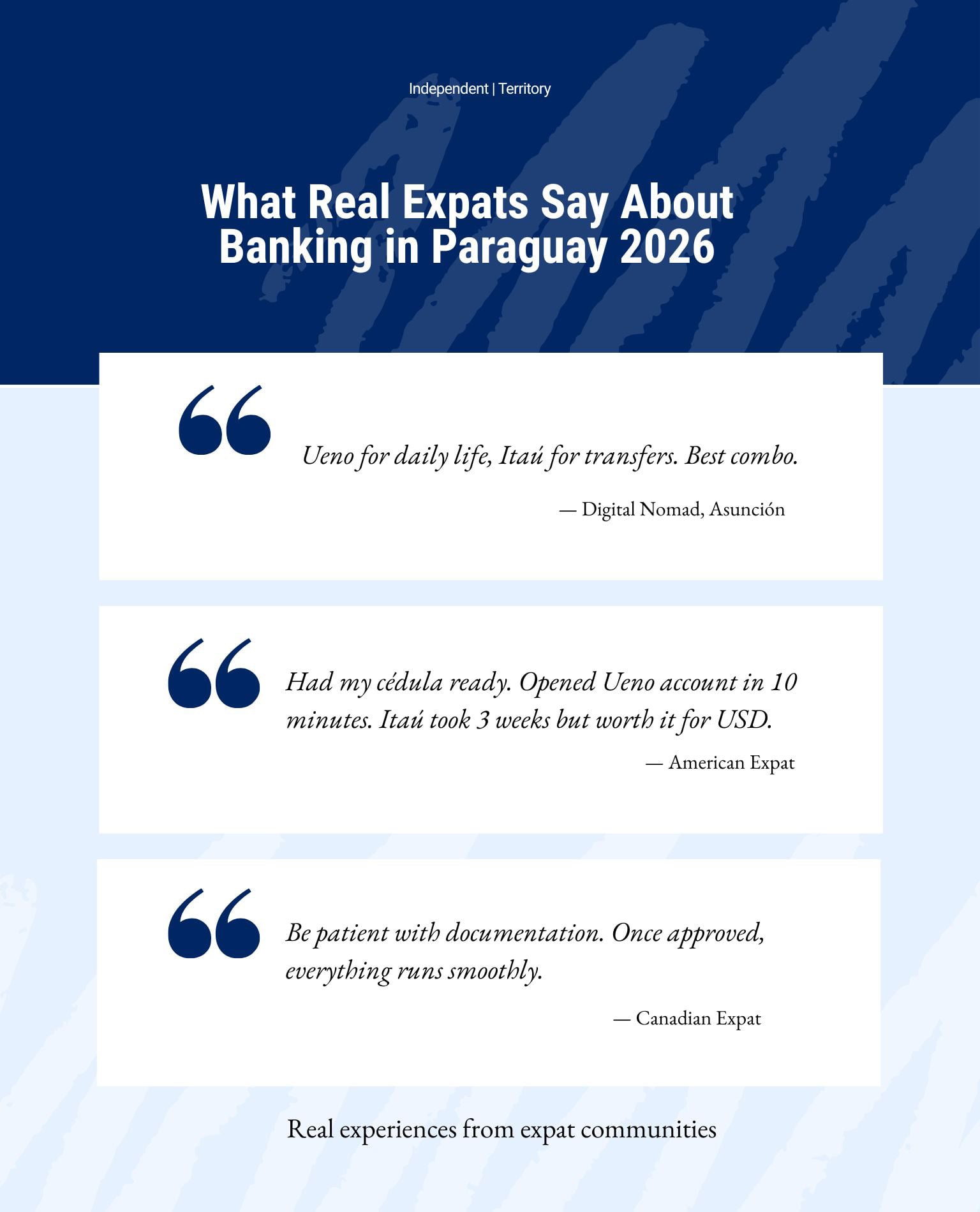
Real expat experiences reveal how banking in Paraguay works in practice
Account Rejections
Rejection is the most common frustration for foreigners. It usually comes down to risk clarity, not eligibility.
Common causes include:
- Unclear or inconsistent income sources
- Documents that don’t match declared financial activity
- No residency or local footprint
- A profile considered “higher risk” without supporting context
In most cases, rejection is not final—it’s a timing, documentation, or positioning issue.
Ongoing Documentation Requests
Even after approval, additional requests are normal.
Banks may later ask for:
- Updated proof of income
- Contracts, invoices, or employment verification
- Clarification on incoming international transfers
This is standard compliance behavior in Paraguay, not a sign of a problem. Think of it as continuous verification rather than scrutiny.
Transfer Limits
Initial transfer limits are often lower than expected.
Limits typically depend on:
- Account age and activity history
- Consistency of deposits and withdrawals
- Risk classification assigned by the bank
- Strength of supporting documentation
Over time, limits usually increase as the bank builds trust in your transaction patterns.
Slow or Expensive International Transfers
International wires are one of the least predictable parts of banking in Paraguay.
Common issues include:
- Delays caused by intermediary (correspondent) banks
- Additional fees deducted en route via SWIFT
- Extra compliance checks for larger transfers
- Slower processing on first-time transactions
This is why experienced expats rarely rely on a single bank for international flows.
For context, Paraguay’s banking system relies heavily on SWIFT infrastructure and correspondent banking relationships, which is why timing and fees can vary between institutions. A useful reference for understanding this system is the SWIFT network overview.
Limited Banking App Performance
Digital banking in Paraguay is improving, but still uneven across institutions.
Common limitations include:
- Basic or outdated mobile interfaces
- Delayed transaction updates
- Limited self-service features compared to Western banks
While usability is improving, Paraguay is still transitioning toward fully digital-first banking systems.
Key Insight: Most banking problems in Paraguay are not structural barriers—they are adaptation challenges. Once you understand how compliance, documentation, and risk profiling work together, the system becomes far more predictable and manageable.
Understanding the risks helps you build a more reliable banking setup.
Risks of Banking in Paraguay for Foreigners (Hidden Trade-Offs)
Banking in Paraguay for foreigners is functional, but it operates differently from highly digital, globally integrated financial systems.
The key difference is not access—it’s structure. The system is conservative, compliance-driven, and built around risk management rather than speed or convenience.
Understanding these trade-offs upfront helps set realistic expectations and reduces avoidable friction.
USD vs PYG Reality
While USD accounts are available, Paraguay’s financial system still runs primarily on Paraguayan Guaraní (PYG).
That creates a dual-currency operating environment:
- Most daily transactions are in PYG
- USD access depends on bank type and client profile
- Currency conversion exposure still exists depending on your setup
Most foreigners end up managing both currencies rather than relying on USD alone.
Compliance Reviews & Temporary Restrictions
Under strict anti-money laundering (AML) and know your customer (KYC) frameworks, accounts may be reviewed during normal activity.
This can include:
- Temporary holds on incoming or outgoing transfers
- Requests for additional supporting documentation
- Enhanced due diligence on higher-value transactions
These are standard compliance procedures, not indicators of account issues—but they can delay access to funds.
Foreigner Experience Varies by Bank and Branch
Even under the same national regulations, execution differs in practice.
Key variables include:
- Bank experience with foreign clients
- Branch-level interpretation of compliance rules
- Staff familiarity with international income structures
This is why two similar applicants can experience very different outcomes across banks.
System-Level Constraints
Paraguay’s banking system is stable, but relatively small and regionally focused.
That creates structural limitations:
- Dependence on international correspondent banking relationships
- Limited global product and platform integration
- Greater sensitivity to external compliance pressures
Most of the hidden downsides of banking in Paraguay for foreigners come from compliance and system limitations.
If these limitations don’t sit right with you, you’re not stuck with one option. The free Latin America Residency Map helps you quickly identify countries where residency is more aligned with your goals and personal situation.
Workarounds for Banking in Paraguay for Foreigners (What Actually Works)
Once you spend time on the ground, it becomes clear that banking in Paraguay for foreigners is rarely handled through a single account or single institution.
Most long-term residents build a layered setup that reduces friction, improves reliability, and spreads financial risk across different systems.
This is not about complexity—it’s about resilience within the constraints of the system.
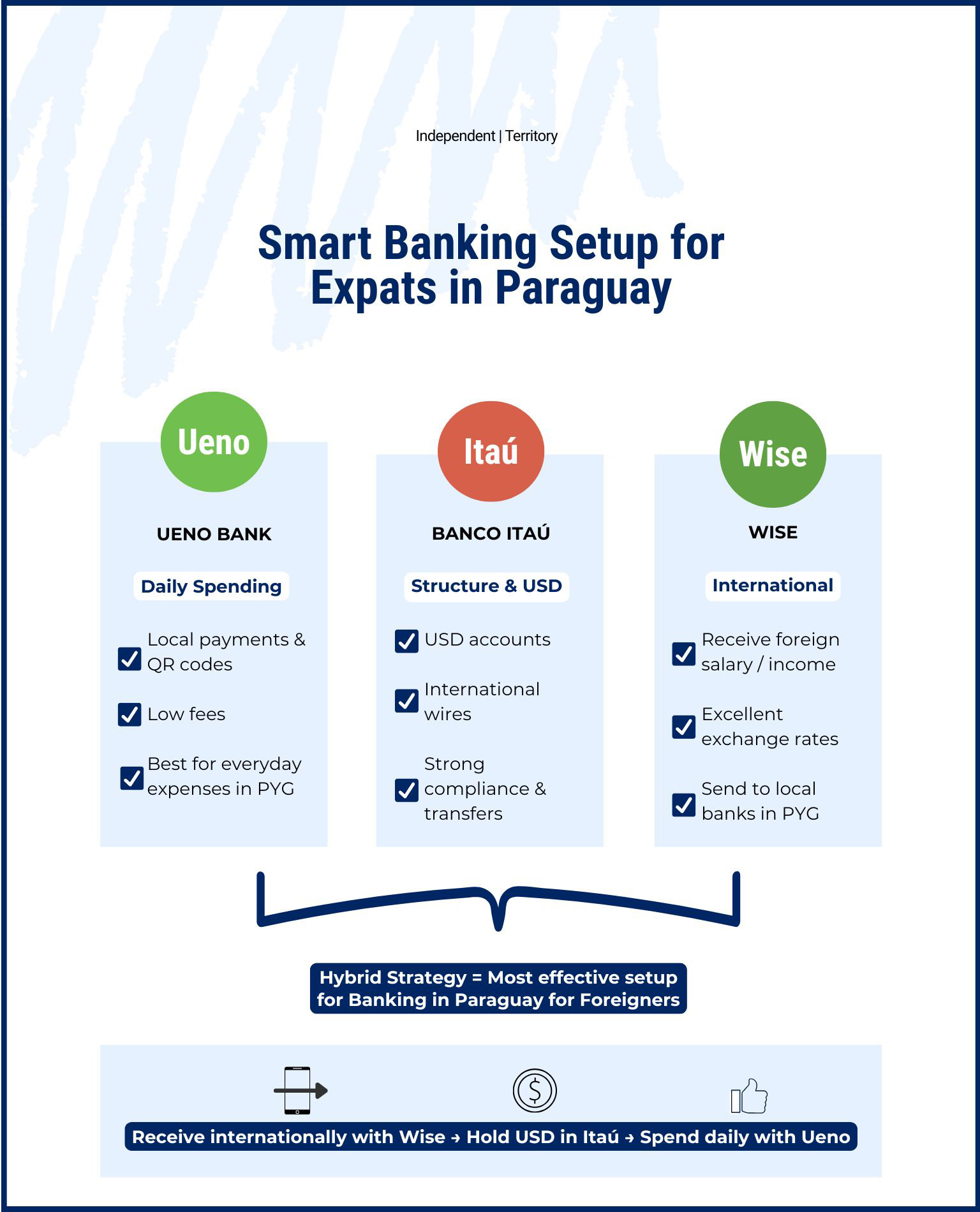
A layered banking setup is what works best in Paraguay.
Multi-Bank Setup (Most Common Approach)
The most effective structure typically looks like this:
- Ueno Bank → daily spending, QR code payments, low fees
- Banco Itaú or Banco Continental → USD handling, transfers, financial structure
Ueno handles day-to-day life, while traditional banks handle compliance-heavy and international activity. This combination balances convenience with stability.
Fintech Bridges
Many foreigners complement Paraguayan banking with international platforms such as:
- Wise
- Payoneer
- Remitly
- Western Union
These are commonly used for:
- Receiving foreign income
- Converting currencies at competitive rates
- Reducing reliance on local SWIFT routing
This is especially common among remote workers paid in USD or EUR.
Keeping Foreign Accounts Open
A frequent mistake is closing home-country accounts too early.
More experienced expats typically maintain:
- A home-country bank account
- A Paraguayan local account
- A fintech transfer layer (Wise/Payoneer)
This creates redundancy and reduces dependency on any single banking system.
Regional Diversification (Advanced Use Case)
Some higher-income individuals expand their setup further by using:
- Accounts in neighboring countries (where residency allows)
- Offshore-friendly jurisdictions for business flows or asset structuring
This is not necessary for most expats, but it appears in more complex international income setups.
Cash Reality in Paraguay
Despite ongoing digital adoption, cash still plays a role in the local economy:
- Some landlords prefer cash payments
- Smaller businesses may offer discounts for cash
- Not all services are fully digitized
A hybrid cash + banking approach still reflects everyday reality in parts of Paraguay.
Bottom Line on Workarounds
The most effective systems are not complicated—they are layered and intentional:
- One local bank for structure and compliance
- One digital platform for daily use
- One external system for international flows
This is what makes banking in Paraguay work in practice—not forcing a single institution to do everything.
This pattern is consistently reflected across expat communities and long-term residents who rely on operational experience rather than official banking expectations.
Is Banking in Paraguay for Foreigners Worth It? (Final Verdict)
Whether banking in Paraguay for foreigners is “worth it” depends entirely on expectations.
If you’re expecting:
- Seamless global banking
- Instant approvals
- Fully digital infrastructure
You will likely be frustrated.
But if your expectations are aligned with the system:
- Moderate bureaucracy
- Relationship-based processes
- Gradual trust building
- Hybrid financial setups
Then it becomes very workable.
When Banking in Paraguay Makes Sense for Foreigners
It works best for:
- Long-term residents with legal status
- Remote workers willing to use hybrid banking setups
- Entrepreneurs operating locally or regionally
- People seeking lower cost of living and financial simplicity
When It Doesn’t Make Sense
It is not ideal for:
- High-frequency global traders
- People needing instant cross-border banking at scale
- Short-term visitors expecting quick account setup
- Anyone unwilling to manage paperwork or compliance requests
Final Takeaway on Banking in Paraguay for Foreigners
There is no perfect bank in Paraguay.
There is only:
- Better positioning
- Better preparation
- And better structure
Once you understand that, the system becomes far more usable.
The real advantage is not the banks themselves—but knowing how to combine them effectively. Ultimately, banking in Paraguay for foreigners works best when expectations match how the system actually operates.
Paraguay works—but only if it fits your broader strategy. If you want to make a clear, informed decision instead of guessing, use the free Latin America Residency Map to map out your best residency options across Latin America.
The Itaú Bank image featured in this post is shared by Marcelo Alves via CC 2.0 via Wikimedia Commons.
Disclaimer: This article is for informational purposes only and does not constitute financial, legal, or tax advice. Banking requirements in Paraguay can change and vary by bank and individual circumstances. Experiences described are based on general expat reports and may not reflect every case. Always confirm details directly with the bank or a qualified professional before making financial decisions.