
18 min read
Paraguay is a South American country known for its low cost of living, relaxed lifestyle, and growing appeal to foreigners. Its territorial tax system means that most income earned outside the country is untaxed, offering a simple and predictable way to manage your finances. With straightforward residency rules and low local taxes on Paraguayan-sourced income, it’s no wonder so many freedom-seekers are choosing Paraguay as their base in Latin America.
……………………………..
Disclaimer: This article is for educational purposes and does not substitute for professional advice.
Table of Contents
Taxes in Paraguay for Expats (2026): A Simple Breakdown
If you’ve been researching taxes in Paraguay for expats, you’ve probably seen bold claims—“0% tax,” “tax-free living,” or “keep everything you earn.” There’s truth in that… but it’s not the full picture. Paraguay’s system is simple compared to most countries, but there are still rules that can catch you off guard if you don’t understand how it actually works.
The key concept is that Paraguay operates on a territorial tax system. In plain terms, this means income earned outside Paraguay is generally not taxed locally, while income earned inside the country may be subject to tax. That’s what makes it attractive—but also where many expats make assumptions that later lead to problems.
This guide breaks down taxes in Paraguay for expats in a clear, practical way—no legal jargon, no over complication. You’ll see what’s taxed, what isn’t, and how expats typically structure things to stay compliant. This is not legal or tax advice, but a straightforward explanation to help you understand how the system works before you go deeper.
Taxes are a major part of the equation, but they’re only one piece of the bigger picture—this guide to living in Paraguay explores what day-to-day life actually looks like beyond the numbers.
For reference, Paraguay’s tax framework is administered by the Dirección Nacional de Ingresos Tributarios, which outlines how local vs. foreign income is treated under current regulations.
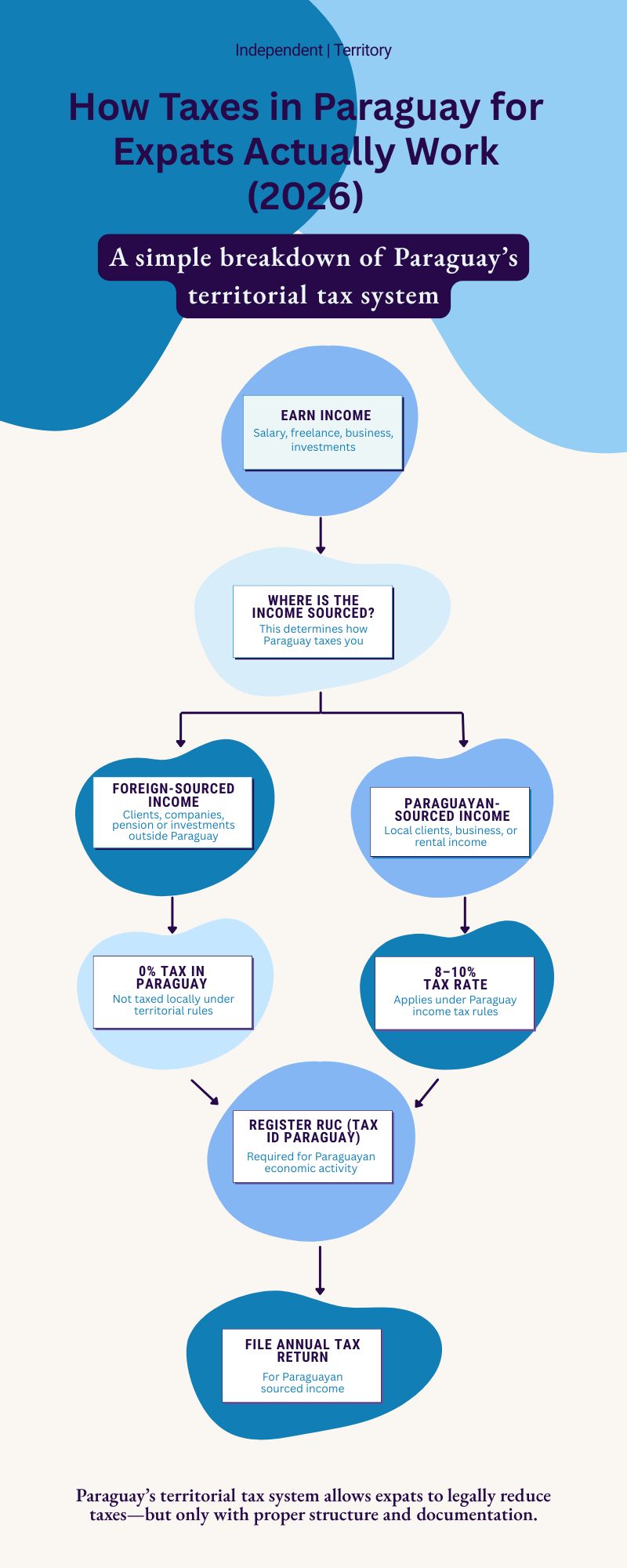
A simple breakdown of how taxes in Paraguay for expats
work under the territorial tax system.
What Is the Paraguay Tax System? (Territorial Tax Explained)
When people talk about taxes in Paraguay for expats, they’re usually referring to one thing: the country’s territorial tax system. This is the foundation of how taxation works—and why Paraguay attracts so much attention from expats, retirees, and remote workers.
A territorial tax system simply means that a country taxes income based on where it is earned, not where you live or hold residency. In Paraguay’s case, this is relatively straightforward:
Income earned inside Paraguay → may be taxed
Income earned outside Paraguay → generally not taxed locally
That’s the core distinction. If your money comes from foreign clients, overseas investments, or a pension paid from abroad, it typically falls outside the Paraguayan tax net.
On the other hand, if you earn money within Paraguay—for example through a local job, business, or rental property—that income is usually subject to local tax rules.
This is why taxes in Paraguay for expats are often described as “low” or even “0%” in certain situations. But that only applies when your income is clearly foreign-sourced.
Misunderstanding this difference is where many expats run into trouble.
According to the Dirección Nacional de Ingresos Tributarios, Paraguay’s tax framework distinguishes between domestic and foreign-source income under its current system. Worldwide Tax Summaries, Paraguay, from PwC also confirm that Paraguay generally does not tax foreign-sourced income for individuals, reinforcing its reputation as a territorial tax jurisdiction.
Before you can take advantage of the tax system, it’s essential to understand how Paraguay residency 2026 works and what’s required to legally establish yourself.
What’s Taxed vs What’s Not (Taxes in Paraguay for Expats Explained)
When it comes to taxes in Paraguay for expats, the simplest rule is: Paraguay taxes income earned in Paraguay, not income from abroad. Here’s a breakdown for clarity:
| Income Type (Paraguay Income Tax Rules) | Taxed in Paraguay? | Notes / Example |
| Foreign client work (remote) | Usually No | Income from clients or businesses outside Paraguay is generally exempt. Proof of foreign source may be required. (PwC Paraguay) |
| Foreign pension / dividends | No | Passive income from abroad is not taxed. |
| Local Paraguayan salary or services | Yes | Taxed under Paraguay income tax rate rules (typically 8–10% progressive) |
| Rental income from Paraguayan property | Yes | Taxed under Paraguay income tax rate rules (typically 8–10% progressive) |
| Investments in Paraguay | Yes | Taxed under Paraguay income tax rate rules (typically 8–10% progressive) |
| Remote work physically done in Paraguay but paid from abroad | Possibly Yes | Some interpretations consider work done inside Paraguay as Paraguayan-source. Many digital nomads stay compliant by clarifying contracts and documenting client locations. Could be taxed under Paraguay income tax rate rules (typically 8–10% progressive) . This area of Paraguay tax law is often misunderstood by remote workers. (ParaguaySovereign) |
Key Takeaways
- Foreign-sourced income is largely untaxed, which is why Paraguay attracts retirees, remote workers, and investors.
- Local Paraguayan-source income is taxable, so it’s important to know where your work or business activities are considered “sourced.”
- If you’re doing remote work from Paraguay, proper documentation of contracts and client location is essential to ensure compliance.
Taxes are only one piece of the equation—your overall financial picture becomes clearer when you factor in the cost of living in Paraguay alongside your income setup.
If you’re exploring options beyond Paraguay, it helps to understand the bigger picture. You can see if you qualify for residency in other Latin America countries and compare which align with your lifestyle and long-term plans.
The Reality of Taxes in Paraguay for Expats (What No One Tells You)
Paraguay’s tax system is simple—but it’s often oversimplified. You’ll hear phrases like “0% tax” or “tax-free living,” but the reality is more nuanced. Understanding this early can save you from costly mistakes later.
Where you base yourself can influence both your lifestyle and expenses, so it’s worth exploring the best places to live in Paraguay before committing.
The “0% Tax” Benefit Is Conditional—Not Automatic
Yes, Paraguay’s territorial tax system allows expats to legally pay 0% tax on foreign-sourced income. But this only applies when your income is clearly earned outside Paraguay.
If there’s any ambiguity—such as where the work is performed or how contracts are structured—your income may be considered Paraguayan-source and become taxable. The system rewards clarity, not assumptions.

Expats must be able to prove where their income comes from to benefit from Paraguay’s 0% foreign income tax rules.
You Must Be Able to Prove Where Your Income Comes From
One of the biggest misconceptions about taxes in Paraguay for expats is that foreign income is simply ignored. In reality, you may need to prove that your income is genuinely foreign-sourced.
This means keeping:
- Contracts showing client location
- Invoices issued to foreign entities
- Bank records confirming international payments
Without clear documentation, it becomes much harder to justify 0% taxation if questions arise.
Banks and Institutions May Still Ask Questions
Even if your tax situation is compliant, banks in Paraguay—and sometimes abroad—may ask about your income sources, residency status, and tax filings.
This is especially common when:
- Opening bank accounts
- Moving large sums of money
- Applying for financial services
Having your RUC registration, tax filings, and documentation in order helps avoid delays and unnecessary scrutiny.
Why the “Paraguay Zero Tax” Idea Is Often Misunderstood
The idea that Paraguay is completely tax-free is one of the most common—and misleading—claims online.
In reality, it’s more accurate to say:
- Foreign income → generally 0% tax
- Paraguayan income → taxed at local rates if above the threshold of PYG 80 million for 2026 (approx. USD $13,057)
- Compliance → required regardless of income level
This is why the “Paraguay zero tax” narrative can lead to problems if taken at face value. The system works extremely well—but only when you follow the rules.
Key Takeaways
- Paraguay offers powerful tax advantages, but they depend on proper structure and documentation.
- Foreign income is not automatically tax-free—it must be clearly foreign-sourced.
- Staying compliant with filings, records, and registration ensures you fully benefit from the system without risk.
Low taxes sound appealing, but they don’t tell the whole story—this breakdown of living in Paraguay pros and cons helps you understand the trade-offs.
Paraguay isn’t the only country offering tax advantages—but the details matter. If you want a clearer view of your options, you can check your residency options across Latin America and see how different countries compare based on your situation.

Tax filing deadlines in Paraguay include monthly filings and annual returns.
How to Become Tax Resident in Paraguay (Step-by-Step)
If you’re exploring taxes in Paraguay for expats, becoming a tax resident in Paraguay is the essential first step. Luckily, the process is straightforward and doesn’t involve unnecessary bureaucracy.
Here’s a simple roadmap for 2026:
- Get Residency – Start by obtaining official Paraguayan residency, either temporary or permanent. This gives you the legal right to live in Paraguay and is required before you can register for tax purposes. Most expats find this process simple and cost-effective.
- Obtain Your Cédula – The Cédula de Identidad is your national ID and is required for nearly all official and financial transactions, including tax registration. Once your residency is approved, securing your cédula is usually quick and easy.
- Register Your RUC – The Registro Único de Contribuyentes (RUC) is part of Paraguay’s tax system (only if you have Paraguayan economic activity). You can complete registration online through the Dirección Nacional de Ingresos Tributarios Marangatu portal: RUC registration.
- Monthly Filing Requirement (Often Overlooked) – RUC holders in Paraguay are required to file monthly reports—even if there is no activity (“sin movimiento”). This includes VAT (IVA) returns and the monthly sales and purchases record (RG 90), which must be submitted electronically through the Marangatú system. Deadlines typically fall between the 7th and 13th of the following month, depending on the last digit of your RUC.
- File Taxes – With an active RUC, individuals who generate Paraguayan income, must file an annual tax return. If your income is fully foreign-sourced and therefore non-taxable, you are not required to file an annual tax return. Many expats work with a local accountant to simplify the process and avoid mistakes or file online through Marangatu.
You can find out where you can legally live in Latin America including Paraguay based on your long-term goals.
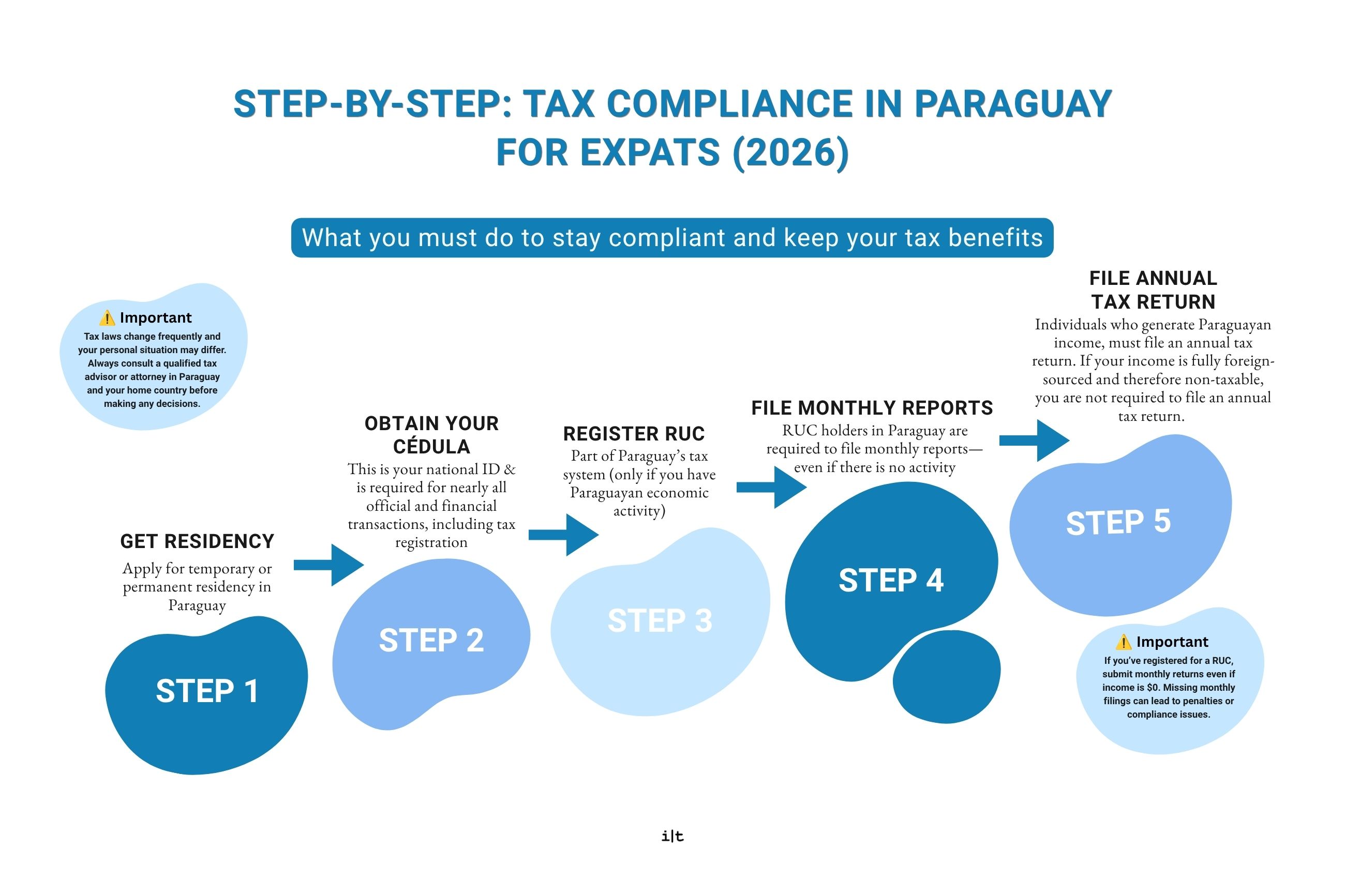
A step-by-step guide to tax compliance in Paraguay for expats, including RUC registration, monthly filings, and annual tax returns.
Key Takeaways
- Becoming a tax resident Paraguay does not automatically mean paying tax on foreign income.
- Registration is mostly administrative, not financial.
- Proper registration protects your 0% tax on foreign-sourced income and keeps you fully compliant.
Understanding the tax system is one thing, but how it fits into your routine becomes clearer when you look at daily life in Paraguay.
Taxes in Paraguay for Expats in 2026: Practical Examples and Common Pitfalls
Understanding taxes in Paraguay for expats is easier when you see real-world scenarios. Here’s how different types of expats are treated under the 2026 territorial tax system.
Taxes in Paraguay for Expats: Digital Nomads Using a Paraguayan Company
If you are a digital nomad and your company is registered in Paraguay, your income is considered Paraguayan-source. This means:
- Your foreign-sourced income is generally not taxed under Paraguay’s territorial system.
- Keep contracts, invoices, and payment records to prove income is foreign-sourced.
Pitfall: Working for foreign clients while also providing Paraguayan services (e.g., local consulting or in-person training) may trigger Paraguayan-source taxation. Clear separation is key.
If your income comes from remote work, this guide to being a digital nomad in Paraguay adds useful context to how the tax system applies in practice.

Many expats choose Paraguay for its territorial tax system, allowing 0% tax on foreign income when structured correctly.
Retirees Living Off Foreign Income
Retirees receiving pensions, social security, or investment income from abroad benefit greatly from Paraguay’s system:
• Foreign pensions and dividends are generally not taxed.
• No wealth or inheritance tax applies to assets held abroad.
• Not subject to filing tax returns.
Pitfall: Retirees who open a local business or earn rental income from Paraguayan properties will need to pay tax on that income. Documentation and clear separation from foreign sources avoid errors.
For retirees, tax advantages are only part of the picture—managing finances in Paraguay as a retiree requires a broader strategy.
Expats Earning Locally in Paraguay
If you earn money directly from Paraguayan clients—through a job, freelance work, or rental properties:
- This income is taxable at 8–10% on personal services.
- Corporate income (from businesses registered locally) is taxed separately under Paraguayan corporate rules.
- Keep accurate records of Paraguayan-source income, invoices, and receipts.
Pitfall: Assuming all income is exempt because you are an expat is a common mistake. Even small local contracts are taxable under the territorial system.
Taxes in Paraguay for Expats (2026) – Quick Reference Table
| Expat Type | Income Source | Taxable in Paraguay? (DNIT Paraguay Tax Rules) | Notes / Pitfalls |
| Digital Nomad – Paraguayan company | Foreign client income | Sometimes | Depends on contract; clear separation of foreign vs local work needed |
| Remote Worker – Foreign company | Foreign client income | No | Keep contracts & invoices to prove foreign source (PwC Paraguay) |
| Retiree | Foreign pension / dividends | No | Local income (business or rental income) must file return |
| Expat earning locally | Paraguayan clients / rentals | Yes | Taxed at 8–10%; accurate records essential |
| Mixed Income | Local + foreign | Yes / No | Only Paraguayan-source income taxed; document sources carefully |
These classifications follow general DNIT Paraguay tax guidelines on income source rules.
Key Takeaways
- Foreign income (from outside Paraguay) is generally tax-exempt for expats.
- Paraguayan-source income must be reported and taxed.
- Proper documentation is critical—contracts, invoices, and bank records protect you from unexpected audits.
- Understanding the difference between “foreign-sourced” and “local-sourced” income builds trust and helps expats feel confident living in Paraguay.
Did you know?: Foreign income is generally 0% taxable in Paraguay—but only if it’s truly foreign-sourced. Local income, rental income, or Paraguayan consulting work is taxed at 8–10%. Always document your contracts and invoices to prove the source.

Many expats misunderstand taxes in Paraguay—small mistakes can lead to compliance issues if ignored.
Common Mistakes with Taxes in Paraguay for Expats (and How to Avoid Them)
Even with Paraguay’s simple territorial tax system, expats can make mistakes that lead to confusion, delays, or unwanted attention from the tax authorities. Understanding these pitfalls—and how to avoid them—protects your 0% tax on foreign income and ensures compliance.
Top Mistakes to Avoid
- Assuming all income is tax-free – Only foreign-sourced income is exempt. Any income earned locally, including freelance work for Paraguayan clients or rental income, is taxable.
- Not filing zero-declaration returns – If you’ve registered for a RUC, even if your local income is zero, you are still required to file monthy returns. Missing this step can create unnecessary complications.
- Mixing foreign and local income – Running local services alongside foreign contracts without clear separation can trigger taxation errors.
- Poor documentation – Contracts, invoices, and bank records must clearly show which income is foreign-sourced. Without this, proof can be challenging during an audit.
- Ignoring monthly filing obligations – Many expats assume that if they have no local income, they only need to file once per year. In reality, RUC holders still need to submit monthly filings—even with zero activity (“sin movimiento”). Missing these filings can lead to penalties or administrative issues, even if no tax is owed.
- Ignoring updates – Tax rules may evolve. In 2026 the government introduced updated reporting obligations for crypto, even if no new taxes were applied.
Even with Paraguay’s simple territorial tax system, misconceptions abound. Use this quick Myth vs Reality table to separate fact from fiction and avoid common mistakes that catch expats off guard.
Paraguay Tax Myths vs Reality for Expats
| Myth | Reality |
| “You don’t need to file taxes.” | If registered for a RUC, monthly filing is required even if income is $0. |
| “Everything is tax-free.” | Only foreign-sourced income is exempt; local income is taxable. |
| “You must live 183 days in Paraguay.” | No minimum stays for permanent residency; temporary visits suffice. |
Quick Reference Table: Do’s and Don’ts Taxes in Paraguay for expats
| Action | Do | Don’t |
| Filing | If you’ve registered for a RUC, submit your monthly returns | If you’ve registered for a RUC, don’t miss a monthly filing, even if your Paraguayan sourced income is $0 |
| Income separation | Keep foreign and local income clearly documented | Mix foreign client work with Paraguayan services without proof |
| Documentation | Keep contracts, invoices, and bank records | Rely only on memory or informal agreements |
| Staying updated | Check official updates (DNIT.gov.py) | Assume rules never change |
| Residency status | Maintain your cédula | Forget to maintain legal residency status or documentation |
Even if you earn 0% taxable income in Paraguay, monthly compliance obligations may still apply. Filing “sin movimiento” reports keeps your tax status clean and avoids unnecessary penalties.
Key Takeaways
- Simple mistakes can unintentionally trigger taxable events.
- Proper filing, documentation, and separation of income are the foundation for stress-free taxes in Paraguay for expats.
- Staying informed and organized ensures you fully benefit from Paraguay’s 0% foreign-sourced income advantage.

Paraguay offers a slower, more peaceful lifestyle—one reason expats are drawn to its low-tax environment.
Long-Term Tax Strategy & Planning for Expats in Paraguay (2026)
Understanding taxes in Paraguay for expats isn’t just about filing correctly today—it’s about planning for the future. Whether you’re a digital nomad, retiree, or investor, having a long-term strategy ensures you maximize Paraguay’s territorial system and avoid surprises down the road.
Key Long-Term Considerations
- Residency → Citizenship Path
- Paraguay allows permanent residency with a relatively simple process. After 3 years of permanent residency, you can apply for citizenship. Planning ahead ensures you can enjoy benefits like Mercosur travel, voting rights, and simplified banking.
- Protecting Foreign Income
- Foreign-sourced income remains 0% taxable, but documentation is crucial.
- Maintain clear records of contracts, invoices, and payments to prove foreign origin.
- Consider working with a Paraguayan accountant for long-term compliance and peace of mind.
- Local Investments & Business Ventures
- Income generated in Paraguay—rental, business profits, or salaries—is taxable at 8–10%.
- Structuring local activities properly (e.g., forming a small IRE company) can optimize tax outcomes.
- Plan growth and investment with future tax implications in mind.
- Digital Nomads & Remote Work
- Keep foreign client work separate from local Paraguayan services.
- Track which services are provided inside vs. outside Paraguay to maintain compliance.
- Use digital tools for accounting and income reporting to simplify annual filings.
- Future Crypto & Asset Reporting
- 2026 introduced reporting obligations for crypto and digital assets, but no new taxes yet.
- Keep records of wallets and transactions for compliance without overpaying.
Financial planning should also account for practical needs like healthcare in Paraguay for expats, especially if you’re relocating long-term.
Long-Term Planning Table: Key Actions for Expats
| Strategy | Recommended Action | Notes |
| Residency → Citizenship | Maintain permanent residency; apply after 3 years | Opens Mercosur benefits and banking options |
| Foreign income → 0% tax (often misunderstood as a Paraguay zero tax myth if misapplied) | Keep contracts & bank records | Zero Paraguayan tax applies if properly documented |
| Local Paraguayan income (business, rental) | Taxed at 8–10% on Paraguayan-sourced income | Plan carefully to comply with local rules |
| Digital nomad work | Track services by source country | Avoid accidentally creating taxable Paraguayan income |
| Crypto / assets | Maintain detailed records | Follow Resolution 47/2026 reporting rules |
Key Takeaways
- Paraguay’s territorial tax system allows expats to legally pay 0% on foreign income, but long-term planning is essential.
- Structuring residency, local activities, and documentation properly avoids unexpected taxes and maximizes financial freedom.
- Forward-looking planning is a key reason why digital nomads, retirees, and investors choose Paraguay as a base.
Watchlist for Expats
- Check home-country tax obligations (exit tax, reporting, or foreign tax credit rules).
- Keep clear separation between foreign vs Paraguayan-sourced income.
- Document crypto and digital asset holdings per Resolution 47/2026.
- Use a local accountant for tricky cases—prevention is easier than correction.

Paraguay, Belize, and Nicaragua all offer territorial tax systems—but differ in simplicity, tax rates, and residency requirements.
Taxes in Paraguay vs Belize & Nicaragua (2026) – How Expats Compare
All three countries—Paraguay, Belize, and Nicaragua—use a territorial tax system, meaning foreign-sourced income is generally not taxed locally. This makes them appeal to digital nomads, retirees, and remote workers. However, each country has practical differences in local income taxation, residency requirements, and administrative ease.
| Strategy | Recommended Action | Notes |
| Paraguay: Local Paraguayan income (business, rental) | Pay 8–10% on Paraguayan-sourced income | Plan carefully to comply with local rules; filings are straightforward |
| Paraguay: Foreign-sourced income (freelance, pension, dividends) | 0% tax | Territorial system exempts most foreign income; maintain proper documentation |
| Belize: Local Belizean income (business, rental) | Pay 25% on Belize-sourced income | Ensure proper registration and reporting; work permits or QRP may apply |
| Belize: Foreign-sourced income | 0% tax | Territorial system exempts foreign earnings; follow QRP or residency documentation requirements (Belize Tax Guide for Expats) |
| Nicaragua: Local Nicaraguan income (business, rental) | Pay 15–30% depending on income bracket | File with municipal and national authorities; stay compliant with local tax filings |
| Nicaragua: Foreign-sourced income | 0% tax | Territorial system exempts foreign income; keep clear proof of foreign origin (Nicaragua Expat Guide) |
If you’re still comparing your options, it’s worth taking a step back and looking at the full landscape. You can explore your residency options in Latin America and quickly see which countries offer the best balance of tax efficiency and lifestyle.
Key Takeaways
- Foreign income is untaxed in all three countries under their territorial systems.
- Paraguay is often seen as the simplest and most predictable option for expats seeking low administrative overhead.
- Paraguay’s permanent residency system is flexible: must visit at least once every 36 months with no minimum stay requirement. Most administrative filings are straightforward.
- Belize and Nicaragua are also favorable for foreign income, but their residency programs, local taxation, and reporting rules can be slightly more complex.
- Comparing these countries helps expats make informed decisions about long-term relocation, digital nomad lifestyle, or retirement planning in Latin America.
- Many expats ask: is Paraguay tax-free for expats? The answer depends on whether income is foreign-sourced or local.
“Paraguay is the simplest and lowest-friction option for expats seeking predictable taxation.”
Conclusion: Taxes in Paraguay for Expats (2026) – Plan Smart, Live Free
Taxes in Paraguay for expats are one of the biggest reasons the country has become a top destination for those seeking financial freedom in Latin America.
By understanding which income is taxed, and if you have a RUC, filing your monthly returns even if zero, plus submitting an annual tax return for local sourced income and keeping clear records, you can legally pay 0% on foreign income while enjoying low local tax rates. The country’s simplicity, predictability, and minimal tax pressure attract digital nomads, retirees, and investors alike.
For long-term peace of mind, follow the step-by-step residency, and if required RUC registration process, separate foreign and local income, and stay informed about reporting obligations like crypto.
If you’re thinking of exploring beyond Paraguay, discover your options with the Latin America Residency Map to see where you qualify for residency in Latin America.
FAQs: Taxes in Paraguay for Expats (2026)
Is Paraguay tax-free for expats?
Paraguay is not necessarily tax-free for expats. The country uses a territorial tax system, meaning foreign-sourced income is generally taxed at 0%, while income earned within Paraguay is subject to local tax rules. Understanding the difference is essential to stay compliant.
What is the Paraguay income tax rate for expats?
The Paraguay income tax rate for expats depends on the source of income. Paraguayan-source income is typically taxed at a progressive rate of 8–10%, while foreign-sourced income is usually not taxed locally under the territorial system.
Do expats need to file taxes in Paraguay if income is foreign?
No. If your income is entirely foreign-sourced and therefore taxed at 0%.
What does RUC mean in Paraguay?
RUC stands for “Registro Único de Contribuyentes,” is used to report income, file taxes, and interact with the tax system. It is required for all residents that are engaged in a Paraguayan economic activity.
How does DNIT handle taxes in Paraguay?
DNIT Paraguay taxes are administered by the Dirección Nacional de Ingresos Tributarios, which oversees tax collection, reporting, and compliance. They define how income is classified as local or foreign-sourced under Paraguay’s territorial tax system.
Is the 0% tax in Paraguay a myth?
The idea of 0% tax is often misunderstood. While foreign-sourced income is generally not taxed, this only applies when income is clearly earned outside Paraguay. Local income, business activity, or poorly documented earnings can still be taxed, which is why the “Paraguay zero tax myth” can lead to mistakes.
Disclaimer: This article “Taxes in Paraguay for Expats” is for informational purposes only and is not intended as professional tax, legal, or financial advice. Tax laws change frequently and your personal situation may differ. Always consult a qualified tax advisor or attorney in Paraguay and your home country before making any decisions.Independent Territory is not responsible for any actions taken based on this content.