
23 min read
Paraguay isn’t just another expat destination—it’s a place where freedom, simplicity, and financial flexibility come together. This guide shows you exactly how to secure Paraguay residency and take advantage of 0% tax on foreign income in 2026.
……………………………..
60-Second Paraguay Residency 2026 TL;DR
- Cost: $2,000–$5,000 (standard) | $12k–$20k (fast-track investment)
- Timeline: Permanent residency in 3–6 months (investment) or 24 months (standard)
- Physical presence: Almost none – 1 short visit every 3 years is enough
- Tax: 0% on all foreign income, pensions, crypto, investments (pure territorial system)
- Citizenship: After only 3 years total (dual citizenship allowed) + Mercosur passport perks
- Who qualifies: US, EU, UK, Canada, Australia, etc. → fly in visa-free 90 days
- Process in 4 trips (or 2 with a lawyer):
- Prepare apostilled docs abroad
- Arrive, get local checks, submit at Migraciones → instant 90-day provisional
- Wait 45–90 days → approval
- Quick return trip → collect cédula (national ID)
- 2025 applications hit 38,000+ and 2026 is exploding – start now or wait longer later.
That’s literally it — Paraguay residency is the cheapest, fastest, and one of the most powerful programs in Latin America. Read on for the full step-by-step guide, exact document checklist, and 2026 updates.
Table of Contents
Tired of 40–50 % tax rates, rising crime, and endless bureaucracy back home? In 2026, the Paraguay Residency Program has emerged as one of the world’s easiest, cheapest, and most powerful for digital nomads, remote workers, retirees, and anyone who wants a real Plan B — without ever having to live there full-time.
Here’s why thousands are choosing Paraguay right now:
- 0 % tax on all foreign-sourced income, pensions, investments, and crypto (true territorial taxation)
- Comfortable, modern living for $1,200–$1,800/month in Asunción or lakeside resorts
- Permanent residency in 3–6 months (investment route) or 24 months (standard route)
- Total cost $2,000–$5,000 — no language test, no high income proof, no mandatory stay
- Citizenship and second passport after just 3 years (dual citizenship allowed)
- Safer than most of Latin America and far less bureaucracy than Portugal, Spain, Panama, or Thailand
US, EU, UK, Canadian, Australian, and 140+ other nationals arrive visa-free for 90 days and convert to residency from inside the country — no consulate visits required.
This 2026 edition gives you the exact current requirements, costs, timelines, document checklist, proven shortcuts, and clear outcomes so you can secure Paraguay residency this year — before the next application surge hits.
Why Expats Are Choosing Paraguay Residency in 2026
High taxes, rising crime, political chaos, and crushing inflation are pushing thousands to the breaking point. In 2026, Paraguay has become the #1 escape route — offering a simple, low-cost path to permanent residency, financial freedom, and genuine peace of mind.
Here’s what’s driving the surge (38,000+ applications in 2025 and climbing):
Foreign-sourced income is 100% exempt. Only local earnings face an 8% to 10% rate — no wealth, inheritance, or estate taxes. Digital nomads and investors routinely drop from 35–50% effective rates back home to near-zero overnight.
Homicide rate ~7.8 per 100,000 (lower than Brazil, similar to Argentina). Politically stable, no earthquakes, no hurricanes. Expats regularly walk at night without worry — something many haven’t felt in years.
Modern apartment in Asunción: $400–600/month. Meals out: under $5. Total comfortable lifestyle: $1,200–$1,800/month — 60–70% less than most Western countries.
Permanent residency in 3–24 months, citizenship after just 3 years (dual citizenship allowed), and Mercosur travel perks.
No language tests, company setup from ~$5,000, pro-foreigner rules, and minimal red tape.
The numbers don’t lie: applications exploded in 2025 and 2026 is on track for another record. Expats from North America, Europe, and beyond are voting with their feet — and rediscovering what freedom actually feels like.

Simple, authentic rural life — one of the reasons retirees love Paraguay residence.
To see the contrast clearly, here’s a comparison table of your current struggles versus Paraguay’s solutions:
| Your Home Country Frustrations | Paraguay’s Solutions |
| Sky-High Taxes (37-50%+ Rates) | Territorial Freedom: 0% on Foreign Income, 8% to 10% Local |
| Rising Crime and Unrest | Safer Communities: 7.8/100k Homicide Rate, Peaceful Neutrality |
| Inflation Eroding Savings | Affordable Bliss: $400-600/Month Rent, Meals Under $5 |
| Political Chaos | Stable Sanctuary: Low-Risk Haven |
| Bureaucratic Nightmares | Open Arms: Easy Setup, Pro-Expat Vibes |
This glimpse into Paraguay residency’s emotional appeal sets the stage for the practical side. Dive deeper into the everyday joys in our Benefits of Living in Paraguay as an Expat section.
Paraguay Visa Options for Expats 2026 (Quick Overview)
Paraguay keeps entry dead simple — perfect for testing the waters before committing to residency.
Visa-Free Entry (143 countries – updated 2025) US, Canada, UK, EU, Australia, NZ, Japan, Korea, Israel, South Africa, UAE, Taiwan, etc. → 90 days on arrival, extendable once for another 90 days at Migraciones in Asunción (~$50–100, same-day).
Tourist-to-Residency Conversion (Most Popular Path) Arrive visa-free → apply for temporary or permanent residency from inside the country → no need to leave. Processing: 45–90 days. Start before day 90 to avoid overstay fines. Ideal for digital nomads — no local work permit required for remote income.
To make this clearer, here’s a comparison table of key visa options for expats aiming for long-term stays in Paraguay:
| Visa Type | Duration | Eligibility | Estimated Cost (USD) |
| Visa-Free/Tourist Entry | Up to 90 days (extendable to 180) | Citizens of US, EU, Canada, etc. (over 80 countries) | Free (extension ~$50-100) |
| Tourist to Residency Conversion | N/A (leads to 2-year temporary residency) | All expats in country; ideal for digital nomads | Included in residency fees (~$600-1,000 total) |
| Short-Term Work Visa | Up to 1 year (renewable) | Job offer from Paraguayan employer | $200-300 (plus consulate fees) |
| Student Visa | Up to 1 year (renewable) | Enrollment in approved program | $100-200 |
| Mercosur Visa/Residency | Up to 2 years initial (leads to permanent) | Mercosur nationals or associates | $100-300 (simplified process) |
These visa pathways for expats in Paraguay set a strong foundation for securing Paraguay residency, blending ease with opportunity. Next, we’ll explore the full spectrum of Paraguay residency programs to help you choose the right fit.
Looking ahead in 2026, Paraguay’s immigration landscape is evolving amid the 2025 boom of over 38,000 residency applications. While no major visa changes are confirmed, trends point to potential streamlined online applications to handle the surge, possibly reducing in-person visits for extensions or conversions.
Fees may see inflation adjustments—current extension costs hover around $50-100 USD—but expect minor hikes to match economic shifts.
More significantly, since January 1, 2026, the Dirección Nacional de Migraciones (DNM) will implement stricter verification, including mandatory reporting and justification reviews for extended absences during renewals or border checks. For example, if you’ve been away longer than allowed, you’ll need to visit DNM in Asunción to explain (e.g., via work or family obligations) and may face revocation if unconvincing—though approvals are common for valid reasons.
The good news? This won’t affect initial visa entries or temporary residency applications, which only require a single visit every 12 months to stay active. It’s mainly a heads-up for long-term permanent holders planning “snowbird” lifestyles.
For full details, see the official DNM permanent residency guidelines and expert analysis from ParaguayProfis on absence rules. Always consult a local lawyer for your situation, as enforcement could evolve. Stay updated via the official website, as high demand might extend processing times for visa-related steps toward Paraguay residency.
Not sure if Paraguay is your best option? Use our Latin America Residency Map to quickly discover which countries you qualify for.
The Paraguay flag — symbolizing national pride and the welcoming spirit expats experience.
Paraguay Residency Programs Overview
Once you arrive in this welcoming nation, the next step toward long-term stays is choosing the right residency program. Paraguay residency offers three main tracks—temporary, permanent, and investment-based—each designed with flexibility to suit digital nomads, retirees, families, and entrepreneurs alike.
These options stand out for their accessibility, requiring no language tests, no mandatory minimum income, and relatively low barriers compared to programs in Europe or the Caribbean.
Whether you’re building toward tax advantages or simply securing a stable base, understanding Paraguay temporary residency, Paraguay permanent residency, and Paraguay residency by investment will empower your decision.
Below, we break them down with a visual matrix for quick comparison, ensuring you can visualize how Paraguay residency fits your lifestyle.
The entry point for most expats pursuing Paraguay residency is the temporary residency permit.
This grants a 2-year initial stay, and can be converted to permanent residency after the first two years as long as you maintain solvency and visit Paraguay at least once a year (though no full-time presence is required). No strict minimum income is mandated, but you’ll need to demonstrate economic solvency—typically through bank statements showing funds equivalent to about 35 minimum wages (around US$5,200–6,000 as of late 2025, based on the current minimum wage of approximately 2,798,309 Paraguayan guaraní or ~$368 USD monthly). This can be proven via pension statements, or employment proof, making it straightforward for remote workers.
Application happens in-country at the Dirección Nacional de Migraciones, with processing in approximately 1–3 months. It’s an ideal starting block for those testing Paraguay residency before committing longer-term.
After holding temporary status for two years, you can upgrade to Paraguay permanent residency, which is valid indefinitely (with ID renewal every 10 years).
Key perks include full work rights (though remote earners don’t need a local permit), access to public services, and a clearer path to citizenship after three years of permanent residency.
Solvency proof remains similar to temporary—no fixed deposit required post-2024 reforms—and absences are allowed up to three consecutive years without revocation if justified.
For expats in Paraguay seeking stability without ongoing renewals, Paraguay permanent residency delivers lifelong security with minimal upkeep.
For those wanting to skip the temporary phase, Paraguay residency by investment via the SUACE (Sistema Único de Apertura y Cierre de Empresas) program offers immediate permanent status.
Options include committing to a $70,000 investment over 10 years (not upfront; phased via business assets, shares, or real estate), starting a company with minimal capital (~US$5,000), or purchasing property through a corporate entity. This bypasses the two-year wait, with approvals in 1–6 months.
It’s particularly attractive for entrepreneurs, as it aligns with Paraguay’s business-friendly environment and territorial tax benefits. No physical presence is needed post-approval beyond initial setup, making Paraguay residency by investment a fast-track for high-net-worth individuals or investors.
Paraguay residency shines for specific lifestyles.
Digital nomads benefit immensely—no work permit is required for remote, foreign-sourced income, allowing you to leverage the 0% tax on overseas earnings while enjoying reliable urban internet (speeds up to 600 Mbps in Asunción).
Retirees find a pensioner paradise: low healthcare costs (~$50–100/month for private insurance, with free public options post-residency) and no age-based restrictions mean your fixed income goes further in this affordable haven.
Both groups appreciate the lack of full-time residency mandates, enabling a “snowbird” approach.
To help you compare at a glance, here’s an updated Paraguay residency programs matrix tailored for 2026 trends:
| Program Type | Duration & Renewal | Key Requirements & Solvency Proof | Estimated Costs (USD, 2025–2026) | Best For (Digital Nomads/Retirees) |
| Paraguay Temporary Residency | 2 years initial; renewable indefinitely | Apostilled docs (birth cert, criminal check); solvency ~$5,200–6,000 (bank statements/pension) | $600–1,000 (fees + docs) | Digital nomads testing waters; retirees with modest pensions |
| Paraguay Permanent Residency | Indefinite; ID renew every 10 years | After 2 years temporary; similar docs & solvency | $600–1,000 total | Long-term expats; retirees seeking stability |
| Paraguay Residency by Investment (SUACE) | Immediate permanent; indefinite | Company setup or $70k/10-year commitment; standard docs | $10,000–15,000 upfront + investment | Entrepreneurs/digital nomads; investors bypassing waits |

Paraguay residency is one of the fastest options worldwide—consider starting your Paraguay residency journey in 2026.
Paraguay Residency Requirements for Expats
With your chosen Paraguay residency program in mind—whether it’s the flexible temporary option, the secure permanent path, or the accelerated investment route—the next hurdle is gathering the necessary documents and proofs. Don’t let this phase intimidate you; Paraguay immigration for expats is refreshingly straightforward, focusing on basic verification rather than endless hoops.
Unlike more demanding programs elsewhere, there’s no language exam, no mandatory job offer, or sky-high income thresholds. This makes Paraguay residency requirements approachable for digital nomads in Paraguay juggling remote work, retirees on fixed pensions, or families seeking a simpler life.
Below, we outline everything you need, step by step, to ensure your application sails through the Dirección Nacional de Migraciones.
Core General Documents for All Applicants
Every expat pursuing Paraguay residency starts with these essentials. Prepare them in advance, as most require apostille (Hague certification) from your home country for international validity:
- Valid Passport: Must have at least six months’ remaining validity and blank pages for stamps. A color copy of the photo page is often requested.
- Apostilled Birth Certificate: Original or certified copy, apostilled in your country of birth.
- Marriage/Divorce Certificate (If Applicable): For married applicants, an apostilled marriage certificate; for divorced or widowed, relevant decrees to confirm status.
- Clean Criminal Record: A police clearance certificate from your home country, plus any nation where you’ve lived over six months in the last five years—all apostilled and not older than six months.
- Medical Certificate: A simple health declaration from a Paraguayan doctor (obtained locally upon arrival) confirming you’re free of contagious diseases; no extensive tests required.
For permanent or investment routes, similar proof applies, or documentation of your SUACE commitment (e.g., company registration). No fixed deposit is required upfront, making Paraguay residency requirements flexible for expats arriving on visa-free entry [^3].
These form the backbone of Paraguay residency requirements, ensuring authenticity without overwhelming bureaucracy.
Financial Proof of Solvency
Paraguay doesn’t demand a high minimum income, but you must show you won’t be a burden. For temporary Paraguay residency, prove solvency equivalent to about 35 times the minimum wage—around PYG 97,930,815 or US$5,200 as of late 2025 (minimum wage: ~PYG 2,798,309 monthly)[^1].
Options include bank statements from abroad showing sufficient balances, pension or investment income statements for retirees and digital nomads in Paraguay, or—once you have your cédula—a local bank deposit (fully refundable post-approval with no lock-in) [^2].
Additional Requirements for Families
Bringing loved ones? Paraguay immigration for expats welcomes families with minimal extras:
- Children’s apostilled birth certificates and passports.
- Parental consent if one parent is absent.
- Proof of school enrollment in Paraguay if applicable (not mandatory, but helpful for longer stays). Spouses and minor children are included on the primary applicant’s file, sharing the same residency status.
Health and Insurance Considerations
Good news: No mandatory health insurance for Paraguay residency approval. However, we strongly recommend private coverage (~$50–100/month for comprehensive plans) for peace of mind, especially with affordable local providers. Once approved, you’ll gain access to the free public healthcare in Paraguay (SNS), which covers basics like emergencies and vaccinations— a boon for retirees managing costs.
Before committing to Paraguay, check where you actually qualify for residency. This free Latin America Residency Map shows your best options in seconds.

Contented expat couple beaming—one of thousands who secured Paraguay residency and a fresh, tax-free start in 2026.
2026 Updates and Tips
As we enter 2026, expect minor adjustments to Paraguay residency requirements amid inflation (minimum wage likely rising 5–10%) and post-pandemic efficiencies. Solvency thresholds could tick up to ~US$5,500–6,000, with potential enhanced biometrics (fingerprints, photos) during in-person submissions for added security. Online pre-applications may expand to reduce wait times, but core docs remain consistent.
Here’s a quick checklist of Paraguay residency requirements:
- Valid passport (6+ months)
- Apostilled birth certificate
- Marriage/divorce docs (if needed)
- Criminal records (home + recent residences)
- Local medical certificate
- Solvency proof (~US$5,200 equivalent)
- Family docs (for dependents)
Meeting these Paraguay residency requirements positions you perfectly for approval. Up next, our step-by-step guide to the application process will walk you through turning these documents into your official cédula.
Step-by-Step Guide to Obtaining Paraguay Residency
Now that you’ve mastered the Paraguay residency requirements and gathered your documents, it’s time to put them into action with a clear, actionable plan. The process for securing Paraguay residency is remarkably efficient—often wrapping up in 2–4 months total—thanks to Paraguay’s expat-friendly policies that prioritize speed over red tape.
Whether you’re a digital nomad in Paraguay eyeing remote work freedom or a retiree chasing tax perks, this guide walks you through the journey from preparation to your official cédula (national ID card). Note that while temporary residency is the standard starting point for most (leading to permanent after two years), investment options via SUACE can fast-track you to permanent status.
We’ll focus on the core temporary-to-permanent path here, with tips for variations. Hiring a local lawyer (~US$1,000–2,000) can streamline everything, and aim to apply outside peak holiday seasons (December–January, Holy Week) to dodge crowds.
Start well before your trip—ideally 1–3 months out—to avoid delays. Collect all core items from the requirements section: your valid passport, apostille your birth certificate, marriage/divorce docs (if applicable), criminal record clearances from your home country and any recent residences, and a sworn statement of your profession or intent in Paraguay (e.g., remote work or retirement).
For solvency proof, prepare foreign bank statements, pension letters, or income docs showing ~US$5,200 equivalent—no Paraguayan bank deposit needed upfront, as post-2022 reforms allow simple declarations or foreign evidence for temporary Paraguay residency.
Have everything apostilled via the Hague Convention in your home country (most nations participate; costs ~$20–100 per doc). Translation to Spanish by a certified translator (~$50–150 total) is done in Paraguay.
If pursuing Paraguay residency by investment, include company formation plans or proof of funds for your $70,000/10-year commitment.
Pro tip: Scan and digitize all documents for easy access.
Touch down and head to Asunción—plan for a 5–7 day stay to kick things off. Your first order of business is obtaining Paraguayan-specific clearances that can’t be done abroad; solvency proof uses foreign documents here—no local bank account needed yet, as it requires your post-approval cédula:
a) Visit Interpol Paraguay for a local criminal background check (~$10–20, 1–2 days).
Get the “Certificado de Antecedentes para Extranjeros” from the National Police’s IT Department (free, same-day).
b) Secure a basic medical certificate from a local clinic if not already covered (~$20–50).
c) Rent short-term lodging (Airbnb in Asunción runs $30–50/night) and use cash or international cards—ATMs are plentiful. If your 90 days are tight, apply for a 90-day extension at the migration office early (~$50–100).
With docs in hand, visit the Dirección Nacional de Migraciones (DNM) central office in Asunción (open weekdays 7 AM–1 PM; book an appointment online via migraciones.gov.py to skip lines). Submit your full packet, pay fees (~US$200–300 for temporary residency processing, plus ~$50 for forms), and declare solvency via your prepared foreign bank statements, pension letters, or income proofs—no local deposit required.
You’ll get an immediate “Residencia Precaria” receipt, a provisional 90-day permit letting you stay legally while processing.
For families, include dependents’ docs here.
If going the SUACE investment route for direct permanent Paraguay residency, submit alongside company registration at the one-stop SUACE window—fees ~US$350–425. Expect a quick review; most get preliminary approval on-site.
Now the hands-off phase: DNM reviews your application, running background checks and verifying apostilles (timeline: 45–90 days on average, though high 2025 demand pushed some to 95–105 days). You’ll receive a notification via email—positive approvals come as a formal resolution granting temporary residency (valid 2 years, renewable). No interview is standard, but biometrics (fingerprints, photo) may occur during submission if not already done.
Track status online or via your lawyer. During this wait, you can leave and re-enter Paraguay freely with your precaria receipt. For 2026, expect possible online tracking enhancements to cut anxiety.
Approval in hand? Return to Paraguay (another 3–5 day trip) to collect your residency card (carnet de radicación temporal) at DNM—often ready in 30–60 days post-resolution. Then, head to the National Police Identification Department for your cédula (~$10–20 fee, 1–2 weeks processing). This ID unlocks full perks: opening a local bank account (now straightforward with major banks like Banco Continental or Itau, where you can optionally make a solvency deposit of ~US$5,200 if desired—fully refundable with no lock-in) [^4], property purchases, and public services. With the cédula in hand, your Paraguay residency is fully activated, paving the way for seamless long-term stays.
Your temporary Paraguay residency lasts 2 years and can be renewed indefinitely before it expires—simply submit updated solvency proofs (e.g., recent bank statements), fresh criminal clearances, and a renewal form at the Dirección Nacional de Migraciones (DNM) about 30–60 days prior. Renewal is straightforward and proactive, with no fixed deposit needed; just maintain economic solvency (~US$5,200 equivalent) and visit Paraguay at least once every 12 months to avoid complications (flexibility allows up to 12-month absences if justified).
After two years (or sooner via the SUACE investment route), transition to permanent Paraguay residency by filing similar updated documents at DNM—processing takes 1–3 months, granting indefinite stay (renew ID every 10 years).
Once permanent, absences up to three consecutive years are permitted without revocation if explained.
From there, citizenship is achievable after three total years of residency: Apply for naturalization with a basic Spanish conversation, a short cultural knowledge test, and proof of good conduct. Dual citizenship is fully allowed, turning your Paraguay residency into a powerful second passport with Mercosur benefits. For details on renewal flexibility, see Paraguay Pathways or Nomad Tax Guide.
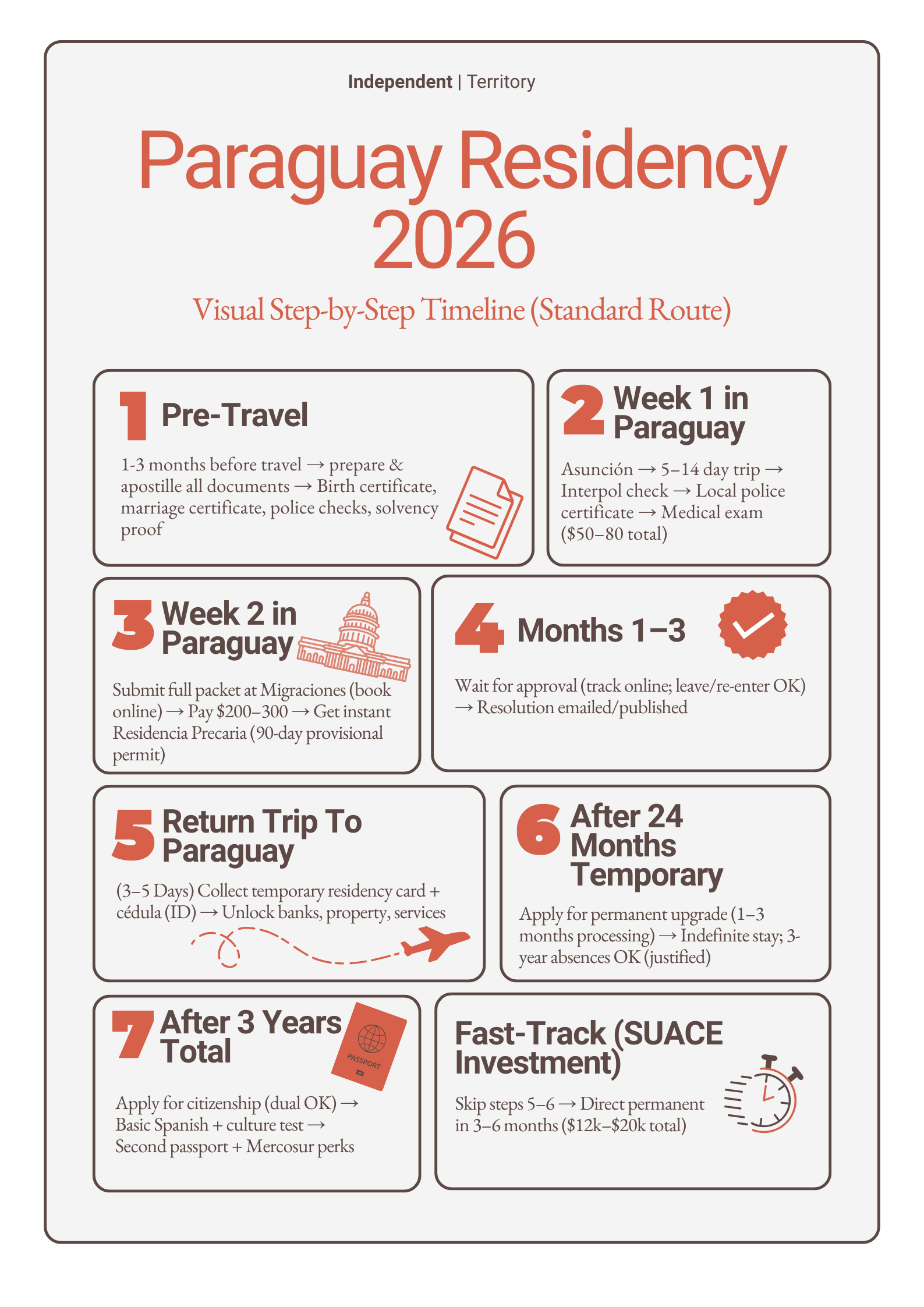
Paraguay residency step-by-step timeline
Reality Check: To keep things moving, it really helps to work with a local lawyer or another third-party service to handle filings and translations—they can save you weeks of time and a lot of frustration. Below is a list of residency specialists we’ve gathered for convenience only; it’s not a recommendation or endorsement. The best time to apply is usually February through November, skipping major holidays. With a bit of planning and the right help, Paraguay residency can go from idea to reality.
| Name | Contact Info | Primary Services / Focus |
| Expat Solutions Consulting | Encarnación, Itapúa, Paraguay Email: info@expatsolutionsconsulting.com Phone: +595 985703782 (WhatsApp) | Immigration & residency processing: bank account assistance, cultural advisory, Spanish classes, company formation, real estate listings, driver’s license assistance. |
| Paraguay Solutions | Best contact via site form or their home page. | Consultancy focused on immigration: residency, tax planning, business incorporation, banking guidance, real estate assistance, and other Paraguay setup services. |
| MARPAT Abogados | Asunción, Paraguay Phone: +595 981 386 873 / +595 21 445 223 Email: marpat@marpat.com.py | Full-service law firm: intellectual property, regulatory & environmental law, corporate & commercial law, immigration & residency assistance, translations, legal documentation, litigation support. |
| Gestoría en Paraguay | Asunción, Paraguay Email: info@gestoriaenparaguay.com.py WhatsApp: +595 987 295000 | Gestoría: support including residency, identity documentation, and planning services with a focus on expat integration and administrative processes. |
| BKM Berkemeyer | Asunción & Ciudad del Este, Paraguay Email: law@berke.com.py Phone: +595 21 446 706 | Full-Service Law Firm |
| Ecovis Paraguay | Avda. Sacramento c/ Genaro Romero, Asunción, Paraguay Phone: +595 21 728 99 00 Email: asuncion@ecovis.com | Part of Ecovis global network: offering accounting, tax, audit, and business advisory services tailored to local and international companies (Paraguay branch). |
| Sweet Home Paraguay | Best contact via site form or their about page. | Services offered: Virtual mailbox in Paraguay for Digital Nomads and other residency expat services. |
| Angel Pontiggia | Asunción, Paraguay Email: pontiggia@protonmail.com Phone: +595 994 944 222 | Independent immigration & relocation specialist: She focuses on a “fast, transparent process” for Paraguay residency and visa services, personalized relocation guidance for expatriates, digital nomads, families, and investors. |

Iguazú Falls — one of the world’s greatest natural wonders easily accessible with your new Paraguay residency.
Costs for Paraguay Residency
Budgeting for Paraguay residency doesn’t have to feel overwhelming—especially when you compare the low Paraguay residency costs to pricier programs in Europe or the Caribbean.
Whether you’re pursuing temporary residency as a stepping stone or jumping straight to permanent via investment, the outlay remains affordable and transparent, often totaling far less than a single year’s taxes back home.
Below, we break down the essentials, including hidden costs like travel and living expenses, so you can plan with confidence and avoid surprises.
Key Cost Breakdown
- Application Fees: Around US$250–425 (government processing for temporary or permanent; includes forms and biometrics).
- Apostille: (Translation Costs): US$100–500 (per document; varies by home country and number of papers). Translation costs are done in Paraguay.
- Lawyer or Facilitator Fees: US$1,000–2,000 (optional but recommended for hassle-free handling; higher for SUACE investment setups).
- Solvency Proof: ~US$5,200 (demonstrated via bank statements, no lock-in required).
Total Estimated Cost for Temporary Paraguay Residency: US$2,000–4,000 (all-in, including docs and a facilitator; lower if DIY).
For Investment Route (SUACE): Add US$10,000–15,000 upfront for company formation, plus your phased $70,000 commitment over 10 years.
Hidden costs to factor in: Round-trip flights (~US$800–1,500 from US/Europe), accommodations during visits (US$500–800 for 1–2 weeks in Asunción), and daily expenses (~US$30–50/day). With high 2025 application volumes, budget a buffer for potential slight delays into 2026.
For a clear visual, here’s a detailed table of Paraguay residency costs:
| Item | Estimated Cost (USD) | Notes |
| Application & Government Fees | $250–425 | Includes submission, biometrics; ~$350 for SUACE |
| Apostilles & Translations | $100–500 | Per document; Hague countries cheaper |
| Lawyer/Facilitator | $1,000–2,000 | Optional; covers filings, translations |
| Solvency Proof | ~$5,200 | Bank statements, government pension, stocks etc.; no permanent tie-up |
| Local Clearances (Interpol, Medical) | $50–100 | Obtained in Paraguay |
| Travel & Living (Per Trip) | $1,000–2,000 | Flights + 1–2 weeks in Asunción (~$1,000/month baseline) |
| Total for Temporary | $2,000–4,000 | DIY lower; facilitator mid-range |
| Investment Route Add-On | $10,000–15,000 + $70k/10yrs | Company setup + phased commitment |
These costs for Paraguay residency keep the process accessible, letting you focus on the excitement of your new chapter rather than the finances. Ready to explore the perks? Keep reading to our Benefits of Living in Paraguay as an Expat section next.
Benefits of Living in Paraguay as an Expat
Once you’ve secured your Paraguay residency and settled into the rhythm of this underrated South American gem, the real rewards of living in Paraguay as an expat begin to shine. It’s not just about the paperwork—it’s the everyday freedom, savings, and serenity that make expats in Paraguay rave about their choice.
With tax residency in Paraguay unlocking unparalleled financial perks and a lifestyle that feels worlds away from home-country stresses. This is where your Plan B transforms into a thriving reality to manage your finances in Paraguay as a retiree as well.
From bustling urban vibes to tranquil countryside escapes, discover the best places to live in Paraguay. Here’s why so many are calling Paraguay home in 2026.
- Tax Advantages That Change Everything: Paraguay’s territorial system is straightforward: foreign-sourced income—from remote work, investments, pensions, or crypto—is 100% exempt. Only local earnings face an 8% to 10% rate, with zero wealth, inheritance, or overseas capital-gains levies. The result? Most expats slash their effective burden to single digits (or zero), saving tens of thousands annually compared to home-country rates. One 2025 relocatee summed it up: “From 40% effective to essentially nothing on my portfolio and business—residency paid for itself in year one.” Bottom line: more of your money stays in your pocket, ready for travel, reinvestment, or simply enjoying a slower, sunnier life.
- A Lifestyle of Affordability and Ease: Living in Paraguay as an expat means stretching your budget in ways that feel liberating. Expect to pay around US$500–800 per month for a modern apartment in prime areas (like Villa Morra in Asunción), with utilities under $100 and groceries for a couple at $300–400. The subtropical climate—very warm summers (often exceeding 100°F/38°C), mild winters (around 60°F/16°C to 70°F/21°C), and plenty of sunshine—invites outdoor living year-round. Friendly locals (known for their “tereré” social rituals) make integration warm and genuine, while access to stunning nature is effortless: Day-trip to the awe-inspiring Iguazu Falls (just a few hours away) or explore the vast Chaco wilderness. Another advantage is the opportunity around buying property in Paraguay, where low prices and fewer restrictions make it far more accessible than in many Western countries. Healthcare is another win—private clinics offer quality care at $20–50 per visit, with public options free post-residency.
- Thriving Expat Communities and Improving Safety: Expats in Paraguay are forming strong communities, particularly in Asunción, which offers several expat-friendly neighborhoods in Asunción and active English-speaking groups on Facebook and Meetup, along with the lakeside city of Encarnación. Safety ratings continue to improve into 2026, with homicide rates stabilizing around 7–8 per 100,000 (lower than many regional peers) and urban areas like Asunción feeling secure for daily life. Petty crime exists, but common-sense precautions keep most incidents at bay—far from the unrest many flee back home.

Traditional tereré or mate, the social drink that can be a daily ritual after securing Paraguay residency.
Potential Challenges (and How to Crush Them)
Paraguay is far easier than most countries, but it’s still a developing nation — a few hurdles exist. All are minor and easily fixed.
• Bureaucracy & Delays: High volume can push processing past the normal 45–90 days. Fix: Hire a reputable local lawyer or facilitator ($1,000–$2,000). Most expats who do this finish in half the time and with zero headaches.
• Language Barrier: Everything official is in Spanish; English is limited outside expat zones. Fix: Learn basic Spanish with Duolingo before arrival (3 months = conversational). Use cheap translators for appointments and join free language-exchange groups in Asunción. Within months you’ll be fine.
• Currency Fluctuations & Mild Inflation: The Paraguayan Guaraní (PYG) can swing 5–10 % yearly; inflation runs 4–6 %. Fix: Keep most money in USD accounts (easy after you have your cédula), send via Wise, and budget in dollars. Even with swings, costs remain 50–70 % below Western levels.
Bottom line: these are small inconveniences compared to the rewards. Plan ahead, use professionals when needed, and you’ll sail through.
Not sure if Paraguay fits your lifestyle? Explore the pros and cons before you decide.
2026 Outlook: Stability in a Turbulent world
Amid potential world and regional politics—Paraguay’s neutral stance stands out as a major plus, insulating it from spillover drama. Economic growth (projected 3.5–4% GDP in 2026) and infrastructure investments (e.g., new roads and energy projects) signal upward momentum, though rural areas may lag. For expats, this means reliable stability without the volatility seen elsewhere in Latin America.
To summarize these challenges moving to Paraguay and their fixes:
| Challenge | Why It Happens | Quick Overcome Strategy |
| Bureaucracy & Delays | High application volumes, manual checks | Hire agent; book online appointments |
| Language Barrier | Spanish-dominant society | Learn basics; use translators/apps |
| Currency Fluctuations | Emerging market volatility | Diversify in USD; monitor rates |
| Regional Uncertainties | Neighboring political shifts | Leverage Paraguay’s neutrality |
These hurdles are minor compared to the rewards of Paraguay for expats, turning potential frustrations into growth opportunities. With preparation, your Paraguay residency journey stays on track—next up, our FAQs on Paraguay Residency and Visas to answer your burning questions.
FAQs: Paraguay Residency Requirements and Visa Pathways
How long does it take to get permanent residency in Paraguay?
For most expats, permanent Paraguay residency requires two years of temporary residency first, with the upgrade application processing in 1–3 months. Direct permanent status via the SUACE investment program can be achieved in 1–6 months from submission. Total timeline from arrival: 2–3 years standard, or under a year with investment. No full-time presence needed during temporary phase—just one visit per year. Source: Residencia Permanente guidelines
Can I work remotely while on Paraguay residency?
Yes—absolutely. Paraguay residency allows remote work for foreign employers or your own business without a local work permit, as long as income is sourced abroad. This leverages the territorial tax system (0% on foreign earnings), making it ideal for digital nomads in Paraguay. Local employment requires sponsorship, but remote setups are unrestricted post-approval. Source: Nomad Tax Guide 2025
Is Paraguay safe for families?
Paraguay is generally safe for families, with homicide rates around 7–8 per 100,000 (lower than Brazil’s 20+ and comparable to parts of the US). For the current safest neighborhoods and cities (with 2025–2026 crime stats, schools, and family-friendly areas), see our full guide: 8 Safest Places to Live in Paraguay. Urban spots like Asunción and San Bernardino keep getting safer thanks to more policing, and petty theft is the only real concern — normal precautions are plenty
What is the path to citizenship in Paraguay after residency?
After three years of total residency (typically two temporary + one permanent), you can apply for naturalization. Requirements include basic Spanish conversation, a short cultural/test on Paraguay’s history, proof of good conduct, and economic solvency. Dual citizenship is permitted, and processing takes 6–12 months. No renunciation of your original passport needed. Source: constituteproject.org and Global Citizen Solutions Guide.
These FAQs cover the essentials of Paraguay residency requirements and visa pathways, but for personalized advice, consult a qualified lawyer.
Conclusion: Make 2026 the Year You Claim Your Freedom with Paraguay Residency
As we wrap up this guide to Paraguay residency, it’s clear why this unassuming South American nation is capturing the hearts—and passports—of expats worldwide. Paraguay residency stands out as the ideal choice: remarkably easy with straightforward visa pathways for expats in Paraguay, incredibly affordable (total costs often under US$4,000 for temporary status), and profoundly tax-friendly thanks to the territorial system that keeps foreign income untouched at 0%.
Whether you’re a digital nomad in Paraguay craving remote work freedom, a retiree seeking low-cost healthcare and subtropical serenity, or a family escaping high taxes and instability, the benefits—from quick approvals and no full-time stay requirements to a clear three-year path to citizenship—make long-term stays in Paraguay a no-brainer. Amid global uncertainties, Paraguay’s stability, growing expat communities, and lifestyle reset offer not just a Plan B, but a vibrant Plan A.
In summary, Paraguay residency delivers visa and residency pathways for expats that are accessible, cost-effective, and loaded with perks like tax residency in Paraguay, making moving to Paraguay one of the smartest relocations you can make.
Paraguay is just one option. Explore our Latin America Residency Map to see which countries might be an even better fit for your situation.
For more tailored insights, check all our Paraguay posts here.
References
[^1]: Minimum wage data (Nov 2025): Wage Indicator
[^2]: Solvency via foreign statements (no deposit): Sweet Home Paraguay – Residency Guide
[^3]: No upfront deposit required: Creimerman Law – Paraguay Immigration 2025
[^4]: Bank account requires cédula Move to Paraguay – Opening a Bank Account and Creimerman Law – Banking for Foreigners