

21 min read
Belize is the only English-speaking country in Central America — which makes it uniquely accessible for North Americans looking to build a life abroad without a language barrier. Sandwiched between Mexico and Guatemala, it offers Caribbean coastline, jungle interior, Maya ruins, and a cost of living that — done right — is genuinely lower than most of the Western world. It’s also a place that rewards preparation. The expats who thrive here almost always arrived with their eyes open. The ones who struggle usually didn’t.
……………………………..
Tired of rising costs, political instability, and feeling stuck in your home country? You’re not alone — and that’s exactly why so many people are considering living in Belize.
With its English-speaking culture, Caribbean beaches, jungle landscapes, and some of the most attractive tax advantages in the Western Hemisphere, Belize looks like one of the easiest places to start a new life abroad. No language barrier. No complicated visa drama upfront. Just show up and start living.
But the dream often collides hard with reality, leading many to make critical mistakes moving to Belize.
Thousands move to Belize every year chasing a better lifestyle. Many end up regretting the decision before the first year is out.
What looks like paradise on Instagram — turquoise water, hammocks, low prices — can quickly turn into unexpected financial strain, infrastructure headaches, and daily frustrations that no one bothered to mention in that YouTube vlog you watched at 2 a.m. on a Friday night.
This isn’t another sugar-coated “move to Belize” article. It’s a straight-talking guide to the most costly mistakes moving to Belize — and exactly how to avoid them in 2026.
Whether you’re a remote worker, retiree, or family looking for a fresh start, knowing what to know before moving to Belize is critical if you want to avoid the Belize expat problems that catch most people off guard.
Table of Contents
Why So Many Expats get it wrong and make mistakes moving to belize
Belize gets lumped in with Mexico, Costa Rica, and Panama as one of the “easy” Central American expat destinations.
And in some ways, it earns that reputation — English is the official language, the US dollar is widely accepted, and the barrier to entry feels low.
That’s exactly the problem.
The ease of arrival makes people skip the due diligence they’d do for somewhere more “foreign.” They spend a week on Ambergris Caye, fall in love with the pace and the sunsets, and start Googling real estate listings before their tan fades.
What they miss: the living in Belize reality is a small country with massive regional variation, genuine infrastructure gaps, and a cost structure that can quietly drain your savings if you’re not paying attention. The gap between a two-week vacation and sustainable long-term living is enormous — and social media does almost nothing to close it.
Here are the 10 mistakes moving to Belize that close that gap the hard way — and the expat mistakes Belize newcomers repeat most often.
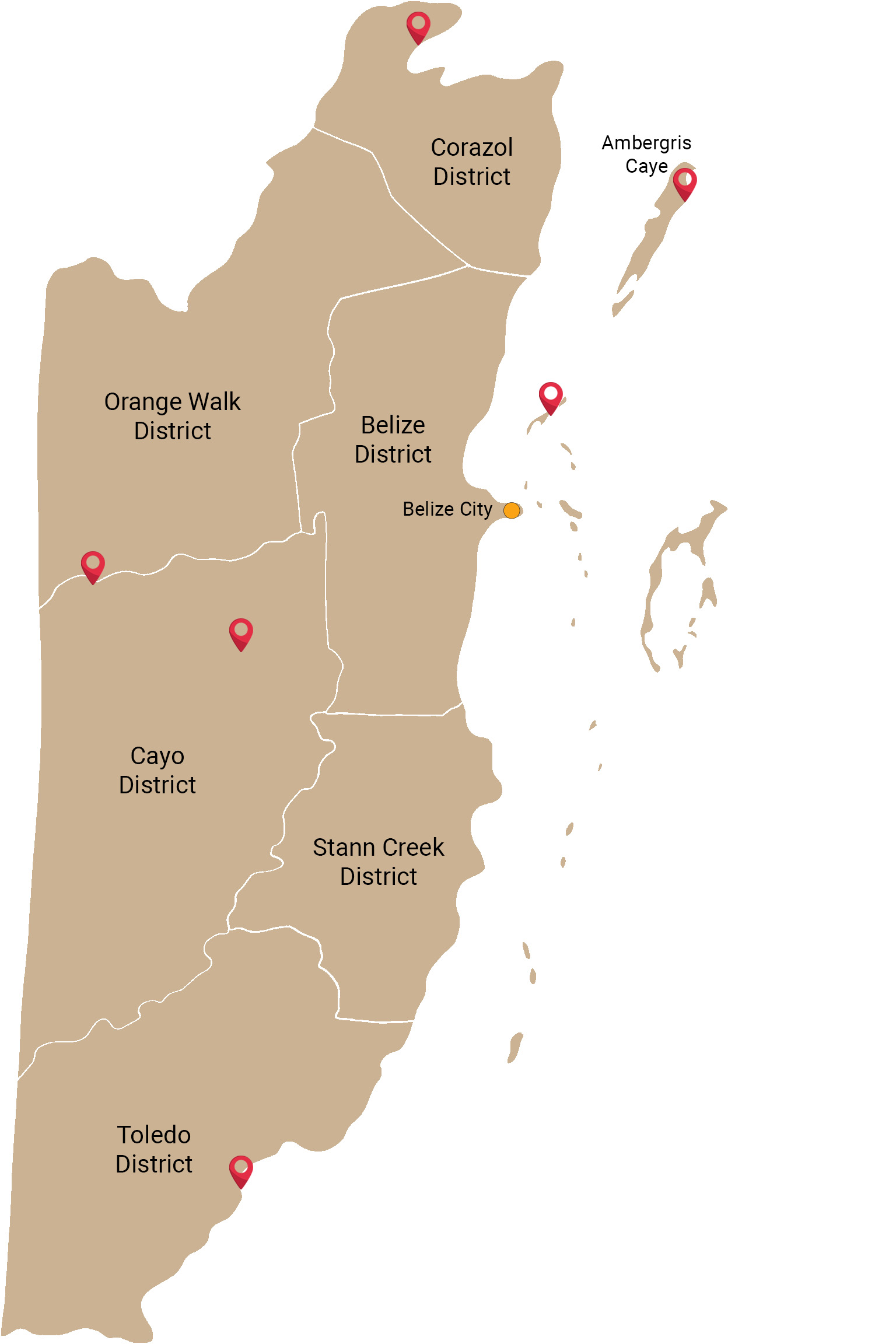
Not all areas in Belize are created equal. Choosing the wrong location is one of the top 10 mistakes moving to Belize that expats regret most.
Mistake #1: Choosing Location Based on Lifestyle, Not Infrastructure
This is the most common mistake, and it cascades into almost every other problem on this list.
People choose where to live in Belize based on what feels good — the beach, the vibe, the proximity to a dive site — without asking the more important questions:
• Can I get reliable internet here?
• Is there a decent clinic within an hour?
• What happens when I need a plumber?
The regional variation in Belize is extreme. Ambergris Caye and Placencia have established expat infrastructure — decent connectivity, more services, regular flights.
Corozal in the north offers easy border access to Chetumal, Mexico, which matters a lot for healthcare and supplies. Inland areas like the Cayo District are beautiful and affordable but come with genuine trade-offs in connectivity and services. Remote jungle or coastal communities can feel idyllic in the dry season and genuinely isolated during the rainy season.
How to Avoid It: Before you fall in love with a location, build a needs scorecard. Write down your non-negotiables — internet speed for work, proximity to healthcare, access to international flights, community size — and score each region honestly against them. Lifestyle is the bonus, not the criteria.
Our guide to the best places to live in Belize breaks down the top expat-friendly areas side by side, and if you’re torn between the coast and the interior, our coastal vs inland Belize breakdown will help you think it through clearly.
Dave & Sandra were a semi-retired couple from Oregon who picked a small fishing village south of Placencia because it was quiet, affordable, and gorgeous.
What they didn’t account for: the road turned into a mud obstacle course every rainy season, the nearest pharmacy was 90 minutes away, and internet speeds made video calls with their grand-kids a weekly comedy of buffering. Because they couldn’t fully function remotely, they eventually moved to Corozal — and wish they’d done the homework first.
Mistake #2: Underestimating the True Cost of Living
Belize has a reputation for being cheap. That reputation is partly earned and mostly misleading.
Yes, local food, local transport, and locally produced goods are genuinely affordable.
But Belize imports a huge percentage of consumer goods, and import duties are steep. According to the Belize Chamber of Commerce, customs duties range from 0% to as high as 70% depending on the product category, with a 12.5% General Sales Tax added on top. Anything you’re used to buying at a US grocery store — whether it’s a box of breakfast cereal, a bottle of wine, or a laptop — will cost significantly more than back home.
Then there’s lifestyle creep. Expats who arrive and immediately replicate a North American lifestyle — dining out regularly, buying imported goods, air conditioning running all day — find their budgets blowing up fast. Belize can be cheap, but only if you actually adapt to local living.
Location also dramatically changes your costs.
Corozal in the north is one of the most affordable expat towns in the country. Placencia, with its booming tourism economy, is substantially more expensive. Ambergris Caye can feel like living in a resort — beautiful and priced accordingly.
| Expense | Corozal (Monthly) | Placencia (Monthly) | US Average (Monthly) |
| Rent (2BR) | $400–$600 USD | $900–$1,500 USD | $1,800–$2,500 USD |
| Groceries | $250–$350 | $400–$600 | $500–$700 |
| Utilities | $80–$150 | $150–$300 | $200–$350 |
| Transport | $50–$100 | $100–$200 | $400–$600 |
| Total (est.) | $1,000–$1,500 | $2,000–$3,000 | $3,500–$5,000 |
Estimates based on 2026 expat community data. Costs vary significantly by lifestyle.
If you want a lifestyle comparison the cost of living in Belize vs Mexico guide gives you real numbers to plan against.
Tax & Banking Considerations: Avoiding Financial Mistakes Moving to Belize
American expats face a layer of complexity that often gets ignored in the excitement of planning a move.
There is no US–Belize tax treaty and you are still filing US taxes from abroad. The Foreign Earned Income Exclusion (FEIE) helps but requires proper setup and ongoing compliance.
Local banking in Belize for expats can also be a friction point. Opening a bank account as a foreign national takes time and documentation. International wire transfers can be slow and expensive. Many expats operate primarily on US accounts with ATM withdrawals — which work but come with fees and daily limits.
How to Avoid It: Build a real 12-month budget before you move, not a dream budget. Include a 20% buffer for unexpected costs. Prioritize local sourcing — market produce, local butchers, Belizean-made goods — wherever possible.
For the full tax picture, the taxes in Belize for expats guide covers what you actually owe — and what you don’t.
Kathy, a 52-year-old marketing consultant from Florida, based her cost projections on general “Belize is cheap” research. She budgeted $1,800/month for a comfortable life in Placencia.
By month three, she was consistently spending $2,800. The gap came from imported wine, air conditioning she couldn’t live without in the heat, and the assumption that eating out would be cheap. It wasn’t — not in a tourist town. She adapted, but it took six months of financial stress to get there.
“High-speed internet everywhere” — famous last words. Don’t assume paradise equals modern infrastructure.
Mistake #3: Assuming Internet Is Reliable Everywhere
If you’re a remote worker, this mistake can end your Belize experiment entirely.
Internet connectivity in Belize ranges from surprisingly decent to genuinely unusable, depending on where you are.
In the tourist coastal areas — Ambergris Caye, Placencia, parts of Cayo — service has improved significantly. In rural inland areas or smaller coastal communities, you can still find yourself staring at a spinning wheel for minutes at a time.
The infrastructure is simply not uniform, and it may not be improving on your timeline.
How to Avoid It: Never sign a lease before testing the internet yourself — ideally across multiple days and during peak hours. Ask local expats directly what their experience is, not property managers who have a vested interest in telling you it’s fine.
If you’re a remote worker, plan for problems from day one: Starlink is a viable option in Belize and could be worth the setup cost. A backup mobile hotspot from a different carrier is also smart since the main providers can have separate outages.
The ultimate guide to working remotely from Belize covers connectivity by region, backup options, and what remote workers need to know before committing.
James is a software developer who moved to a beautiful property inland, about 45 minutes from San Ignacio. The property manager showed him speeds of 15 Mbps during the viewing.
What the manager didn’t mention: those were evening speeds when no one else was online. During his work hours, he was regularly dropping to 1–2 Mbps, and calls were unstable. Finally, he bit the bullet on Starlink. Now it works. But it cost him months of stress and a lot of money he hadn’t planned for.
Mistake #4: Expecting US-Level Healthcare Access
Belize’s healthcare system works well for routine care at a very low cost. A doctor’s visit, basic medications, and standard treatments are genuinely affordable and accessible in the major towns.
For day-to-day health, Belize is fine.
For anything serious, the picture changes. There are no world-class hospitals in Belize.
For complex procedures, specialist care, or genuine medical emergencies, most expats end up going to Chetumal or Mérida in Mexico, or back to the US. That means having the means to get there fast — and international health insurance that covers medical evacuation is not optional, it’s essential.
How to Avoid It: Secure comprehensive international health insurance with evacuation coverage before you land.
Understand what the nearest clinic can and can’t handle for your specific health profile. If you have ongoing medical needs — a condition that requires specialist monitoring, regular prescriptions, or specific treatments — research availability in your chosen area in detail before committing to it.
The healthcare in Belize for expats guide covers costs, quality by region, insurance options, and exactly when evacuation becomes the right call.
Robert had a heart scare six months into his Belize retirement. He’d been paying into a local health system thinking he was covered. He wasn’t — not for the level of care he needed. He ended up being evacuated to Mérida at considerable personal expense for a cardiac procedure. It went well, and he’s fine. But the cost and the stress of navigating it unprepared was significant. He now has proper international coverage and keeps a medical emergency fund.

Getting residency wrong can cost you thousands and force you to leave.
Mistake #5: Misunderstanding Residency and Long-Term Stay Options
Showing up and staying in Belize indefinitely is not the same as having a plan.
Many expats default to “visa runs” — leaving the country periodically to reset their tourist stay allowance. This works as a short-term workaround, but it’s not a long-term strategy, it accumulates cost, and it creates genuine uncertainty about your right to stay.
In 2026, enforcement of visa run patterns has tightened, and immigration officials have the discretion to question or deny re-entry.
Belize offers real pathways worth understanding. The Qualified Retired Persons (QRP) program, administered by the Belize Tourism Board, is open to applicants aged 40 and over who can demonstrate a monthly income of at least $2,000 USD from outside Belize.
It offers significant benefits including exemption from Belizean taxes on foreign income and duty-free import of personal goods.
Permanent residency is available after one year of continuous legal presence. Both have paperwork requirements, fees, and processing times that are longer and more bureaucratic than people expect.
How to Avoid It: Decide your long-term intention early. If you’re going to stay, start the process immediately — don’t wait until you’ve already been doing visa runs for a year.
The Belize permanent residency guide walks you through the full process, current timelines, and fees. If your considering retiring in Belize on a pension this guide is a practical reality check on whether the QRP works for your situation. Either way, hire a local attorney who knows the current system — requirements shift, and secondhand Facebook advice is not a strategy.
Mark and Elena spent two years doing quarterly visa runs to Chetumal, figuring they’d “sort out residency eventually.” However, residency became a necessity when Elena had a medical situation that required extended stays for treatment. Without residency, they faced real uncertainty about her right to stay for care. They got it sorted — but under the worst possible circumstances and with significant legal cost. Starting the process early would have cost a fraction of what the crisis situation required.
Not sure Belize is the right fit for your situation?
Explore and compare residency pathways across the region — Panama, Mexico, Costa Rica, Paraguay, and more — in one place. It’s the fastest way to see where you actually qualify before you commit to one country.
Get The FREE Latin American Interactive Map
Mistake #6: Ignoring Safety Differences by Region
Belize is neither uniformly safe nor uniformly dangerous. Anyone who tells you both of those things with confidence has a limited picture.
Belize City has real crime problems, particularly in certain neighborhoods. Parts of it are genuinely not recommended for expat daily life, and most experienced expats suggest treating Belize City as a transit hub rather than a base.
Outside of Belize City, the picture improves substantially — but it’s still not homogeneous.
Popular expat hubs like Placencia, Corozal, and the Cayo District have established communities, lower crime rates, and the kind of social infrastructure that makes it easier to stay aware and connected.
Isolated areas require more situational self-reliance, and expats there often note that response times for any kind of emergency — police, medical, fire — can be very long.
How to Avoid It: Research your specific target area, not Belize in general. Talk to expats already living there. Avoid isolated properties when you’re new and haven’t yet built local networks.
Common-sense security practices — secure doors and windows, low-profile living, getting to know neighbors — matter more here than in a gated North American suburb.
The safety in Belize guide breaks down crime by area, which neighborhoods to avoid, and what daily life actually looks like on the ground.
Lisa rented a beautiful place on the outskirts of a small coastal town. It was considered a “safe” area, and for the most part, it was. But after two break-ins in her first six months — minor incidents, nothing violent — she realized she’d underestimated how important community proximity and local relationships were to daily security. She moved closer to the expat center of town, got involved in a few local community groups, and hasn’t had a problem since.
Mistake #7: Expecting Things to Work Like Back Home
“Belize time” is a phrase you’ll hear constantly if you spend any time in expat communities. It means things move slower.
Appointments happen eventually.
Contractors show up when they show up.
Bureaucracy operates on its own schedule.
This isn’t necessarily laziness or incompetence — it’s a different relationship with time and urgency, rooted in culture.
The business culture in Belize is relationship-based. People do things for people they know and trust.
Building that takes time, and trying to operate with North American efficiency expectations without first building those relationships is one of the most common sources of expat frustration.
Banking can also be genuinely slow by international standards. Administrative processes at government offices can require multiple visits for things that feel like they should be one-step. Supply chains for specific items can be unpredictable.
How to Avoid It: Adjust your baseline expectation before you arrive. Build in longer timelines for everything administrative.
Invest in relationships — with your neighbors, with local business owners, with anyone who is part of your daily life. That investment pays off in ways that no amount of impatience ever will.
Tom was a project manager — highly efficient, systems-oriented, and used to tight deadlines. He moved to Belize thinking that personality would serve him well anywhere. It served him terribly for the first year. He burned through multiple contractors, had constant frustrations with government processes, and couldn’t understand why nothing ran the way it should. A long conversation with a long-term expat was the turning point: “You’re trying to manage Belize. You can’t. You have to join it.” He adjusted, and his second year was almost unrecognizable from his first.
Beach lover or jungle explorer? Choosing a town that doesn’t match your lifestyle is a regret many expats face.
Mistake #8: Choosing the Wrong Town for Your Lifestyle
Belize isn’t one place. The towns are genuinely different from each other — in pace, community size, accessibility, cost, and culture — and matching your personality and needs to the right one matters enormously for long-term happiness.
| Town | Vibe | Cost | Best For | Watch Out For |
| Corozal | Quiet, community-oriented | Low | Retirees, budget-conscious expats | Limited nightlife and services |
| Placencia | Beach resort, social | Medium–High | Couples, social expats, divers | Tourist-driven prices, busy high season |
| San Ignacio (Cayo) | Active, nature-focused | Low–Medium | Adventurers, families, long-term livers | Distance from coast, healthcare |
| Punta Gorda | Remote, authentic | Low | Truly off-grid types, eco-expats | Rainy season isolation, limited services |
| Belmopan | Functional, expat community | Medium | Families, remote workers, central access | Not very charming |
| Ambergris Caye | Tourist island | High | Short-term stays, dive enthusiasts | Very expensive for long-term living |
Red Flags When Visiting
When you do scouting trips, watch for these signals that a place isn’t right for you:
- When nearby expats report chronic internet issues and your rental tests fine
- The nearest medical facility is more than an hour away and you have health considerations
- The year-round expat community is tiny (fewer than 20 families), and you need social connection
- Rainy season access involves a dirt road you haven’t driven in the wet
How to Avoid It: Don’t choose a location from one visit during dry season. Spend extended time — minimum two to four weeks — in at least two or three candidate areas.
We’ve written detailed guides on the towns that come up most often: living in Corozal, living in Punta Gorda, and living in Belmopan each give you the honest pros, cons, and real costs. If you’re drawn to the water, our coastal living in Belize guide covers Ambergris Caye, Caye Caulker, and Placencia side by side, get the full details at our living in Belize as an expat guide.
Phil and Maria moved to Ambergris Caye because they spent a dreamy two-week vacation there and loved it. They signed a lease remotely and arrived to start their new life. Three months in, they knew it wasn’t right — it was too touristy, too expensive, too transient. The community they’d imagined wasn’t really there; most people were on holiday, not building a life. They eventually moved to Corozal, which they describe as the best decision they made after the worst one.
Mistake #9: Overestimating Self-Reliant Living
Belize looks ideal for off-grid, sustainable living. The land is fertile, the climate is productive, and the expat internet is full of people who’ve made it work. What gets underrepresented: how hard it is to actually pull off.
Power reliability varies by area. Water supply — whether from municipal systems, wells, or rainwater collection — requires active management and can fail. Supply chains for specialty items (spare parts, building materials, specific tools) can involve long waits or creative problem-solving. The isolation that feels romantic in the planning stage can feel genuinely difficult after six months of managing it alone.
Hurricane and Climate Resilience
Belize sits squarely in the Caribbean hurricane belt. The rainy season runs roughly June through November, and while direct hurricane hits are less frequent than in other parts of the Caribbean, they happen — and the infrastructure response to serious storms can be slow.
Rainy season flooding, road damage, and power outages are routine experiences for many areas.
How to Avoid It: If self-reliant living is your goal, don’t start there. Start somewhere semi-supported — close to a town with services — and test a full season before going more remote.
Understand your property’s flood and storm history before committing to it. The self-reliant living in Belize guide covers the region’s best suited for independence, the infrastructure realities, and how to set yourself up to actually make it work.
Greg and Susan built their dream eco-homestead in a rural area of the Toledo District. They’d done a lot of research and prep. What they hadn’t anticipated was a serious rainy season that turned their access road into an unnavigable mess for three months, flooded their lower garden beds, and led to a generator failure at the worst possible time. They survived it and learned from it, but wished they’d done a first year closer to town.

Moving to Belize isn’t a vacation—it’s a lifestyle. Plan for the long game or pay the price.
Mistake #10: Not Thinking Long-Term – Why Some Expats Make Mistakes Moving to Belize
The first few months in Belize are often genuinely wonderful. Everything is new, the weather is warm, you feel free, and the adventure of building a new life is genuinely exciting. This is the honeymoon phase, and it’s real.
What comes after varies enormously depending on how well you prepared for the ten things on this list.
Expats who chose the wrong location start feeling the friction of it constantly.
Those who underestimated costs start watching their savings more nervously than they planned.
Those without proper residency start dreading the next visa run.
Those who haven’t built a community start feeling isolated in ways that compound over time.
The people who thrive long-term in Belize typically share a few traits: they researched location deeply, they have stable income that doesn’t depend on perfect internet, they built real local relationships, they started residency paperwork early, and they adjusted their expectations to match where they actually moved, not the idea of it.
How to Avoid It: Before you commit to a permanent move, plan for month six, not month one.
Ask yourself: Do I have a sustainable income here? Do I have a community? Do I have legitimate legal status? Do I have healthcare? If you can’t answer yes to all four, keep planning before you go.
Angela described her first year as “the most beautiful slow-motion car crash of her life.” She loved Belize — genuinely. But she’d moved too fast, without residency planned, without community built, without real income stability. By month eight, she’d moved twice, exhausted herself with visa logistics, and felt lonelier than she had in years. She stayed, sorted it out, and is now genuinely happy there. But she’s the first to say: “Do the work before you arrive. All of it.”
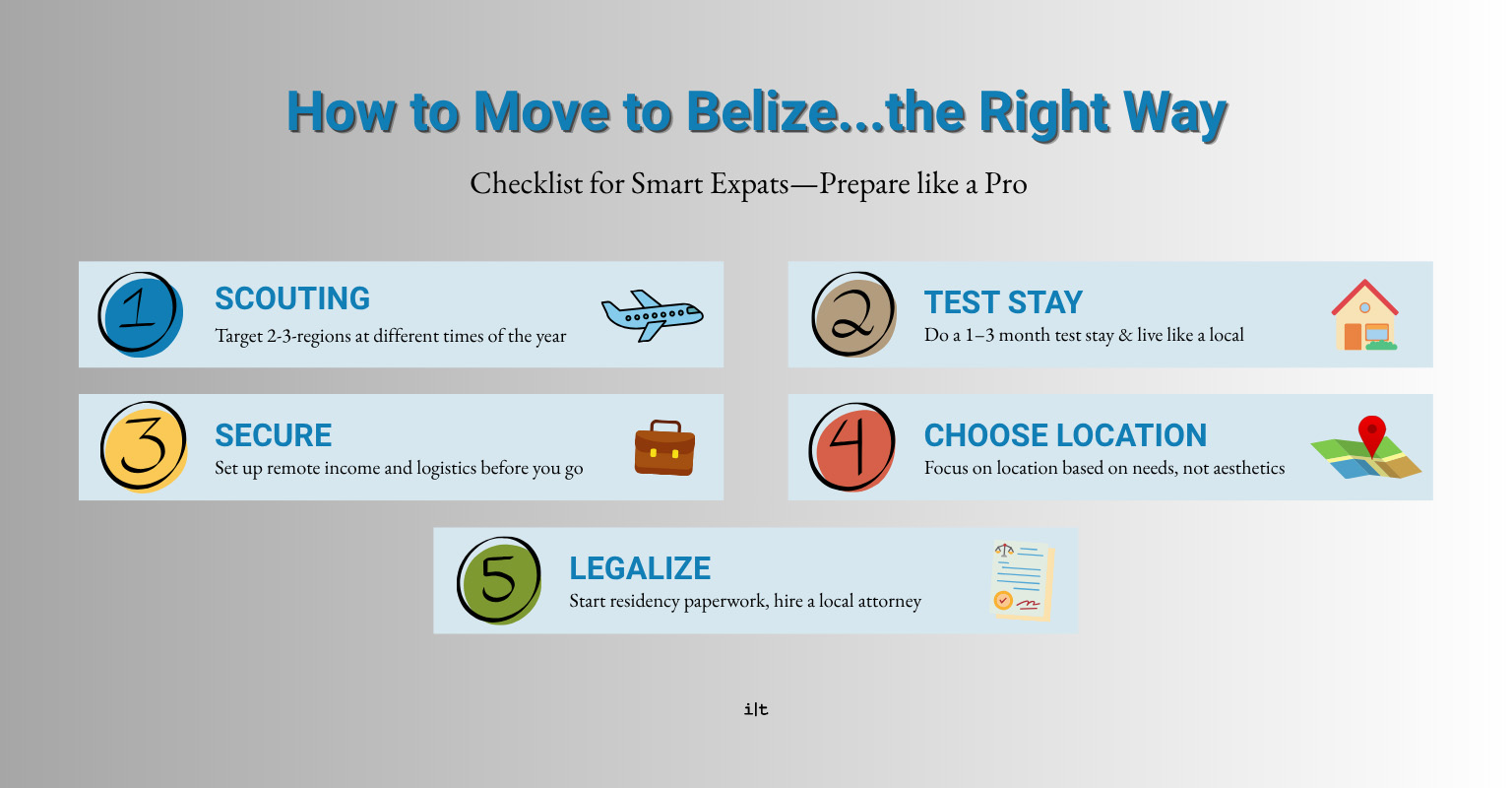
The smart checklist every future Belize expat needs. Stop guessing and start planning properly.
How to Move to Belize the Right Way
Belize can absolutely work for the right person who’s done the work. Here’s a practical checklist to move smarter:
- Do multi-region scouting trips: Visit at least two or three candidate towns. Travel during different seasons if possible or talk to people who’ve been there in both dry and rainy seasons. Don’t sign anything based on one visit.
- Do a 1–3 month test stay: Rent furnished short-term before committing to a year lease. Live like a resident, not a tourist. Work from your laptop in actual cafes and accommodation. Test the infrastructure for real.
- Set up income and logistics before you go: Confirm your remote income is stable. Understand your US (or home country) banking and tax situation. Have international health insurance with evacuation coverage before you land.
- Choose location based on needs, not aesthetics: Use a needs-based scorecard. Internet, healthcare, road access, community size, cost — these come before the view from the property.
- Start residency, insurance, and backups early: Don’t wait on the paperwork. Get a local attorney. Build redundancies for internet, power, and water before you need them.
Final Thoughts: Belize Can Work — If You Avoid These Mistakes Moving to Belize
Belize is a genuinely compelling place to build a different kind of life. The culture is warm, the landscapes are extraordinary, and for the right person — prepared, flexible, and realistic — it delivers on a lot of what it promises.
The problem is almost never Belize itself.
It’s the gap between expectation and preparation.
The expats who regret the mistakes moving to Belize almost universally moved too fast, skipped the research, or assumed that wanting it badly enough was a substitute for planning it properly.
The ones who thrive did the work first.
Use this guide as your reality check. Come back to it when you’re tempted to skip a step.
Ready to explore your options beyond Belize?
Discover which countries might be a perfect fit for your situation.
Download the FREE Latin American Interactive Map
✔No Spam
✔Instant Access
✔ Free Download
FAQs About About Common Mistakes Moving to Belize
What is the biggest mistake expats make in Belize?
The biggest expat mistake Belize newcomers make is choosing a location based on lifestyle appeal without evaluating infrastructure first. It’s also the most common of all the mistakes moving to Belize — everything else flows from that decision. Costs, connectivity, healthcare access, community all depend on where you land, so getting it wrong early creates compounding Belize expat problems throughout the first year.
Is Belize a good place to live long-term?
For the right person, yes. The living in Belize reality works well for retirees with stable income, remote workers in well-connected areas, and people genuinely willing to adapt to a different pace and culture. It’s not a good fit for people who need high-quality healthcare nearby, fast, and reliable internet everywhere, or North American convenience.
What is the actual monthly cost for a comfortable expat lifestyle in Belize?
As of 2026, a couple can enjoy a comfortable life in lower-cost northern areas like Corozal for approximately $1,700–$2,300 per month by shopping at local markets, eating Belizean food, and living like residents. In popular beach and tourist spots such as Ambergris Caye or Placencia, the same comfortable lifestyle typically runs $2,900–$4,500 per month, thanks to higher rent, imported items, and dining out.
Pro tip: Always build in a 20–25% buffer on top of your planned budget. Inflation, surprise repairs, and fluctuating exchange rates catch many new expats off guard — one of the most common financial mistakes moving to Belize.
Is Belize safe for expats in 2026?
It depends almost entirely on where you are. Established expat communities in Placencia, Corozal, and the Cayo District have reasonable safety records. Belize City has real crime issues in specific areas. Research your specific target area — don’t generalize from national statistics.
Can you work remotely from Belize reliably?
Yes, in the right locations. Coastal and island hubs with established expat populations have usable internet. Rural and remote areas remain inconsistent. Starlink has improved options in areas without good, fixed broadband, but it requires setup investment. Test connections before committing to any location.
How do hurricanes and rainy season affect living in Belize?
Rainy season (June–November) brings flooding, road damage, and power outages in many areas — this is normal life in Belize, not an emergency. Hurricanes are a genuine risk, and coastal properties require hurricane preparedness. The Toledo District in the south is one of the wettest places in Central America and becomes genuinely isolated during heavy rains. Know your area’s seasonal reality before committing.
What should I know about importing belongings or buying a car?
Import duties in Belize are significant — the Belize Customs and Excise Department publishes duty rates for vehicles, and rates on many consumer goods run from 20–45%, with some categories reaching 70%. Many expats buy locally rather than ship. The QRP program offers duty exemptions for qualified retirees, which is one of its major practical benefits.
Can Americans and expats own property in Belize easily?
Yes — Belize allows foreign nationals to own property under the same terms as citizens, which is a genuine advantage over many other countries in the region. The title and legal due diligence process requires a good local attorney, and it’s worth investing in one. Squatting and informal land claims in rural areas are a real issue, so proper legal vetting of any rural property is essential.
A note on how this post was written: This guide draws on our own research and covering Belize for Independent Territory, conversations with expats currently living there, active expat community forums, and publicly available data on residency requirements, import duties, and cost of living. Where we cite specific figures, we link to the source. Everything else reflects the ground-level picture as we understand it in 2026 — not a promotional version of it.