

13 min read
Living in Belize offers more than just potential tax advantages—it’s about lifestyle, flexibility, and a different pace of life. From Caribbean coastlines to quiet inland towns, Belize attracts expats looking for simplicity and independence. But like anywhere, the reality depends on how well you plan—especially when it comes to costs, residency, and daily life. Taxes are just one piece of the bigger picture.
……………………………..
Disclaimer: This article is for educational purposes and does not substitute for professional advice.
Table of Contents
If you’re concerned about taxes in Belize for expats, you are probably trying to answer a simple question: Will I actually pay tax if I move there—or is Belize really as tax-friendly as people say?
The truth is more subtle than the headlines imply.
Belize has earned a reputation as a tax-friendly destination in Central America, largely because it uses a territorial tax system. This means the country generally taxes only income earned inside Belize — meaning foreign pensions, dividends, and remote work income are generally not taxed locally.
However, Belize is not a “zero-tax” country.
If you earn income inside Belize—through employment, a local business, or property—you may be subject to income tax. The standard structure includes a flat tax rate of around 25% on income above approximately BZD 29,000 (about USD 14,500).
In this 2026 guide, we break it down simply — no legal jargon on how the Belize tax system for expats works. You’ll learn exactly what is taxed, what isn’t, and whether Belize is truly the right fit for remote workers, retirees, and offshore income earners.
If you’re still evaluating the country overall, start with our complete guide to living in Belize.
Quick Answer: Do Expats Pay Taxes in Belize?
Short answer: It depends on where your money comes from:
- Foreign income (remote work for a foreign employer, pensions, investments, dividends) → Usually not taxed in Belize.
- Local (Belize-sourced) income → Taxed at a flat 25% on amounts above the exemption threshold.
Key tax facts for expats:
- Income below approx. BZD 29,000 (~USD 14,500) is generally not taxed
- Income above that is taxed at a flat rate of ~25%
- Tax applies only to Belize-sourced income
- Expats are taxed based on where income is earned
In simple terms, the income tax for Belize expats depends entirely on whether your money is earned locally or abroad. This is why Belize is often discussed in offshore and expat tax planning conversations. Tax residency is generally triggered after 183 days in the country in a calendar year.
You can also explore the reality of daily life in our breakdown of the pros and cons of living in Belize for expats.

Coastal living in Belize is a major draw for expats seeking a slower pace of life.
How Taxes in Belize for Expats Actually Work (Simple Breakdown)
Belize operates a territorial tax system. You are taxed based on where the income is earned (source), not on your citizenship or residency.
Generally, this is very different from worldwide tax systems used by countries like: the United States — where US citizens and residents are taxed on global income no matter where they live. On the other hand, Canada and other Western countries — taxed on worldwide income while still living in or if living abroad, maintaining personal or economic ties in those countries.
In Belize, your citizenship doesn’t matter — only the source of the income does.
Why this matters for expats
If you move to Belize but still:
- Work for a foreign employer
- Earn remote income from outside Belize
- Receive pensions or dividends from abroad
You may not owe Belize income tax on that money. However, any income generated inside Belize becomes taxable. If you’re planning long-term, understanding Belize permanent residency requirements is just as important as taxes.
Thinking beyond taxes?—Belize is just one piece of the puzzle. If you’re exploring where you can legally live, reduce your tax burden, and stay flexible, you need a clear strategy. → Download the Latin America Residency Map to see the easiest residency options across the region—ranked by simplicity, cost, and long-term viability.
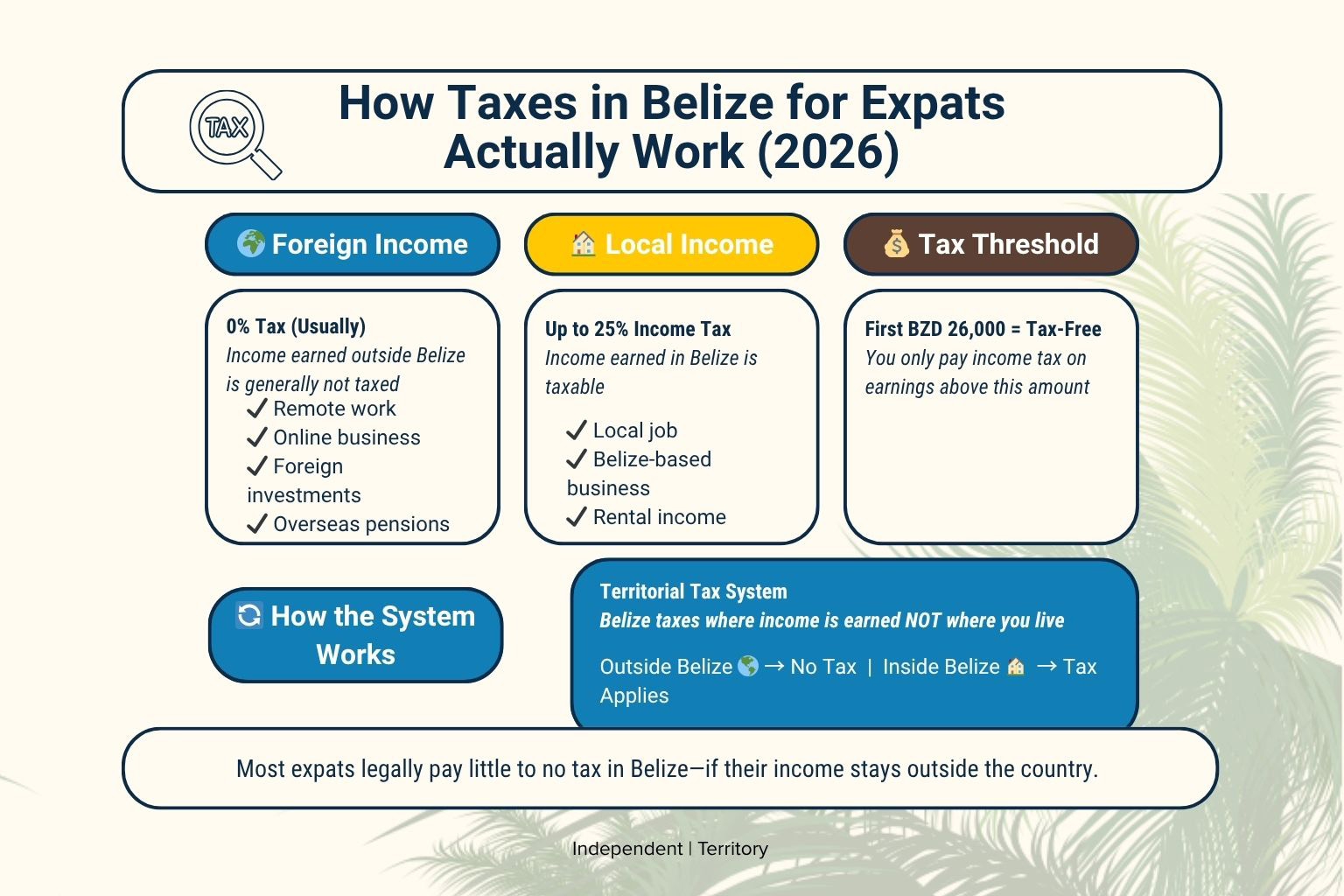
A simple breakdown of taxes in Belize for expats, including foreign income, local tax rates, and how the territorial system works.
Territorial Taxation in Belize for Expats Explained Simply
Think of it like this:
- If the money is made outside Belize → Belize doesn’t usually tax it
- If the money is made inside Belize → it may be taxed
This is what makes Belize attractive for digital nomads and retirees. You are essentially taxed based on economic activity inside the country, not your citizenship or worldwide income.
What Counts as Belize-Sourced Income for Expats
Understanding what qualifies as local income is critical.
You are typically taxed if you earn income from:
- Employment with a Belize-based company
- Running a local business in Belize
- Providing services physically in Belize
- Rental income from property in Belize
Examples:
- Working in a Belize café or resort → taxable
- Owning a local tourism business → taxable
- Renting out a Belize property → taxable
This is the foundation of income tax Belize expats need to understand. For example, running a business locally in places like Belmopan or Punta Gorda would typically fall under Belize taxation.
What Expats Actually Pay in Taxes in Belize (Real Examples)
Let’s break this down into real-life expat scenarios.
Taxes in Belize for Expats Working Remotely for Foreign Companies
This is the most common situation for modern expats. Most digital nomads and remote workers generally pay zero Belize income tax on their foreign salary. As long as the work is performed for a non-Belize entity and the income is not sourced locally, it remains untaxed in Belize.
However, your tax obligations in your home country may still apply (for example, US citizens are still taxed globally). If you’re earning online, see our full breakdown of working remotely from Belize to understand how income, visas, and daily logistics actually work.

Cafes and bakeries in Belize are popular spots for remote work and daily life.
Taxes in Belize for Expats Running a Local Business
If your business operates inside Belize, you fall under local taxation rules.
The standard personal income tax rate is 25% (above the BZD 29,000 [USD $14,500] threshold). Self-employed individuals and companies may also pay Business Tax based on turnover (rates typically range from 1.75% to 19% depending on the industry).
There could be possible social security contributions depending on the business structure. This is where Belize becomes less “tax-free paradise” and more standard small-country tax system.
Taxes in Belize for Retired Expats
Retirees are one of the largest expat groups in Belize. Foreign pensions and retirement income are generally not taxed in Belize.
Common situations:
- Foreign pension income → usually not taxed locally
- Overseas investments → typically not taxed in Belize
- Local income (if any consulting or business activity) → may be taxed
This is why Belize is often marketed as retirement-friendly—but again, only if your income is foreign-sourced. If you’re relying on a pension, read our full breakdown of retiring in Belize in 2026 before deciding.
Taxes in Belize for Expats Earning Rental Income
Rental income from Belize property is considered local income and is taxable at the standard 25% rate (after the exemption threshold).
This includes:
- Renting long-term housing
- Airbnb or short-term rentals
- Commercial property leasing
Rental income in Belize is generally taxable under local rules. Where you buy matters—see the best places to live in Belize to understand which areas make sense for investment.
Does Belize Tax Foreign Income for Expats?
Generally, no. This is one of the biggest advantages of the system. Belize does not tax offshore income, foreign pensions, investment returns, or remote work earnings paid by overseas companies.
Important nuances:
- Your residency status still matters for other obligations.
- Tax treatment depends on where income is generated
- Physical presence in Belize can affect classification
- Earning money from local clients or employment can trigger taxation.
This is often referred to in discussions about offshore income Belize strategies, but it is not a loophole—it is simply how territorial taxation works. For more details on how territorial taxation works for Americans, see territorial tax system details from Taxes for Expats.

Remote work in Belize often blends lifestyle with income flexibility.
Other Taxes in Belize for Expats You Should Know About
Even if income tax is limited, there are other taxes worth understanding.
Property Taxes in Belize: Property taxes are relatively low compared to the US or Europe and are based on the unimproved value of land. Rates vary by municipality.
Capital Gains Tax: One of the reasons investors look at Belize is:
- No standard capital gains tax on most assets
This can make property and investment strategies more attractive compared to high-tax jurisdictions. You can learn more about property tax calculations and the absence of capital gains tax in this Belize property tax and capital gains information guide.
Import Duties and Consumption Taxes
Belize charges a General Sales Tax (GST) of 12.5% on most goods and services. Import duties can be high on certain items. So, while income tax may be limited, everyday goods can be affected by import pricing.
Taxes in Belize can be low—but only if your setup is right. Most expats get this wrong because they don’t understand how residency, income type, and location all connect. → Get the Latin America Residency Map to compare Belize with other countries offering territorial taxation and easier pathways to residency.
Taxes in Belize for Expats vs Other Tax-Friendly Countries in Latin America
To understand Belize properly, it helps to compare it with other expat destinations.
| Country | Foreign Income Taxed? | Top Local Income Tax Rate | Simplicity | Best For | Cost of Living |
| Belize | No | 25% | High | Remote workers, retirees, English-speakers | Medium |
| Panama | No | 25% | High | Business owners, investors | Medium-High |
| Costa Rica | No | 25–30% | Medium | Nature lovers, families, healthcare | Medium-High |
| Nicaragua | No | 30% | Medium | Budget-conscious expats, adventurers | Low |
| Paraguay | No | 10% | High | Low-tax seekers, South America | Low |
Belize stands out for its Caribbean coastline, straightforward rules, and English-speaking environment, but it’s always smart to compare options. Find out how Belize compares to other territorial tax systems across Latin America.
Panama offers more developed infrastructure and banking, while Costa Rica appeals with its stability and eco-lifestyle. Nicaragua is often the most affordable option but comes with higher perceived political and infrastructure risks. Paraguay remains attractive for those wanting very low overall taxes in South America.
Key difference:
- Belize → simple territorial system, smaller economy
- Panama → more structured and financially developed
- Others → hybrid systems with more complexity
This is why Belize is often chosen for simplicity over optimization complexity.
Common Mistakes Expats Make With Taxes in Belize
Many expats misunderstand how the system actually works.
Here are the most common mistakes:
- Assuming Belize means “no taxes at all”
- Confusing tax residency with immigration residency
- Not separating foreign vs local income properly
- Ignoring home country tax obligations
- Misunderstanding how worldwide tax systems (US/Canada/EU) still apply
Even if Belize doesn’t tax you, your home country might. Many of these mistakes come from misunderstanding daily realities—read our guide on safety in Belize for expats to get a clearer picture.
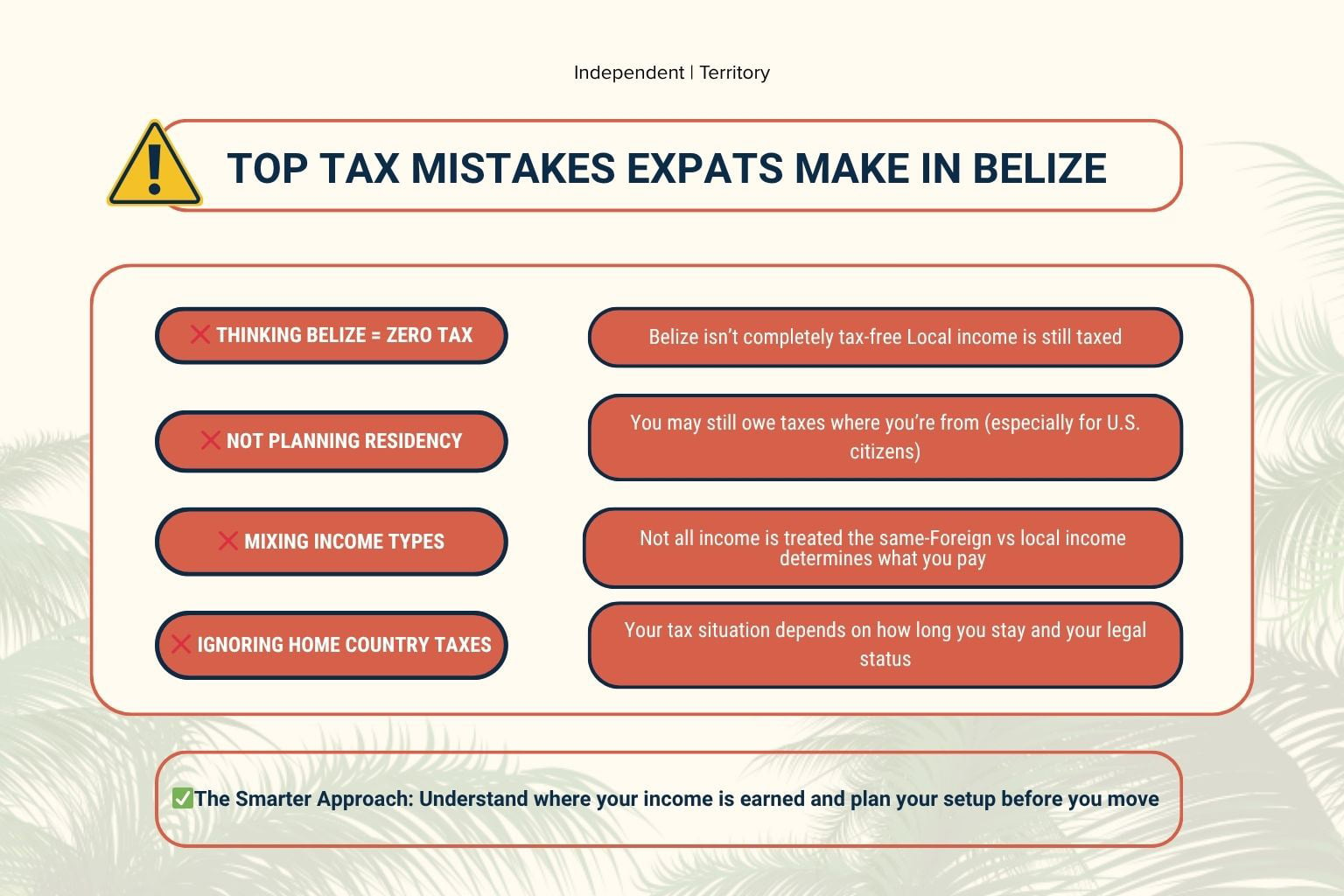
Avoid common mistakes that can lead to unexpected taxes in Belize.
Do Expats Need a Tax Advisor in Belize?
It depends on your situation.
You may NOT need one if:
- You only earn foreign remote income
- You are retired with simple pension income
- You have no local business activity
You SHOULD consider one if:
- You own a business in Belize
- You invest in local property
- You have mixed income sources
- You are structuring residency + income planning
In practice, many expats start simple—but complexity increases over time.
Tax Residency in Belize for Expats – Who Qualifies?
Tax residency is not always the same as immigration residency.
You are generally considered a tax resident if you spend 183 days or more in Belize during a calendar year. Many expats also apply through the Qualified Retirement Program (QRP) for additional benefits. As well as:
- Having economic ties in the country
- Earning local income
However, Belize is not as rigidly defined as larger tax jurisdictions. For official rules and updates contact the Belize Tax Service Department.
If you’re planning to stay long term, your tax situation ties closely into residency—see Belize permanent residency 2026 requirements.

Belize tax returns are typically due by March 31 each year.
Filing Requirements and Deadlines for Taxes in Belize
For individuals with taxable Belize income:
- Filing deadline is typically March 31
- Required only if you have taxable local income
- Remote foreign income earners often have no local filing requirement
For the most accurate information, always check the Belize Tax Service Department official guidelines.
Are Taxes in Belize for Expats Actually Low or Misunderstood?
Belize is genuinely tax-friendly for the right people — especially those with primarily foreign income.
But the reality is more precise:
- It is not completely tax-free.
- It is territorial-based
- It is simple compared to many countries
- It is most beneficial for foreign-income earners
- Local earnings are taxed
- Compliance still matters.
Misunderstandings happen when people assume:
“No tax on foreign income = no tax at all”
That is not accurate.
Belize might look simple on paper—but your outcome depends entirely on how you structure your move. If you’re serious about finding the best place in Latin America to live, reduce taxes, and stay independent, don’t guess.
→ Download the Latin America Residency Map and see which countries actually make sense for your situation—before you commit.
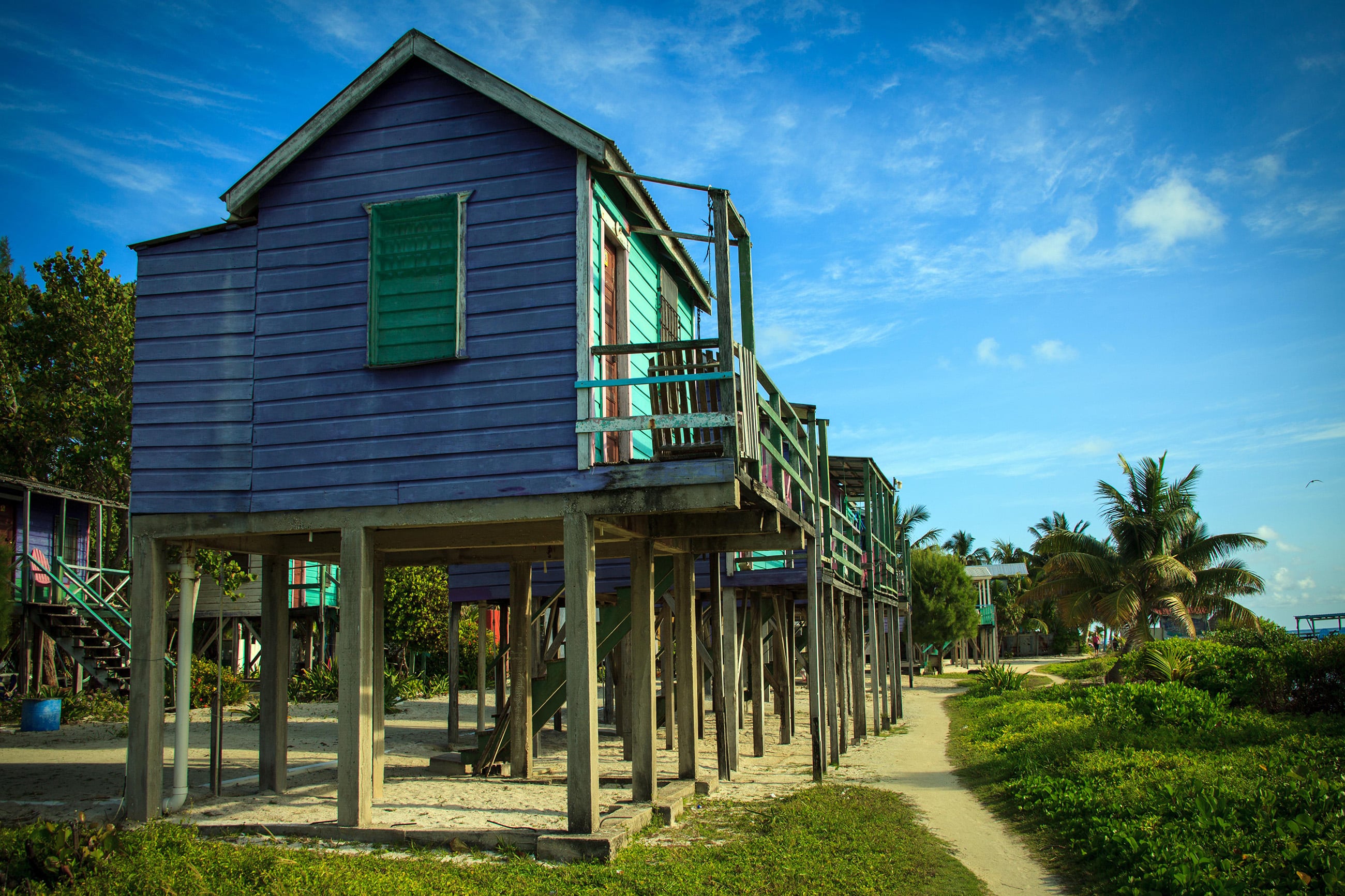
Coastal properties in Belize attract expats, retirees, and investors.
Final Thoughts on Taxes in Belize for Expats
Belize offers one of the simpler and more expat-friendly tax systems in the region thanks to its territorial tax approach. Most foreign income — including remote work pay, pensions, investments, and offshore earnings — is generally not taxed locally.
That said, it is not a complete tax-free paradise. Local earnings are taxed at 25% above the BZD 29,000 (USD $14,500) threshold.
Belize works especially well for:
- Remote workers paid by foreign companies
- Retirees living on overseas pensions and savings
- Digital nomads and straightforward offshore income earners
The key to success is understanding the taxes in Belize for expats: the difference between residency and source of income, and staying on top of your obligations. Belize is not a tax-free paradise—but it is a simple, territorial tax system that can significantly reduce tax exposure for the right expat profile.
American expats should note that while Belize does not tax most foreign income, the US still taxes citizens on worldwide income. For more information, read this guide on US tax obligations for Americans in Belize.
Not sure where you qualify for residency yet? The Latin America Interactive Residency Map helps you to see residency options across the region so you can quickly make an informed decision.
Still deciding if Belize is right for you?
Start here:
- Want more independence? Explore practical locations in our guide to self-reliant living in Belize.
- Healthcare can change the equation—see what to expect in healthcare in Belize for expats.
- Taxes are only part of the story—compare real numbers in cost of living in Belize vs Mexico.
FAQs About Taxes in Belize for Expats
Do expats pay tax in Belize or not?
Yes—but only in specific situations. Under the Belize tax system, expats typically pay tax on income earned within Belize. This includes local employment, business income, or rental income from property in Belize. Foreign-sourced income—such as remote work, pensions, or investments earned outside the country—is generally not taxed locally.
Is Belize tax-free for foreigners?
No, Belize is not completely tax-free for foreigners. However, it uses a territorial tax system, which means most foreign income is not taxed in Belize. This creates a low-tax environment for expats who earn money outside the country, but local income is still subject to income tax.
Does Belize tax remote workers?
In many cases, no. If you’re a remote worker earning income from clients or employers outside Belize, that income is typically not taxed locally. This is one of the main reasons Belize is attractive to digital nomads and online entrepreneurs. However, if your work is considered locally sourced or tied to Belize-based clients, it may be taxable.
Do retirees pay tax in Belize?
Most retirees pay little to no tax in Belize, especially if their income comes from foreign pensions, investments, or savings. Since this income is usually sourced outside Belize, it is not taxed locally. However, retirees who generate income in Belize—such as through property rentals or a local business—may still have tax obligations.
Download our Latin America Interactive Residency Map to help you see your residency options across the region!
Important Disclaimer: This article “ Taxes in Belize for Expats” is for informational and educational purposes only. It is not professional, legal, financial, or tax advice. Tax laws change frequently and individual circumstances vary. Always consult a qualified tax advisor, accountant, or attorney licensed in Belize (and your home country) before making any decisions. Independent Territory is not responsible for any actions taken based on this content.