

19 min read
Nicaragua is attracting more expats, remote workers, and freedom-seekers looking for a simpler, lower-cost lifestyle in Latin America. But no matter how appealing the setting is, one factor quietly shapes your entire experience—reliable internet. Whether you’re working or managing daily life, understanding internet in Nicaragua is essential before considering a move.
……………………………..
You’re on a Zoom call in Granada. Everything’s going smoothly—until the screen freezes. A few seconds later, the power cuts… again.
If that scenario makes you pause, it should.
Internet in Nicaragua has improved more than most people realize.
Since 2022, fiber and broadband have expanded across major cities like Managua, Granada, and León. Speeds today are far better than they were just a few years ago, and in the right areas, you can run a remote business, take calls, and stay productive without major issues.
But here’s the part most guides gloss over: reliability still lags behind countries like Mexico or Costa Rica. And in many cases, the real problem isn’t the connection itself—it’s the infrastructure behind it.
So, what should you actually expect?
The truth is, internet in Nicaragua is workable for many remote workers—but only if you choose the right location, set up backups, and adjust your expectations. Go in blind, and you’ll struggle. Plan properly, and it can absolutely work.
If you’re considering the move, this guide breaks down everything you need to know—real speeds, real costs, and where internet works (and where it doesn’t).
If you’re still deciding whether the country fits your lifestyle overall, start with this complete breakdown of living in Nicaragua as an expat.
Table of Contents
Quick Answer: Is the Internet in Nicaragua Good Enough in 2026?
Yes—internet in Nicaragua is good enough for remote work in 2026, but reliability depends heavily on location and setup.
- Major cities (Managua, Granada, León): Fiber speeds of 50–200+ Mbps are common and reliable for most remote work.
- Beach & rural areas: Speeds typically range from 10–50 Mbps, with more frequent drops and instability.
- Overall performance: Mid-tier in Latin America, with average fixed speeds around 90–116 Mbps.
- Best for: Freelancers, remote workers, and those with flexible or async schedules.
- Not ideal for: Jobs requiring constant uptime, live streaming, or latency-sensitive work.
But that’s the simplified version—the reality of internet in Nicaragua depends on where you live, how you set it up, and what you actually need it for. For a broader view of what living here is really like, see this guide to the pros and cons of living in Nicaragua.

Remote work in Nicaragua often means outdoor setups—but connection quality can vary more than you’d expect.
Can You Work Remotely from Nicaragua Day-to-Day?
Yes—but only if you understand how WiFi in Nicaragua actually behaves in real life.
A typical workday here isn’t defined by speed alone.
It’s defined by consistency.
Let’s say you’re based in Granada or Managua. You start your morning with emails, Slack messages, and light browsing—everything works smoothly. Fiber connections in major cities can easily handle this kind of workflow, and for a few hours, you might forget you’re working from a developing country.
Then comes your first Zoom call.
If everything holds, no problem. But this is where cracks can start to show. Upload speeds fluctuate, latency spikes, or in some cases, the call drops entirely. And if the power cuts—even briefly—your connection goes with it.
That said, it’s not all negative.
When you’re in the right area, with a solid provider and a backup plan (usually mobile data), remote work in Nicaragua can feel surprisingly normal. Many freelancers, consultants, and async workers operate here without major issues—especially those who don’t rely on constant live communication.
If your work is flexible, project-based, or doesn’t depend on being online every second, Nicaragua is absolutely workable.
But if you’re in back-to-back meetings, managing live teams, or running anything that requires uninterrupted uptime, you’ll need to think carefully about your setup—and your location.
This is why choosing where to live matters more than almost anything else. Some areas perform consistently, while others don’t.
The bottom line: working remotely from Nicaragua isn’t about having perfect internet—it’s about knowing what to expect, planning for disruptions, and building a setup that works around them.
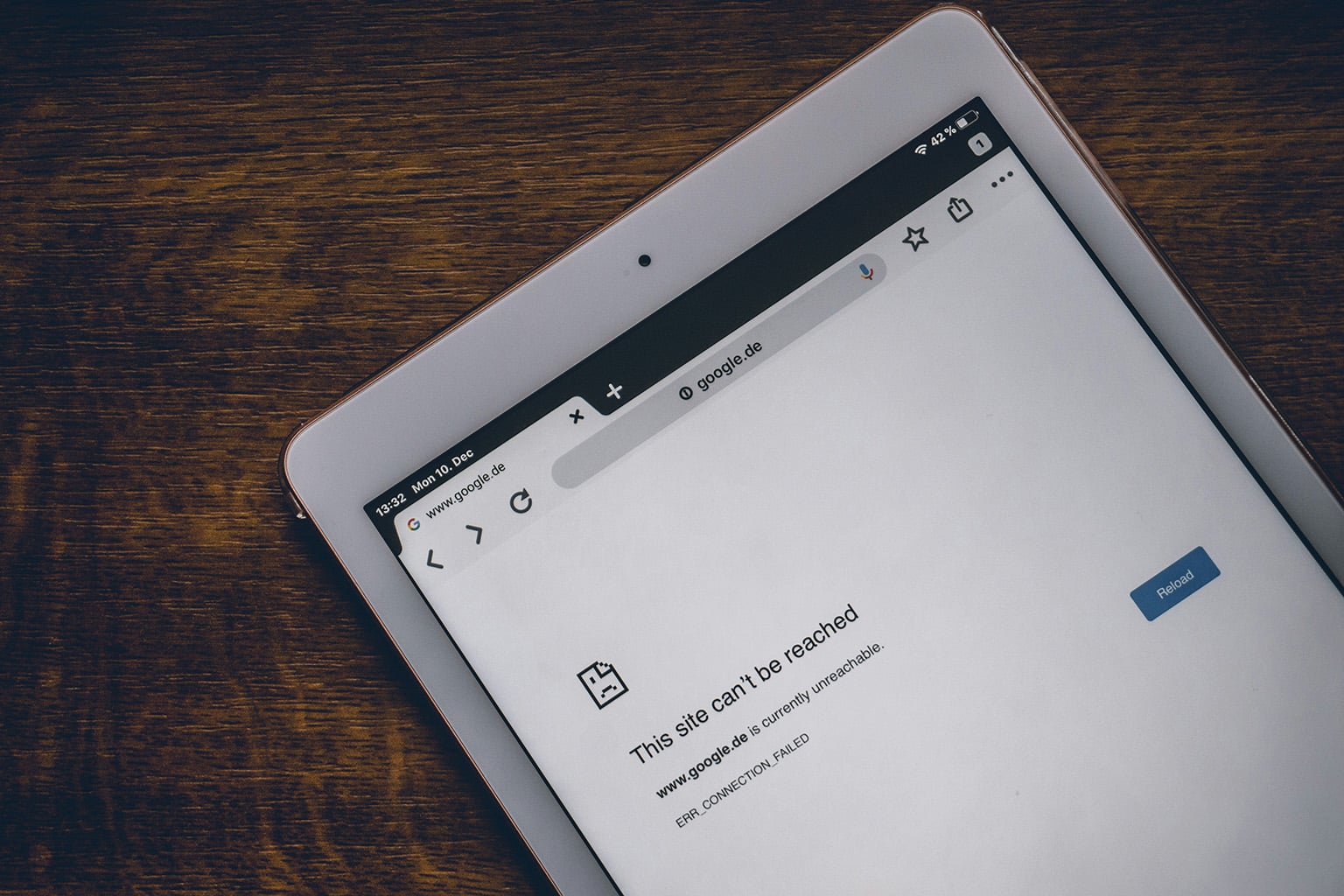
The real question isn’t speed—it’s consistency. Internet reliability in Nicaragua can be hit or miss depending on location.
Is Internet In Nicaraguay Reliable In 2026?
Short answer: internet reliability in Nicaragua is inconsistent—and it has less to do with your provider than you might think.
In major cities, connections are generally stable during the day, especially on fiber. But reliability drops when you factor in real-world conditions: peak usage hours, weather, and—most importantly—power infrastructure.
The World Bank Digital Development Overview highlights how infrastructure gaps and uneven investment continue to impact internet reliability across developing regions like Nicaragua.
You’ll notice patterns quickly.
Speeds slowdown in the evenings when more people are online. During the rainy season, connections can become less stable. And in smaller towns or coastal areas, outages—both internet and power—are simply part of the experience.
The Real Issue Isn’t Internet—It’s Power
This is the part most people misunderstand.
In many cases, internet in Nicaragua isn’t failing—the electricity is.
When the power cuts, your modem, router, and local network infrastructure go down with it.
According to the International Energy Agency (IEA), electricity infrastructure challenges remain a key factor affecting overall connectivity across the country.
In practical terms, this means even a fast fiber connection won’t save you from interruptions if your area experiences unstable power. This is especially common outside Managua and in more rural or coastal regions.

At-home setups are where internet in Nicaragua matters most—this is the reality many expats navigate daily.
Real-World Uptime (What Expats Experience)
So how reliable is internet in Nicaragua day-to-day?
In cities like Managua, Granada, and León, many expats report mostly stable connections with occasional interruptions—typically short outages or brief slowdowns rather than full-day disruptions.
But consistency varies by neighborhood and provider:
• Some areas experience near-daily micro-outages
• Others run smoothly for days, then drop unexpectedly
• Upload speeds (not download) are often the weak point
This lines up with broader regional data from Speedtest Global, which places Nicaragua in the mid-tier globally for fixed broadband performance—decent speeds, but not top-tier consistency.
Backup Solutions (What Actually Works)
If you’re serious about working remotely here, you need a backup plan—it’s not optional.
Here’s what experienced remote workers rely on:
- Mobile data (Claro/Tigo): Your first line of defense during short outages
- UPS (battery backup): Keeps your router running during brief power cuts
- Dual connections: Some setups combine home internet + mobile hotspot
- Satellite internet (Starlink): A premium option for more remote areas, though still dependent on power
None of these are perfect—but combined, they dramatically reduce downtime.
Bottom Line on Reliability: Internet reliability in Nicaragua is good enough for many remote workers—but only if you understand the trade-offs.
If you expect the same stability as the U.S. or Europe, you’ll be frustrated.
But if you plan for occasional disruptions, choose your location carefully, and build in redundancy, you can maintain a consistent workflow. This is the difference between struggling here—and making it work.

Signal strength can vary dramatically—even within the same neighborhood. Testing speeds becomes part of the routine.
Internet Speeds in Nicaragua – Advertised vs. What You Actually Get
When researching Nicaragua internet speed, you’ll often see impressive, advertised speeds from providers — but the real-world experience is more nuanced. The gap between marketing and performance is where most remote workers either succeed or struggle.
In 2026, the median fixed broadband speed in Nicaragua is around 96–116 Mbps download, with upload speeds typically between 22–40 Mbps. This puts Nicaragua at about 69th in the world for fixed home internet Speedtest Global Index, April 2026 data.
Across urban areas, internet speeds in Nicaragua fall into a solid mid-range bracket by Latin American standards. In practice, this is enough for most remote work tasks — but consistency matters more than peak speed.
Typical Internet Plans in Nicaragua (2026)
| Provider | Typical Download Speed | Upload Speed | Notes |
| Claro Nicaragua | 30–200 Mbps | 10–50 Mbps | Widely available in cities, good mobile backup |
| Tigo Nicaragua | 30–150 Mbps | Moderate | Often edges out Claro on fixed speeds in cities |
| Telecable | 50–200 Mbps | Better upload | Smaller coverage footprint |
| WiFiNic / Local | 20–100 Mbps | Varies widely | Highly location-dependent |
Tigo frequently hits higher average fixed speeds in urban areas, while Claro generally performs better for mobile coverage and reliability as a backup.
In real-world use, broadband in Nicaragua often performs well for browsing, streaming, and video calls—but upload speed is where limitations usually appear.
Major providers like Claro and Tigo dominate the market, with limited competition—a factor that often impacts service quality and pricing, as noted in reports from BuddeComm Telecom Research.
Why Upload Speed Matters More Than You Think
Most people focus on download speed, but for remote workers, upload speed is the real bottleneck.
If you’re doing any of the following:
- Zoom or Google Meet calls
- Uploading large files to Google Drive or Dropbox
- Sending video content or working in cloud-based tools
Then upload stability matters more than headline Mbps numbers.
In many parts of Nicaragua, download speeds can look strong on paper, but upload consistency may fluctuate—especially during peak hours.
Speeds You Actually Need for Remote Work
To put Wi-Fi speed in Nicaragua into perspective, here’s what different workloads typically require:
- Basic remote work (email, docs, browsing): 5–10 Mbps
- Zoom/video calls (HD): 10–20 Mbps stable connection
- Cloud work (Google Drive, Notion, SaaS tools): 20–50 Mbps recommended
- Content creation / video editing uploads: 50+ Mbps upload preferred
- 4K streaming or heavy media work: 25–50 Mbps+ with stable latency
The key isn’t maximum speed—it’s consistent performance during peak hours.
To see how internet speed in Nicaragua compares to other countries read the country rankings by the World Population Review.
Pro Tip: Always Test Before You Commit: One of the most common mistakes expats make is signing long-term contracts without testing real-world performance.
Before locking in a provider:
- Test speeds at different times of day
- Check upload consistency (not just download)
- Ask locals or landlords about reliability in that specific building or street
- Use mobile hotspot as a comparison baseline
This is especially important in cities where infrastructure can vary block by block.
Reality Check: While internet speeds in Nicaragua are improving year over year, performance is still highly localized. Two apartments in the same city can have completely different experiences depending on infrastructure access and provider coverage.
If you’re comparing locations, this guide on where expats live in Nicaragua can help you understand how infrastructure varies between neighborhoods and cities.
Bottom Line: On paper, Nicaragua offers competitive broadband speeds for the region. In practice, the experience depends far more on provider choice, location, and setup quality than advertised plans. Tigo tends to deliver stronger fixed-line performance in cities, while Claro is the safer choice when you need dependable mobile backup.
If you’re thinking long-term, use the free Latin America Residency Map to see where you qualify for residency across the region.

The real cost of internet in Nicaragua goes beyond the monthly bill—equipment, installation, and backups all add up.
Cost of Internet in Nicaragua in 2026
If you’re researching the cost of internet in Nicaragua, here’s the honest answer — it’s one of the few places left in Latin America where you can still get functional, work-capable internet at a low monthly cost.
In 2026, most expats and remote workers’ pay:
- $25–$55/month for decent fiber or high-speed broadband in major cities
- $50–$80/month in smaller cities or less competitive areas
- $80+/month for premium or backup solutions (like satellite)
That puts internet providers in Nicaragua firmly on the affordable end of the spectrum — especially compared to North America or even parts of Mexico and Costa Rica.
Typical Internet Plans in Nicaragua (2026)
| Provider | Speed Range | Monthly Price | Best For |
| Claro | 40–300 Mbps | $25–$55 | Urban users, stable fiber areas |
| Tigo | 30–200 Mbps | $25–$50 | Budget users, general browsing |
| Tele cable | 50–150 Mbps | $30–$60 | Regional coverage |
| WifiNic | 10–50 Mbps | $20–$40 | Rural & backup connections |
Speeds and pricing vary significantly by neighborhood — always verify locally.
Compared globally, data from Numbeo Cost of Living Database suggests Nicaragua remains one of the more affordable countries for internet services, though lower prices often reflect lower speeds and infrastructure limitations.
Hidden Costs Most People Miss
This is where a lot of “inexpensive internet” stories fall apart.
Before you sign anything, factor in:
| Installation fees | Typically, $30–$100 depending on provider |
| Contracts | Some providers lock you in for 6–12 months |
| Router rental or purchase | Sometimes included, sometimes not |
| Speed throttling clauses | Especially on lower-tier plans |
And here’s the big one—service quality is location-dependent, not just provider-dependent. Two people using the same plan in different neighborhoods can have completely different experiences.
Best For / Not For
| Category | Verdict |
| Remote workers (basic–moderate use) | ✅ Strong value |
| Digital nomads on a budget | ✅ Very attractive |
| Video editors / heavy upload users | ⚠️ Possible, but requires planning |
| People needing 100% uptime | ❌ Not ideal without backup setup |
The Reality Check: Nicaragua’s internet sits in a very specific position: It’s not the fastest—but it’s one of the cheapest places in Latin America where remote work is still viable.
That’s the trade-off.
You’re not coming here for world-class infrastructure—you’re coming for cost efficiency, flexibility, and lifestyle arbitrage. And if you structure your setup properly (as covered in the reliability section), it works.
How This Fits Into Your Overall Cost of Living
Internet is just one piece of the equation—but it’s an important one if you’re working online.
When you combine low internet costs with affordable rent, food, and transport, Nicaragua becomes one of the few places where you can still build a low-cost, location-independent lifestyle without constantly compromising.
Pro Insight: Price Isn’t the Risk—Assumptions Are: Most people don’t fail in Nicaragua because of internet cost.
They fail because they assume:
• Cheap = reliable
• Or worse—cheap = the same as back home
Neither is true.
The system works—but only if you understand how it actually functions on the ground.
Bottom line: The cost of Wi-Fi in Nicaragua is not the barrier — it’s one of the biggest advantages. Most people pay $25–$55/month for usable fiber connections in the main cities.
Internet is just one piece of the puzzle—see how it fits into the full cost of living in Nicaragua.
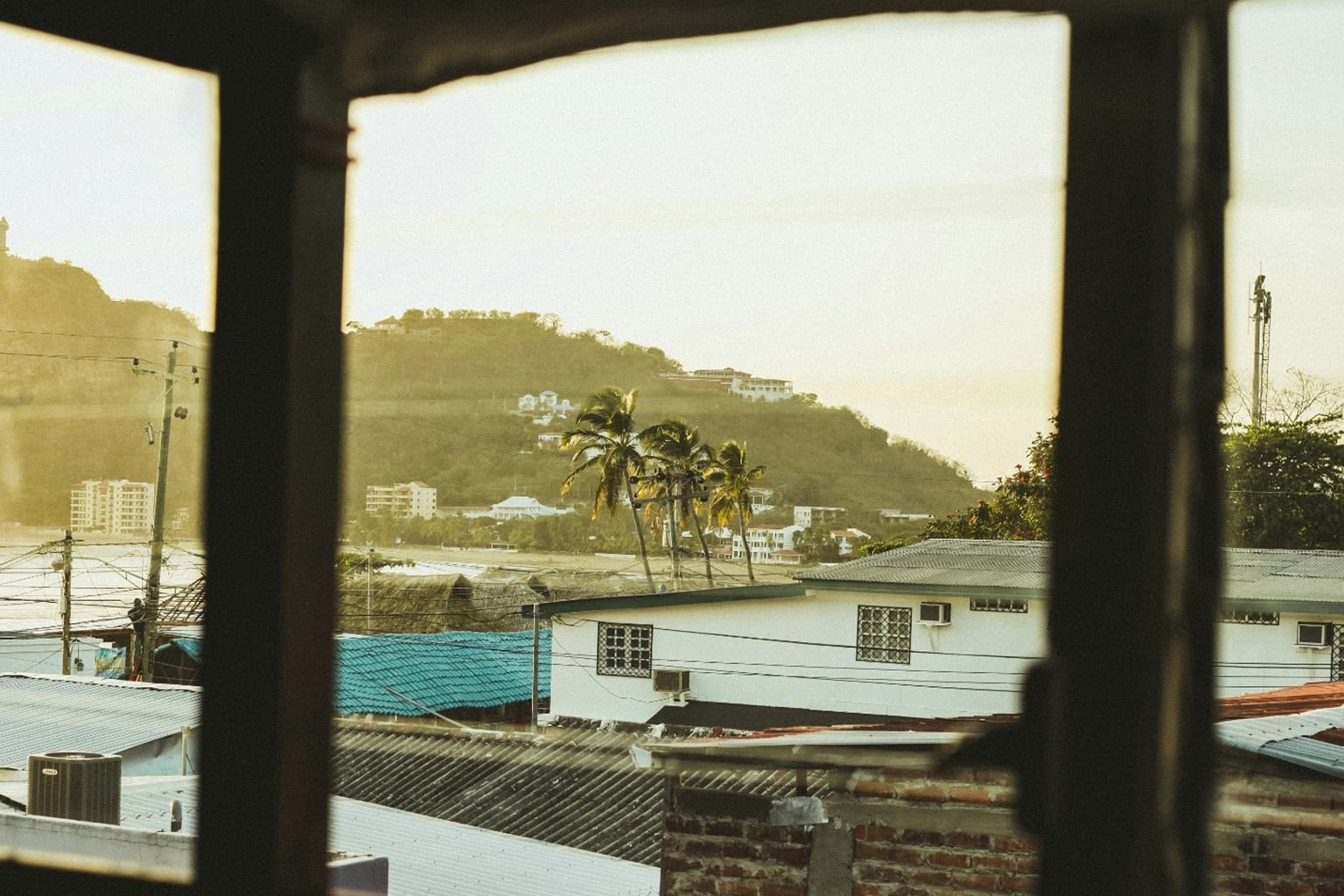
Infrastructure varies street by street—your exact location determines your internet experience in Nicaragua.
Best Places in Nicaragua for Fast & Reliable Internet
If you’re searching for the best internet in Nicaragua, the answer isn’t just about providers—it’s about location.
Infrastructure varies massively across the country. Two people paying for the same plan can have completely different experiences depending on where they live.
So, if you want to live in Nicaragua with good internet, this breakdown matters.
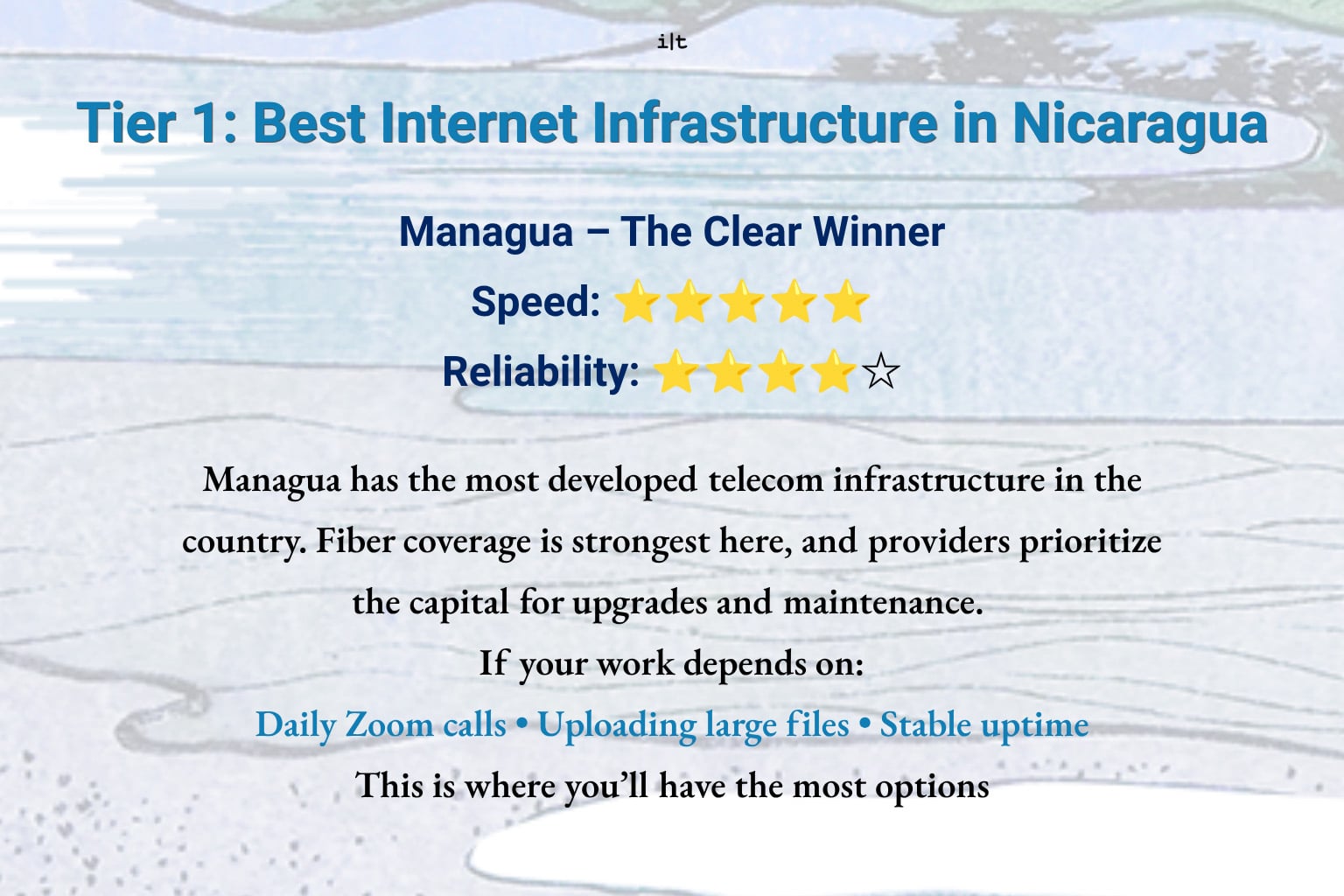
Tier 1 locations offer the most reliable internet in Nicaragua, with better fiber access and faster speeds.
Read our guide to the best places to live in Nicaragua for expats to find top expat communities and reliable Wi-Fi hubs like Managua.
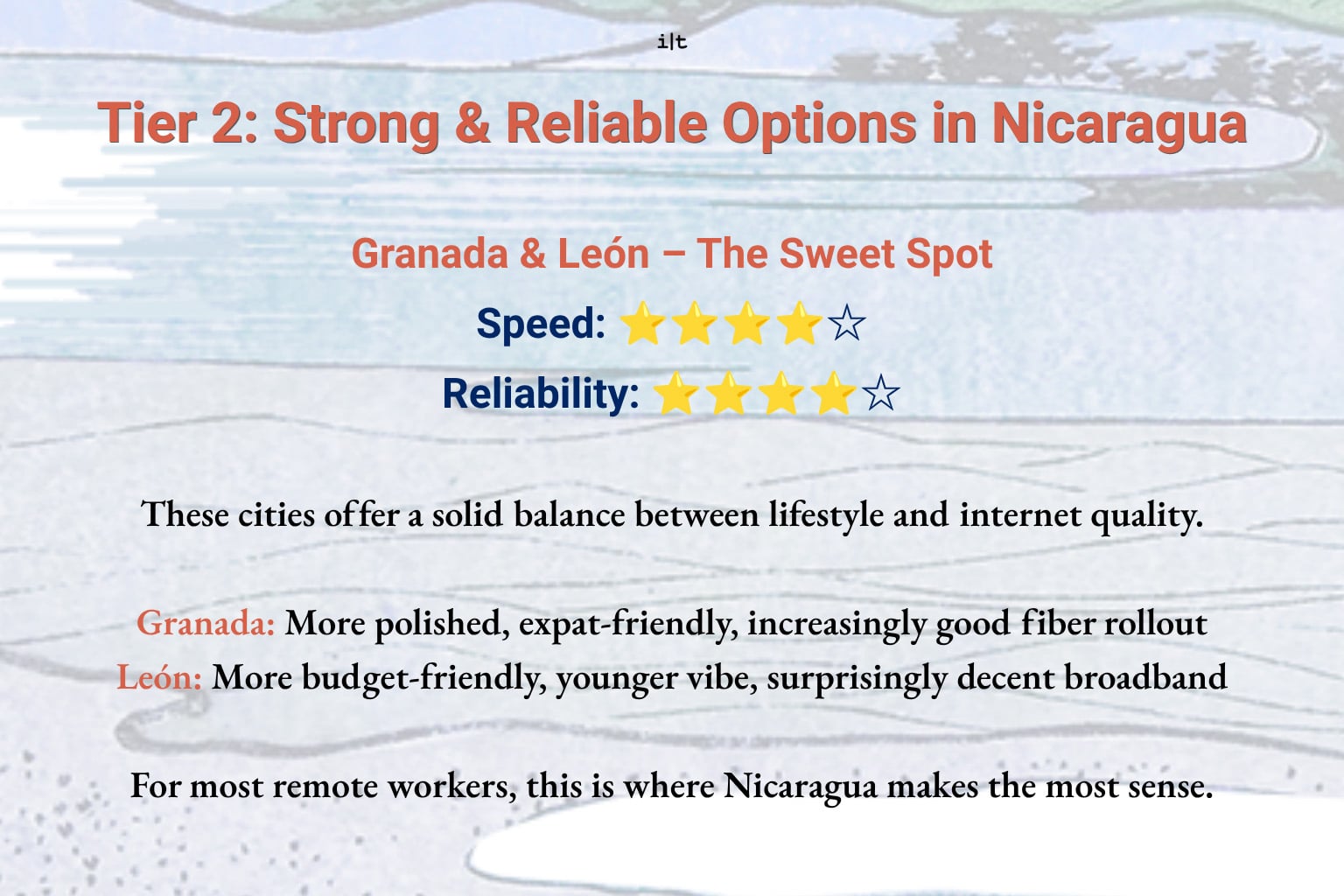
Tier 2 areas provide solid internet options—but reliability can still depend on your exact setup.
Colonial cities offer a different pace of life—this guide to León vs Granada Nicaragua 2026 breaks it down.
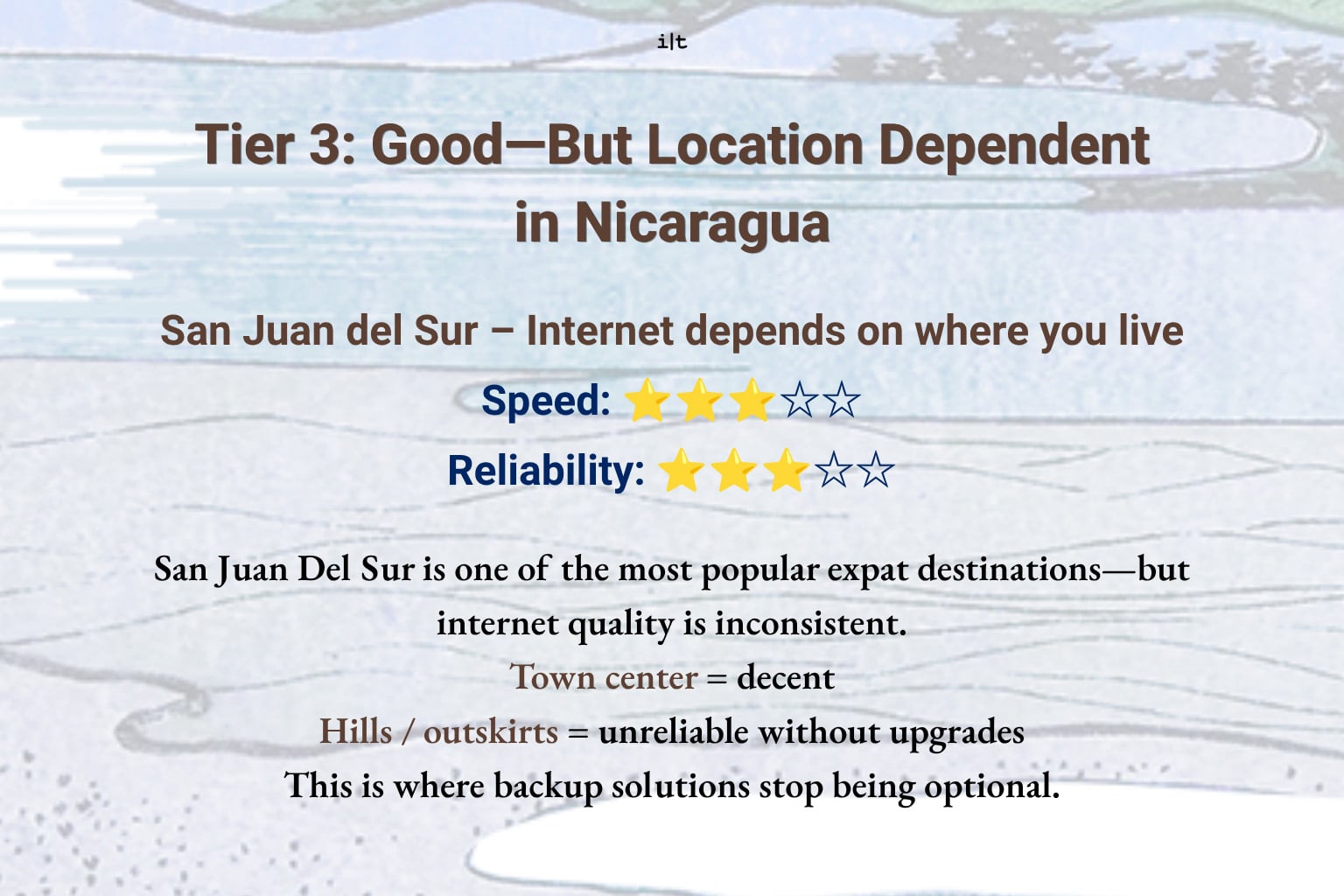
In Tier 3 areas, internet quality in Nicaragua becomes highly location-dependent—and backup plans are essential.
If you’re considering coastal life, here’s a full breakdown of living in San Juan del Sur Nicaragua.
Emerging Areas: Improving Fast: Fiber expansion is slowly reaching more parts of Nicaragua.
Areas outside the main cities—especially along key development corridors—are starting to see:
• Better speeds
• More competition between providers
• Gradual reliability improvements
But right now, these are still early-stage options, not guaranteed setups for remote work.
Quick Picks Based on Your Work Style
This is where most people overthink things—so here’s the shortcut:
- Best for video calls and stability → Managua
- Best balance of lifestyle + internet → Granada
- Best for budget + decent speeds → León
If you choose based on your work requirements first, you avoid 90% of the problems expats run into.
The Bottom Line: The best Wi-Fi in Nicaragua isn’t evenly distributed—it’s concentrated. If you pick the right city, you can work online without constant frustration.
Pick the wrong one, and you’ll spend your time troubleshooting instead of living.

Some areas are simply not built for reliable connectivity—this is where expectations need to shift.
Areas with the Worst Internet in Nicaragua (Honest Warnings)
If you’re researching bad internet in Nicaragua, this is the part most blogs either gloss over—or completely avoid.
The reality: not all of Nicaragua is viable for remote work.
Some areas still struggle with basic infrastructure, and if your income depends on being online, choosing the wrong location will cost you time, money, and opportunities.
Where Internet in Nicaragua Breaks Down
These areas are where rural internet in Nicaragua is the weakest:
- Rural interior areas (far from major cities)
- Caribbean coast (e.g., Bluefields, Puerto Cabezas)
- Small islands and remote coastal communities
- Mountain and off-grid properties
In these areas, you’ll often find:
- Limited or no fiber infrastructure
- Slower wireless or fixed internet options
- Frequent outages with slower response times
- Fewer providers—sometimes effectively a monopoly
Electricity reliability plays a major role in internet stability, and infrastructure challenges remain a factor across the country, as outlined by the International Energy Agency.
Why Internet Is Worse in These Areas: It comes down to three core issues:
1. Infrastructure Gaps: Fiber rollout is concentrated in major cities. Outside of that, networks are patchy or outdated.
2. Limited Competition: In some regions, you may only have one viable provider—which removes any pressure to improve service.
3. Geography & Weather: Remote terrain and heavy rainy seasons can disrupt already fragile connections.
When It’s Still Doable (With the Right Setup)
This is where most people get it wrong—bad internet doesn’t always mean impossible.
You can make these areas work if you’re intentional:
• Mobile hotspots (4G/5G where available) → Good for backup or light work
• Satellite internet (e.g., Starlink) → Expensive, but a game-changer in remote areas
• Dual-provider setups → Reduces downtime risk
But this requires planning—and accepting higher costs.

When the connection drops, adaptability matters—many expats rely on backup setups like mobile workspaces.
Reality-Based Scenarios (Don’t Skip This):
This is where you make the right decision—or regret it later:
- If you rely on daily Zoom calls → Avoid rural interiors and the Caribbean coast
- If you upload large files or do heavy cloud work → Avoid small towns and island locations
- If you need consistent uptime → Avoid anywhere without fiber access
- If you want a plug-and-play setup → Stick to Managua, Granada, or León
This isn’t about being negative—it’s about being accurate.
The Trade-Off Most People Underestimate
The areas with the worst internet in Nicaragua are often the most appealing on the surface:
- More nature focused locations
- Lower cost of living
- Fewer crowds
But you’re trading ease for remoteness—and that means your connection. Use this guide to help you understand where expats live in Nicaragua—and why most choose infrastructure over scenery.
The Bottom Line: Rural Nicaragua internet is improving—but it’s not there yet. If your lifestyle depends on being online, you need to be selective.
The mistake isn’t moving to Nicaragua: The mistake is choosing a location that doesn’t support the way you work. And that’s entirely avoidable if you go in with the right expectations.
Mobile hotspots are a key backup strategy when fixed internet in Nicaragua isn’t reliable.
Mobile Data & Hotspots as Backup in Nicaragua
If you’re working remotely, mobile internet in Nicaragua is not your primary solution—but it is your most important backup. When fixed broadband drops, mobile data is often what keeps you online.
Claro vs Tigo (Mobile Coverage in Nicaragua)
The two main providers for a SIM card in Nicaragua internet setup are Claro and Tigo.
- Claro Nicaragua: Generally better nationwide coverage and more consistent speeds in both cities and rural areas
- Tigo Nicaragua: Competitive pricing and solid urban performance, but slightly less consistent outside major zones
For most remote workers, Claro tends to be the safer default.
Data Plans, eSIMs & Short-Term Options
Mobile data in Nicaragua is relatively affordable:
- Prepaid SIM cards are usually available in cities
- Monthly data packages are low-cost compared to North America and Europe
- eSIM availability is improving, but physical SIMs are still more common for longer stays
For short-term stays, mobile data can be set up quickly and used immediately as a fallback connection.
Hotspot Performance: When It Actually Saves You
Mobile hotspots are not a replacement for fiber—but they are a critical safety net.
They work best for:
- Temporary power outages
- Backup during ISP downtime
- Light remote work (email, docs, messaging)
Can You Run a Full Workday on Mobile Data?
This is one of the most common hidden questions about mobile internet in Nicaragua.
Short answer:
- Yes — short-term emergency use
- You can get through a workday if your main internet goes down briefly.
- No — long-term replacement
- It is not stable or consistent enough to rely on full-time for remote work.
Mobile Connectivity Reality Check: According to the GSMA Mobile Connectivity Index, mobile internet access in countries like Nicaragua is widely available, but performance varies significantly depending on location, network load, and infrastructure quality.
In practical terms:
• Peak hours = noticeable slowdowns
• Cities = usable LTE coverage
• Rural areas = inconsistent signal and slower speeds
How to Get Internet Set Up in Nicaragua as an Expat
If you’re planning to live and work in Nicaragua, setting up home internet is usually straightforward—especially in cities.
Step-by-Step Setup Process
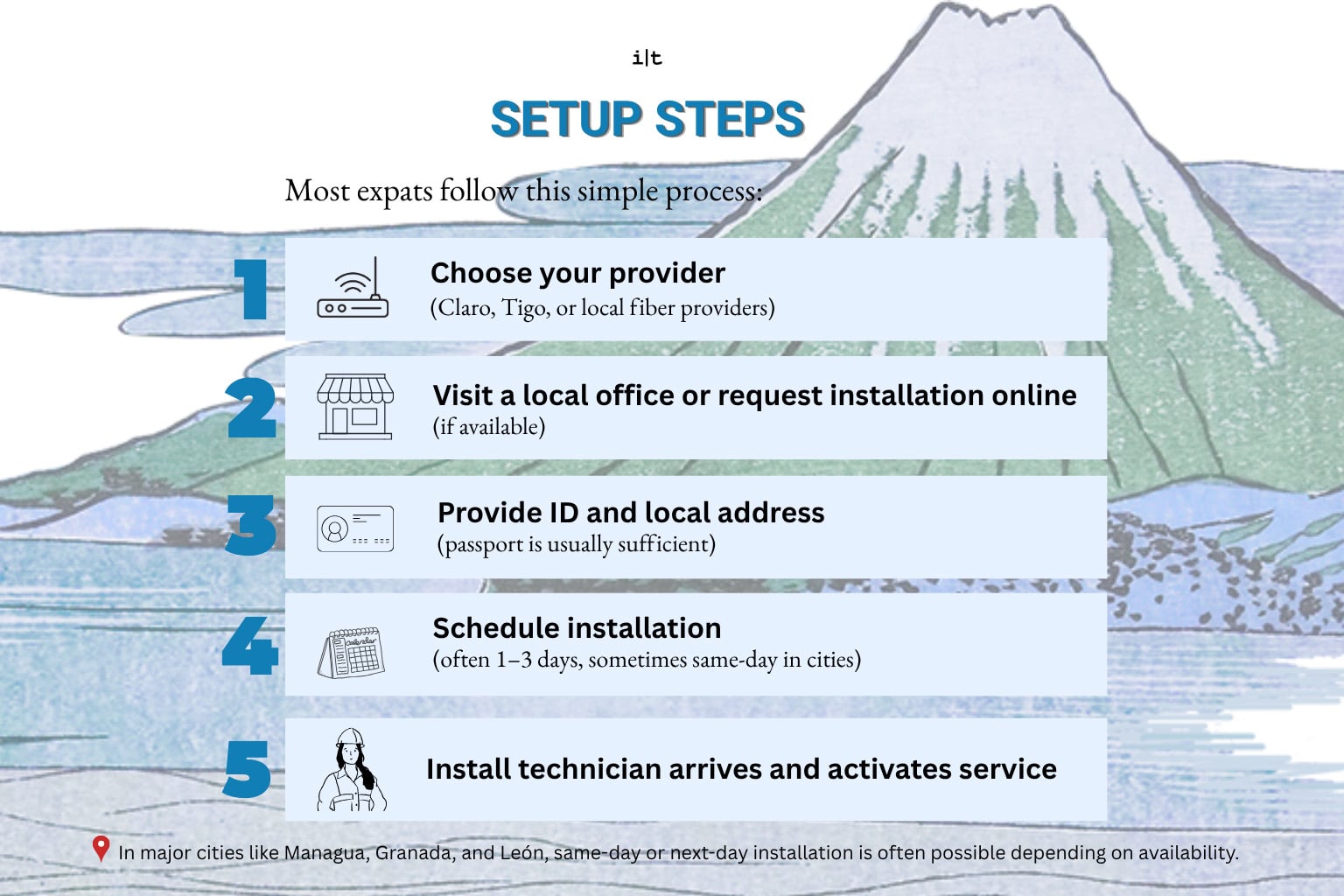
Setting up internet in Nicaragua is straightforward—but knowing the process saves time and frustration.
Choosing Between Internet Providers in Nicaragua
When comparing internet providers in Nicaragua, your decision usually comes down to:
- Coverage in your exact neighborhood
- Installation speed
- Stability vs price balance
- Local user feedback (this matters more than advertised speeds)
There is no “perfect” provider—only the best option for your specific location.
Tips for Digital Nomads (Important)—Before signing a lease or committing to a long-term setup:
- Ask landlords what internet provider is already installed
- Test actual speeds during peak hours if possible
- Prefer rentals with existing fiber connections
- Always confirm mobile coverage as backup in your area
This small due diligence step prevents most connectivity issues expats run into.
Before you sign a lease or commit long-term, use the Latin America Residency Map to see legal stay paths across 14+ countries, and compare your long-term options before choosing where to base yourself.
Internet in Nicaragua vs Other Latin American Countries (2026)
When comparing internet in Nicaragua vs Belize vs Paraguay, the difference comes down to one thing: cost vs consistency.
Nicaragua is one of the cheapest—but not the most reliable. According to data from Speedtest Global Index, internet speeds in Nicaragua remain significantly lower than in most of Latin America, especially outside major cities.
Quick Comparison (2026)
| Country | Speed (Avg) | Cost (Monthly) | Reliability | Best For |
| Nicaragua | 80–120 Mbps | $20–$50 | ⭐⭐⭐☆☆ | Budget remote workers |
| Paraguay | 100–200+ Mbps | $30–$70 | ⭐⭐⭐⭐☆ | Stability + value |
| Belize | 50–150 Mbps | $60–$120 | ⭐⭐⭐⭐☆ | English-speaking + consistency |
What This Means in Practice:
- Internet Nicaragua vs Paraguay: Paraguay is more consistent and better for uptime, but slightly more expensive.
- Internet Nicaragua vs Belize: Belize is more reliable in key areas, but significantly higher cost.
The Positioning: You’re trading reliability for cost—whether that’s worth it depends on your work. Nicaragua isn’t trying to compete on top-tier infrastructure. It wins on affordability.
- Lower monthly costs
- Lower overall cost of living
- Internet that’s “good enough” if you choose the right location
Bottom Line: If you need maximum reliability, Paraguay or Belize are safer bets. However, regional reports from Statista Digital Economy Data consistently rank countries like Chile and Mexico ahead of Nicaragua in both speed and network reliability. If you want the lowest cost entry point into remote living, and can tolerate some variability, Nicaragua is still one of the best value plays in Latin America.
What Expats Say About Internet in Nicaragua (Real Experiences)
The reality of internet in Nicaragua becomes much clearer when you look at how expats actually experience it day to day. The pattern is consistent: location matters more than anything else.
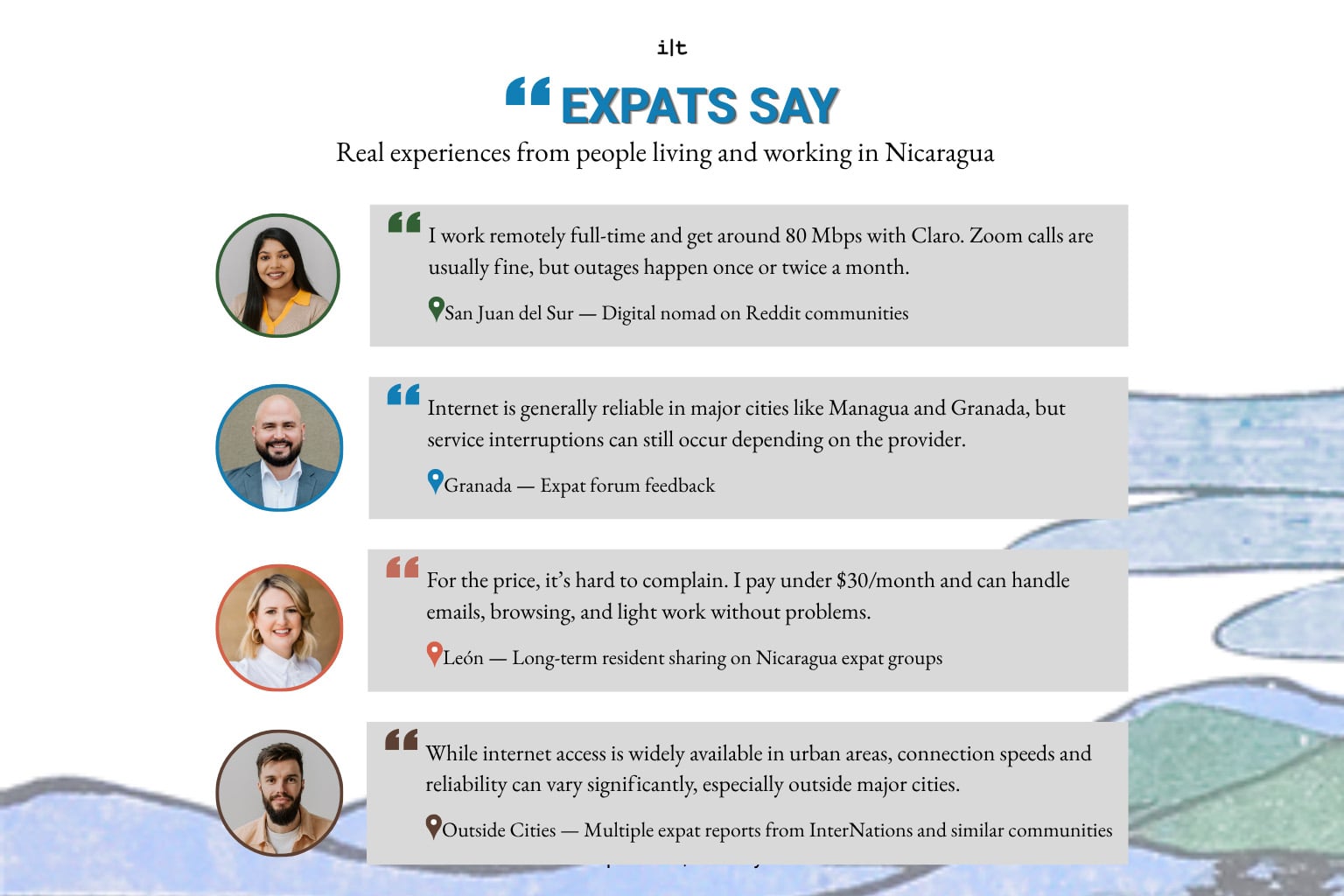
Real experiences tell the full story—what expats actually say about internet in Nicaragua.
What This Means for You:
- Cities (Managua, Granada, León): Reliable enough for most remote work.
- Coastal towns (like San Juan del Sur): Usable, but plan for occasional outages and use mobile backup.
- Rural areas: Unpredictable — backups are essential.
If you plan to rely on reliable Wi-Fi for your income, your choice of location and provider will make or break the experience.
Final Verdict – Who Should Move to Nicaragua for Remote Work?
So, is internet in Nicaragua good enough for remote work in 2026?
The honest answer: yes—but only for the right type of remote worker.
Nicaragua works well if you understand the trade-offs and choose your location carefully. It does not compete with top-tier infrastructure countries, but it offers a rare combination of low cost and usable connectivity in the right areas.
✔️ Nicaragua is a good fit if you are:
- A freelance or remote worker with flexible or async work
- Comfortable using backup systems (mobile data, UPS, secondary providers)
- Living in cities like Managua, Granada, or León
- Prioritizing low cost of living over perfect infrastructure
❌ Nicaragua is NOT a good fit if you are:
- Fully dependent on daily high-stakes Zoom meetings
- Working in live trading, streaming, or always-on roles
- Expecting near-perfect uptime like the US or Europe
- Unwilling to plan for occasional outages or variability
The Bottom Line: Internet in Nicaragua is not perfect—but it is functional. For many remote workers, it delivers exactly what they need at a significantly lower cost than most alternative destinations. But success here depends less on speed—and more on expectations, preparation, and location choice.
If internet reliability is non-negotiable for you…
Compare Nicaragua side-by-side with faster options using the Interactive Latin America Residency Map
Download The FREE Latin American Map
✔No Spam
✔Instant Access
✔ Free Download