
17 min read
Belize continues to attract expats from around the world with its beautiful Caribbean coastline, English-speaking culture, and relaxed pace of life. However, banking in Belize for expats can be one of the biggest practical challenges newcomers face. Understanding how to structure your finances effectively can make the difference between a smooth transition and constant frustration when living in this tropical paradise.
……………………………..
Table of Contents
Why Banking in Belize Isn’t What Most Expats Expect
Banking in Belize for expats is one of the most misunderstood parts of relocating here—and one of the fastest ways to create unnecessary stress if you get it wrong.
The currency is pegged to the U.S. dollar, English is the national language, and it has a reputation for being open to retirees and foreign investors.
On the surface, it looks simple—until you actually try to use it like a US, UK, or Canadian system.
This is where people get stuck and things break down. It is not designed for fast, low-cost, digital-first banking.
Processes are slower. Fees are higher. Requirements are stricter. Transfers take longer. And the system prioritizes compliance over convenience.
Where people get stuck is when they rely on it as their primary financial system.
The smarter approach in 2026 is a hybrid banking strategy—and when done correctly, it delivers measurable advantages:
- Reduce international transfer costs by 40–70%
- Maintain faster access to funds (same-day vs 2–3 day wires)
- Lower currency conversion losses
- Diversify financial risk across multiple jurisdictions
- Improve long-term asset protection
Belize offers a stable, open economy for foreign investors with several promising sectors.
According to the U.S. Department of State 2025 Investment Climate Statement, Belize maintains openness to foreign investors with no general restrictions on ownership—making it attractive for expats structuring their finances internationally.
Before setting up your finances, understand what living in Belize actually looks like, explore the full guide to understand how banking fits into the bigger picture.
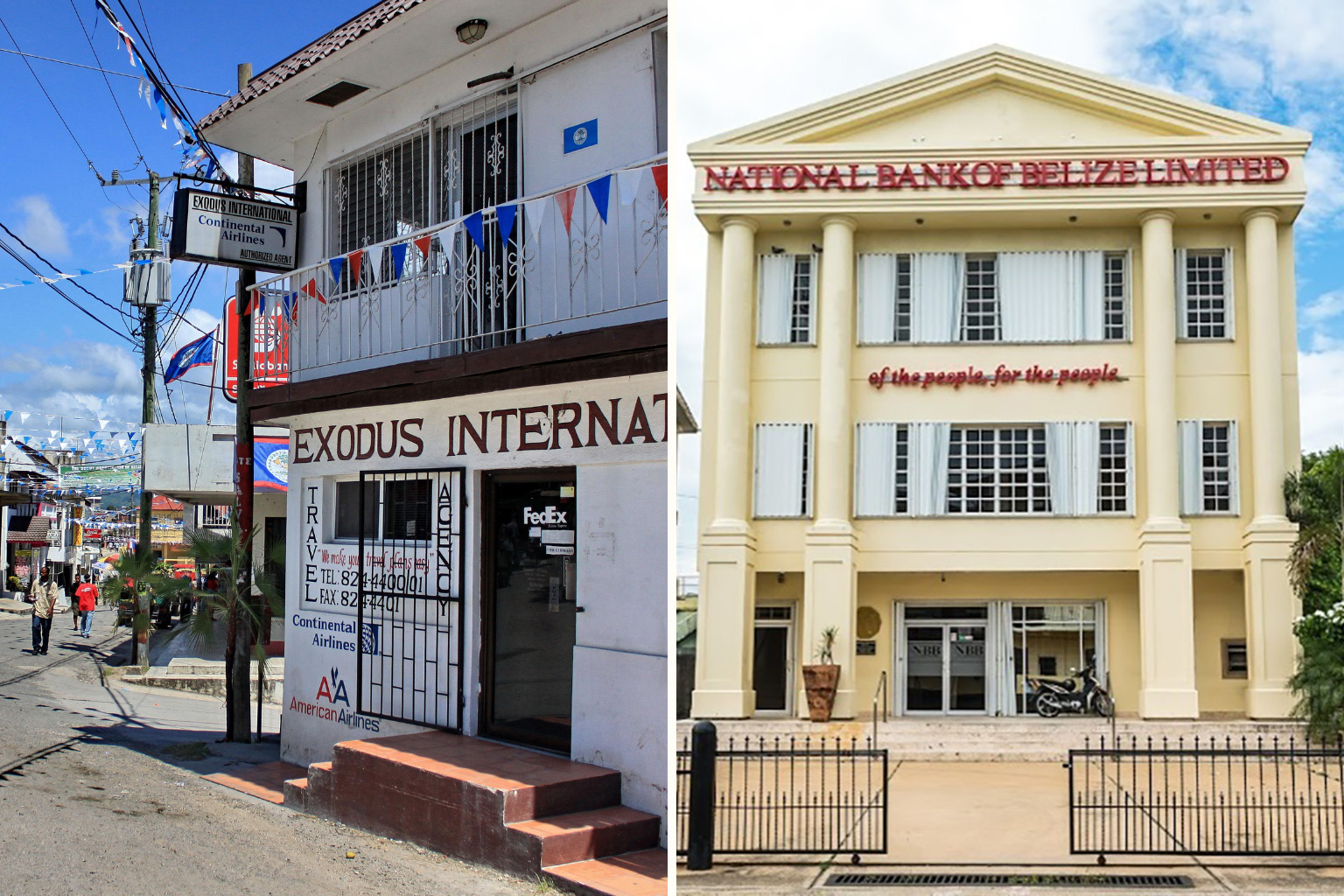
Local banks vs International banks in Belize – choosing the right option matters.
Understanding Belize’s Banking System in 2026
All banks operating in Belize are regulated by the Central Bank of Belize, which oversees both domestic and international financial institutions.
Local vs International Banks: Not the Same System
A common pattern around banking in Belize for expats is assuming all banks operate the same way.
They don’t.
Belize runs two parallel banking tracks, and each serves a completely different purpose. If you don’t understand this early, you’ll end up using the wrong account for the wrong job.
Local vs International Banks (Pros & Cons)
| Feature | Local (Domestic) Banks | International (Offshore) Banks |
| Best for | Daily expenses | Asset protection |
| Currency | BZD + USD | Primarily USD |
| Accessibility | Easier for residents | Stricter onboarding |
| Fees | Moderate to high | Higher but strategic |
| Protection | Deposit insurance (~$10K USD) | Structural protection |
The Financial Services Commission of Belize is responsible for licensing and supervising international and offshore banks in the country.

Welcome to Belize — now let’s get your banking sorted.
Key Features of Banking in Belize
Understanding structure is one thing. Understanding constraints is what actually helps you plan.
- The Belize Dollar Is Pegged to the U.S. Dollar
What this means for you:
• No currency volatility risk locally
• Easy mental conversion for USD earners
• Stable pricing for expenses
However:
• USD access inside local banks can still be limited or controlled.
Stability doesn’t mean full flexibility. - High Liquidity Requirements (Why Banks Feel Conservative)
Belizean banks are required to maintain a high 24% liquidity ratio, one of the highest in the region, as regulated by the Central Bank of Belize.
What that means in plain terms:
• Banks keep a larger portion of deposits available
• Lending is more conservative
• Risk exposure is lower
This is good for stability—but it also means:
• Fewer loan approvals
• Less aggressive banking services
• Slower financial movement - What Services Are Actually Available
You can expect:
• Checking and savings accounts
• Debit cards (credit cards are more limited)
• Domestic and international wire transfers
• Basic online banking
• Safe deposit boxes (at select banks)
What you shouldn’t expect:
• Seamless fintech-level user experience
• Instant transfers
• Broad lending products - Mortgage & Lending Reality in Belize
This is where expectations need to be grounded quickly. Yes—mortgages exist. But they are not structured like what most expats are used to.
Typical Mortgage Terms in Belize:
• Down payment: 40–60%
• Interest rates: typically, 11–14%
• Shorter repayment periods
• Strict approval criteria for non-residents
In practical terms, borrowing locally is expensive and selective.
Why Lending Is So Conservative:
• This ties directly back to the system:
– High liquidity requirements
– Smaller financial market
– Risk-averse lending practices
In practice, local mortgages exist—but they’re rarely the first choice unless you have strong financial ties in Belize.
Bottom Line: The banking system in Belize isn’t broken—it’s designed to minimize risk, even if that means sacrificing convenience.
• Local banks → support the domestic economy
• International banks → support cross-border financial activity
The friction expats experience comes from trying to use one system for everything. In practice, once you understand the separation, the strategy becomes obvious—and that’s where the hybrid approach starts to make sense. If you want a deeper dive about this country review the pros and cons of living in Belize.
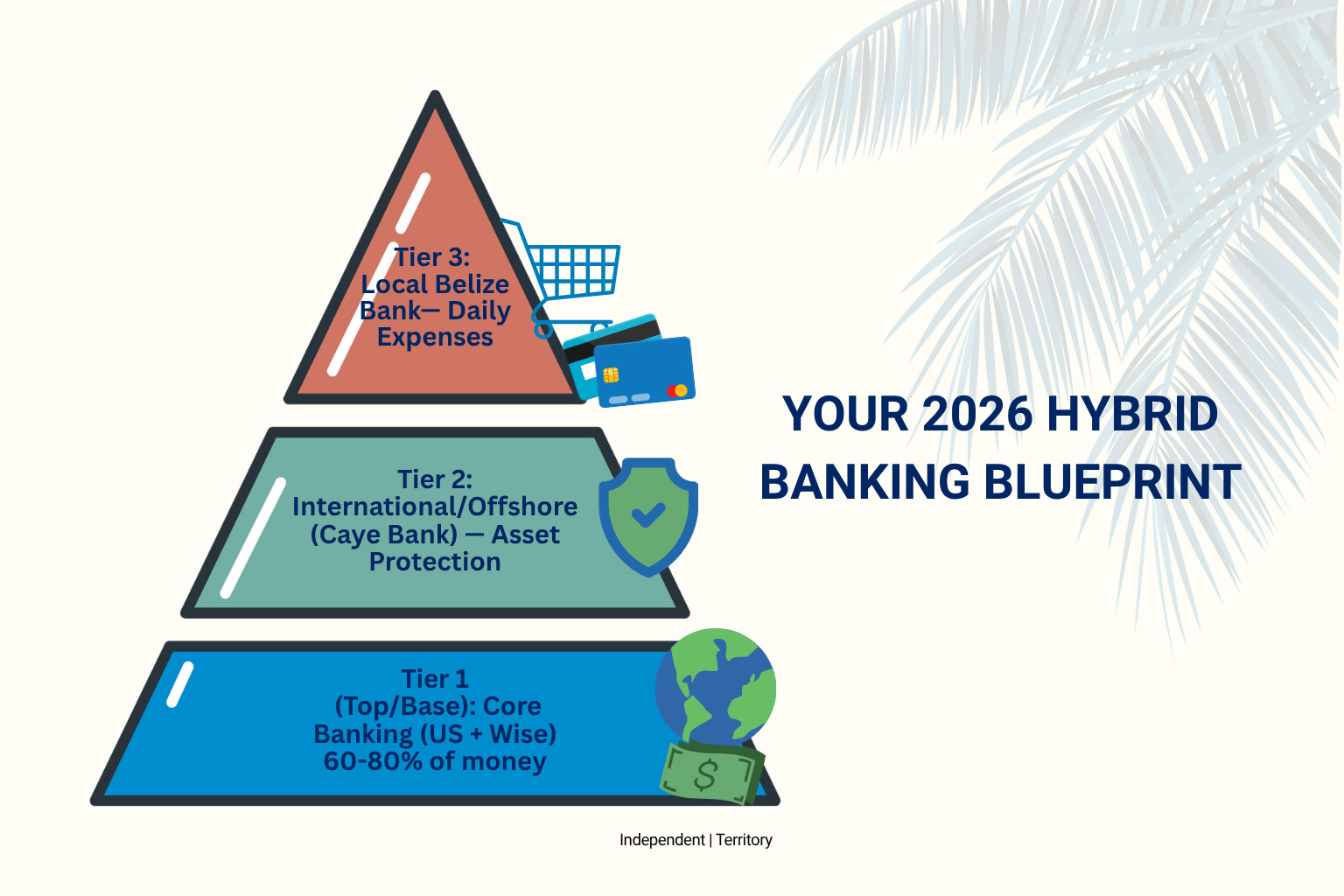
Your 2026 Hybrid Banking Blueprint – The strategy that actually works.
The Hybrid Banking Blueprint – Your Complete 2026 Stack
Once you understand how banking in Belize works, the next step is structuring your accounts in a way that actually fits the system.
Where expats go wrong—they try to force one bank to do everything.
That approach breaks down quickly in Belize.
This is the point where most people move from frustration to strategy.
The more effective strategy is to build a layered banking setup, where each account has a specific role. This is what experienced expats use to reduce friction, lower costs, and maintain control over their money.
This is the hybrid banking blueprint for expats in Belize in 2026.
Think of your banking setup as:
The 3-Layer Hybrid Banking Structure for Expats in Belize
| Layer | Banking Type | Primary Purpose | How It Functions in Your Setup |
| Layer 1 (Core) | US / Fintech System | Income + Liquidity | Acts as your financial backbone—handles salary, investments, bill payments, and fast global transfers |
| Layer 2 (Offshore) | International Account | Diversification | Provides asset protection, USD positioning, and an additional jurisdiction for risk management |
| Layer 3 (Local) | Belize Bank Account | Daily Spending | Used for rent, utilities, and local transactions within Belize |
This layered approach is the foundation of effective banking in Belize for expats—each layer has a specific role, and together they create a system that is flexible, cost-efficient, and resilient.
Tier 1 – Core Banking (Keep This Outside Belize)
This is your financial foundation.
Your core banking system should sit in a stable, highly efficient jurisdiction—typically the U.S., Canada, or another strong banking environment.
What This Tier Handles:
• Income (salary, business revenue, pensions)
• Savings and emergency funds
• Investments
• Credit cards and global spending
This is your control layer. Everything else supports it.
Tier 2 – Belize International (Offshore) Account
This is your bridge between global money and Belize.
International banks in Belize operate under a different framework than domestic banks and are designed for non-residents and cross-border activity.
A commonly used option is:
• Caye International Bank
What This Tier Is Used For
• Holding USD within Belize’s financial system
• Receiving international wires
• Positioning funds closer to local investments (like property)
• Acting as a buffer between your core account and local spending
These accounts are legitimate financial tools—not loopholes.
Belize’s international banking sector is no longer a “light-touch.” Global compliance pressure—especially from organizations like the Organisation for Economic Co-operation and Development—has increased reporting requirements and reduced anonymity. According to the U.S. International Trade Administration’s Belize Market Overview, the country continues to attract investment in tourism, agriculture, and renewable energy.
Tier 3 – Belize Local Bank Account (Daily Operations)
This is your on-the-ground account for living in Belize. It’s the simplest—but also the most commonly misused.
What This Tier Handles:
• Rent and property expenses
• Utilities
• Local purchases
• Paying contractors or services
• Receiving local payments
Used correctly, they work well. Used incorrectly, they become frustrating.
If you’re comparing Belize to other expat destinations like Mexico, read the guide cost of living in Belize vs Mexico.
Recommended Allocations for Banking in Belize for Expats (2026)
| Expat Profile | Core (US / Fintech Accounts) | Offshore / International | Belize Local Account |
| Retiree | 70% (US accounts) | 20% | 10% |
| Digital Nomad | 80% (Fintech platforms) | 15% | 5% |
| Investor | 60% (US accounts) | 30% | 10% |
This suggested allocation framework helps you balance liquidity, cost efficiency, and risk diversification when structuring your banking in Belize for expats strategy. Adjust percentages based on income stability, residency status, and how often you need local access to funds.
Why This Blueprint Works
Banking in Belize for expats becomes difficult when expectations don’t match reality.
This structure works because it aligns with how the system is actually designed:
• Strong systems handle complexity and scale
• Belize international accounts handle positioning and access
• Local banks handle day-to-day life
Each layer does one job—and does it well.
Your banking structure should also align with how taxes work in Belize to support your overall lifestyle.
But here’s the bigger picture—your banking strategy only works if your residency and location strategy are aligned.
If you’re still figuring out where you can legally live and structure your finances, explore your options with the Latin America Residency Map.

Don’t let banking frustration ruin your Belize dream.
The Real Challenges of Banking in Belize for Expats (And How to Solve Them)
Even with the right structure, banking in Belize for expats isn’t frictionless.
This isn’t a broken system—it’s just a different system with stricter constraints.
This tends to catch people off guard because of misunderstanding how Belize banks operate—and expecting them to behave like banks back home.
Below are the core challenges expats run into in 2026, and more importantly, how to work around them.
The Real Challenges of Banking in Belize for Expats (2026) — Problems & Smart Solutions
| Challenge | What’s Really Happening | Real-World Impact | Smart Hybrid Solution |
| Strict Compliance & Slow Account Opening | Influenced by global standards from the OECD Common Reporting Standards (CRS), Belize banks require: • Full identity verification • Source-of-funds checks • Manual approvals | • Account opening takes weeks to months • Multiple document resubmissions • Occasional unexplained rejections | • Prepare documents before arrival (bank references, proof of income) • Keep home country account active • Use Tier 1 (core banking) as your backbone • Don’t move funds until fully operational |
| Limited International Functionality | Belize banks prioritize stability and are regulated by the Central Bank of Belize with conservative policies | • Slow wire transfers (2–3 days) • Higher fees • Limited online banking • Restrictions on outgoing transfers | • Use Tier 1 accounts for global transfers • Use Tier 2 (international account) as buffer • Use Tier 3 (local) for spending only |
| Currency Limitations & USD Access | Belize dollar (BZD) is pegged to USD (2:1), but USD access within banks is controlled | • Not all accounts operate freely in USD • Extra steps for USD transfers • Minor FX inefficiencies | • Hold most USD outside Belize (Tier 1) • Use international account (Tier 2) for USD positioning • Minimize unnecessary conversions |
| Stability vs Flexibility Trade-Off | Belize banks are designed for safety, not speed | • Fewer financial products • Manual processes • Slower service • Limited automation | • Use Belize for local presence and simplicity • Use external systems for speed and efficiency • Don’t rely on one system |
| Residency & Documentation Barriers | Banks often require local ties and verification | • Need for local address • Residency or long-stay proof • In-person visits required | • Align banking setup with relocation timeline • Keep financial base outside Belize initially • Plan ahead before applying |
| Over-Reliance on One Banking System | No single jurisdiction is optimized for everything | • Increased access risk • Transfer bottlenecks • Exposure to regulatory changes | Diversify across jurisdictions: • Home country (US, Canada, etc.) • Belize (local + international) • Optional third jurisdiction→ Reduces risk and increases control |
The banking system in Belize is stable but limited. Once you shift to a hybrid approach and combine the strengths of multiple banking systems, the difference in efficiency is immediately noticeable.
NOTE: For U.S. citizens and residents, opening foreign accounts triggers reporting requirements under FATCA (Foreign Account Tax Compliance Act), as enforced by the IRS.
Your residency status directly affects your ability to open accounts—see the full Belize permanent residency requirements to find out if you can qualify.

Yes, banking in Belize can be smooth and stress-free.
How to Open a Bank Account in Belize as an Expat in 2026
Opening a bank account in Belize as an expat is more straightforward than many expect — especially when you only open the accounts you actually need as part of a smart hybrid banking strategy.
In the hybrid blueprint, most expats only require one or two Belize accounts (typically one local and/or one international). This section gives you the exact 2026 process.
The Central Bank of Belize maintains and regulates all banks and has a current list of all licensed domestic and international banks operating in the country.
Step-by-Step Process to Open a Bank Account in Belize
- Determine Your Tier Needs
Decide if you need a Local Bank Account (daily expenses) or an International/Offshore Account (asset protection & USD holdings), or both. - Choosing the Right Bank
Here’s a comparison of the best options for banking in Belize for expats in 2026:
| Bank Type | Bank Name | Best For | Official Website | Notes |
| Local / Domestic | Atlantic Bank | Everyday banking, branches, loans | Atlantic Bank | Strong local network |
| Local / Domestic | Belize Bank | Full-service domestic banking | Belize Bank | Largest and most established |
| Local / Domestic | Heritage Bank | Personal banking & competitive rates | Heritage Bank | Good customer service |
| International / Offshore | Caye International Bank | Expats, remote opening, asset protection | Caye International Bank | Most popular among expats |
3. Prepare Your Documents (see checklist below)
4. Submit Your Application International banks often allow fully remote applications. Local banks may require in-person or video verification.
5. Fund the Account & Activate Complete compliance checks and make your initial deposit.
Timeline: Expect 2–6 weeks total, though well-prepared applications to international banks can be approved faster (sometimes in 1–3 weeks).
Required Documents Checklist for Expats (2026)
| Document | Details | Notes |
| Valid Passport | Notarized or certified copy | Must be clear and current |
| Proof of Address | Utility bill, bank statement (max 60–90 days old) | From your country of residence |
| Bank Reference Letter | From your current bank (relationship of 1–2+ years) | Very important — get this early |
| Professional/Personal Reference | From lawyer, accountant, or employer | Often 1–2 required |
| Source of Funds/Wealth | Bank statements, tax returns, or income proof | Required due to global compliance |
| Completed Application Form | Provided by the bank | Can usually be filled digitally |
| Tax ID (e.g., SSN/ITIN) | Especially important for US persons | FATCA/CRS reporting |
Pro Tip: Have all documents in English and notarized/apostilled where requested. Incomplete paperwork is the #1 reason for delays or rejections.
Local vs International Bank Opening Differences
- Local Banks (Atlantic, Belize Bank, Heritage): Better for daily Belize life but often stricter for non-residents.
- International Banks (Caye International Bank): Usually easier remote opening and more expat-friendly.
- International banks in Belize are licensed and overseen by the Financial Services Commission of Belize, which sets strict compliance standards for non-resident clients.
Remote Opening Options in 2026
Many expats successfully open accounts remotely, especially with Caye International Bank. Expect video identity verification and enhanced due diligence as standard procedure.
Common Pitfalls to Avoid
• Poor quality document scans
• Choosing the wrong bank type for your needs
• Applying without a strong bank reference letter
• Ignoring FATCA/CRS requirements (especially US citizens)
Based on recent expat feedback (2025–2026), applicants who clearly explain their hybrid setup and intended low local balances tend to get approved faster.

One banking strategy doesn’t fit all expats in Belize.
How Different Expats Should Approach Banking in Belize (2026)
What surprises most expats is that not everyone living in Belize should use the same banking setup.
The right structure depends on how you earn money, how you spend it, and how much flexibility you need across borders.
This is where banking in Belize for expats stops being theoretical—and becomes a practical system built around real-life use cases.
QRP Retirees & Pensioners
If you’re entering Belize through the Qualified Retired Persons (QRP) program, your banking needs are relatively straightforward—but still structured.
Under the Qualified Retirement Program (QRP), participants are required to demonstrate their ability to support themselves financially, according to the Belize Tourism Board’s Official QRP Guidelines.
What Matters Most
• Receiving pension or retirement income reliably
• Minimizing transfer fees
• Keeping access to funds simple and predictable
Recommended Setup
• Tier 1 (Core Account): Keep your pension and savings in your home country
• Tier 2 (Optional): Use a Belize international account if you want USD positioning locally
• Tier 3 (Local Bank): For day-to-day expenses
Key Insight
You don’t need complexity—you need consistency and access. Most QRP retirees run into issues when they:
• Move all funds into Belize
• Rely too heavily on local banks
QRP retirees in particular need a banking setup that aligns with monthly pension transfers and local living costs.
If you’re planning retirement in Belize find out the full details on qualification and requirements, read the retiring in Belize on a pension.
Digital Nomads & Remote Workers
This is where most misunderstandings happen.
If your income is global, your banking should be too.
What Matters Most
• Receiving international payments
• Low-cost currency conversion
• Fast access to funds
Recommended Setup
• Tier 1: Primary account in your home country or global banking system
• Tier 2: Optional international account if you want regional flexibility
• Tier 3: Local Belize account for spending only
Key Insight
You should not rely on Belize to:
• Receive freelance income
• Process client payments
• Manage business finances
If you plan to earn money while living in Belize, your banking strategy should support your remote income streams.
If you’re earning remotely, your banking setup should align with how you work—see the full guide to working remotely from Belize.
Real Estate Investors & Property Owners
This group needs a more structured approach—especially when moving larger sums.
What Matters Most
• Moving funds into Belize efficiently
• Paying for property, construction, or maintenance
• Holding funds in USD when possible
Recommended Setup
• Tier 1: Keep capital outside Belize until needed
• Tier 2: Use an international bank (like Caye International Bank) to position funds
• Tier 3: Use a local bank for payments and ongoing expenses
Key Insight
Belize is not a financing-first market. Most expats:
• Purchase property in cash
• Or fund deals from outside Belize
For official guidance on financing realities and investment conditions, refer to: U.S. Trade.gov Country Commercial Guide – Belize
Strategic Reality
Trying to structure deals entirely inside Belize often leads to:
• Delays
• Limited financing options
• Higher friction
Control your capital externally—deploy it locally.
High-Net-Worth Expats Seeking Asset Protection
This is the most strategic category—and where misinformation is common.
What Matters Most
• Jurisdictional diversification (not keeping all your assets in one country or system)
• Risk management
• Long-term capital preservation
Where Belize Fits In
Belize can play a role—but it’s not a standalone solution.
It works best as:
• A secondary jurisdiction
• A geographic diversification layer
• A lifestyle-aligned financial base
Key Insight
Belize is no longer a “secrecy play.” Due to global compliance frameworks influenced by the Organisation for Economic Co-operation and Development, transparency and reporting standards have increased significantly.
Recommended Approach
• Keep primary wealth structures in strong jurisdictions
• Use Belize selectively—not exclusively
• Focus on access, flexibility, and risk distribution
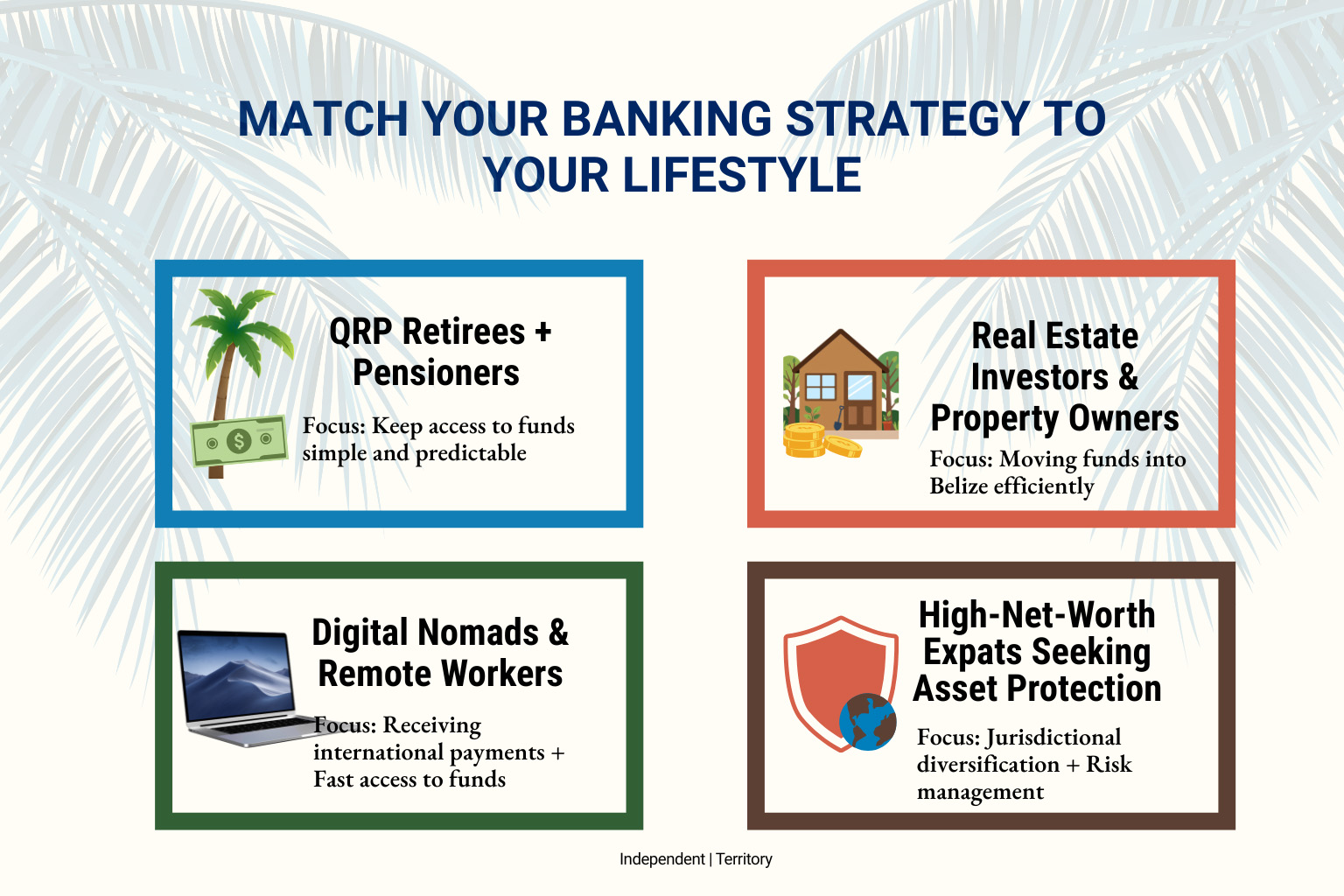
Match your banking strategy to your lifestyle in Belize.
Match Strategy to your expat Lifestyle
Banking in Belize for expats only works well when your setup reflects your actual lifestyle.
The biggest mistake is using the same strategy for everyone.
| Expat Type | Primary Need | Recommended Hybrid Approach | Best Belize Account Focus |
| QRP Retirees & Pensioners | Simplicity | Keep pension/Social Security in US accounts and transfer only monthly needs | Local domestic bank for daily expenses |
| Digital Nomads & Remote Workers | Flexibility | Maximize fintech tools and keep most funds outside Belize | Minimal or no local account if possible |
| Real Estate Investors | Structure | Use external capital for deals; maintain clear separation between investment & living funds | Local bank + International account |
| High-Net-Worth Individuals | Diversification | Layer multiple jurisdictions with strong emphasis on asset protection | International/Offshore account + Local |
Choosing the right banking setup also depends heavily on where you live in Belize, location will directly affect your banking experience. Our guide to the best places to live in Belize can help you match your location with your financial needs.
Conclusion: The Smart Way to Handle Banking in Belize for Expats in 2026
Banking in Belize for expats doesn’t have to be frustrating or overly complicated — as long as you stop treating Belize banks as your primary financial hub.
The most successful expats in 2026 use a Hybrid Banking Blueprint:
Keeping the majority of their funds in efficient US or fintech accounts, using Belize banks only for local needs, and adding an international layer for asset protection when necessary.
This approach delivers lower fees, better liquidity, stronger risk diversification, and far less stress.
The Bottom Line: You don’t need one perfect bank in Belize. You need a smart, intentional structure that matches your lifestyle, income sources, and long-term goals.
When done right, banking in Belize for expats becomes a strategic advantage instead of a daily headache. Use the hybrid model, stay flexible, and always verify the latest requirements directly with the banks.
Explore Where You Can Actually Live in Latin America
If you’re currently mapping out your move or still comparing countries, the next step is understanding where you actually qualify to live—and what options exist beyond Belize.
Discover countries, residency pathways, and relocation options using the Latin America Residency Map.
It’s designed to help you quickly see:
• Where you can realistically obtain residency
• Which countries match your lifestyle and income type
• And how different locations compare across Latin America
Explore your options here: Latin America Residency Map
Frequently Asked Questions: Banking in Belize for Expats
Is banking in Belize for expats difficult?
It’s not difficult, but it is slower and more documentation-heavy than most Western banking systems. Expats should expect stricter compliance checks and longer processing times.
Can foreigners open a bank account in Belize?
Yes. Foreigners can open accounts in Belize, but requirements vary by bank and typically include proof of identity, address, income, and banking references.
Do I need residency to open a bank account in Belize?
Not always but having residency or a long-term address in Belize can significantly improve approval chances and reduce delays.
What is the best banking setup for expats in Belize?
Most expats use a hybrid system: a home-country or international account for core funds, a Belize international account for USD positioning, and a local bank for daily expenses.
Is money safe in Belize banks?
Belize banks are regulated by the Central Bank of Belize, but deposit protection and banking scale are more limited than in larger financial systems. Diversification across jurisdictions is commonly used for risk management.
Can I receive international transfers in Belize?
Yes, but international wires can take longer than expected and may involve intermediary bank fees.
Should I keep all my money in Belize?
No. Most expats do not keep all funds in Belize due to transfer friction, limited financial infrastructure, and the benefits of cross-border diversification.
What is the fastest way to send money to Belize?
International wire transfers remain the most common method, though timing and fees depend on both sending and receiving banks.
Some of the photos featured in this post were shared by talented photographers through Creative Commons licensing. Full credit appears below:
Disclaimer: This article is for informational purposes only and does not constitute financial, legal, or tax advice. Banking requirements in Belize can change and vary by bank and individual circumstances. Experiences described are based on general expat reports and may not reflect every case. Always confirm details directly with the bank or a qualified professional before making financial decisions.