
9 min read
Paraguay draws expats with one of Latin America’s most affordable and relaxed lifestyles—think low everyday costs, genuinely welcoming locals, and a peaceful, slower rhythm that often wins people over for good once they arrive. Yet when you’re planning to live here long-term, healthcare in Paraguay for expats quickly becomes one of the most important practical details to get right from the start.
……………………………..
Healthcare in Paraguay for expats as assumed by outsiders is neither an inadequate quality of care nor a flawless alternative to Western systems. It sits in a practical middle ground—highly affordable, reliable for everyday needs, and limited in specific, predictable ways.
This guide to healthcare in Paraguay for expats is written for people making real relocation decisions, not armchair comparisons. It explains how the system actually works in practice, where it performs well, where it reaches its limits, and how long-term expats structure their healthcare strategies to live comfortably and confidently in Paraguay.
If you are a retiree, digital nomad, family, or long-term resident candidate, understanding healthcare in Paraguay for expats is essential—not because it’s bad, but because planning realistically is what makes it work.
Table of Contents
Why Healthcare Should Be a Deciding Factor—Not an Afterthought
Healthcare is one of the few relocation variables that cannot be improvised once you arrive. Cost of living, housing, and lifestyle can be adjusted. Healthcare cannot.
For expats, healthcare decisions in Paraguay are shaped by:
- Speed of access in emergencies
- Quality of diagnostics and specialists
- Language barriers
- Geographic concentration of services (heavily in Asunción)
- Backup options for rare or serious conditions
Healthcare in Paraguay for expats rewards those who plan deliberately. Those who assume it functions like a scaled-down version of a Western system are the ones who struggle.
How healthcare in Paraguay for expats Was Researched
This guide combines official public data, private healthcare pricing, and real-world expat experience. Information has been cross-checked using:
- Paraguay’s Ministry of Public Health and Social Welfare (MSPBS)
- The national IPS public healthcare system (Instituto de Previsión Social)
- Pricing and service data from private hospitals and clinics in Asunción
- Long-term expat usage patterns and recent 2025–2026 cost updates from expat forums, reports, and clinic sources
Where official policy and lived experience diverge, this guide reflects what expats consistently encounter on the ground, not idealized descriptions.

Affordable private consults make routine visits stress-free healthcare in Paraguay for expats.
Understanding the Healthcare System in Paraguay
Healthcare in Paraguay for expats operates within a dual system:
- Public healthcare (SNS / MSPBS and IPS)
- Private healthcare, which handles the majority of expat needs
Both systems are accessible, but they serve very different roles.
1. Public Healthcare in Paraguay: A Safety Net, Not a Strategy
Public healthcare in Paraguay is universal and legally accessible to residents and, in emergencies, to visitors with valid ID (cédula for residents; passport for short-term). In theory, this sounds reassuring. In practice, expats rarely rely on public healthcare for ongoing treatment.
What Public Healthcare Does Well
- Emergency stabilization
- Basic consultations
- Surgical access when necessary
Where Public Healthcare Falls Short
- Long wait times (often 6+ hours in emergencies, days/weeks for non-urgent)
- Equipment shortages and outdated facilities in many areas
- Overcrowding
- Limited specialist access outside major cities
Public healthcare in Paraguay functions best as a backup system. It is not designed for convenience, speed, or personalized care—and expats who attempt to use it as their primary system usually adjust their expectations quickly.
2. Private Healthcare in Paraguay: Popular Choice for Expats
Private healthcare in Paraguay for expats is the default choice, not the exception.
Private facilities offer
- Short wait times
- Modern diagnostic equipment
- Internationally trained physicians
- Predictable pricing
- English-speaking staff (primarily in Asunción)
Private healthcare is not an upgrade—it is the functional core of healthcare in Paraguay for expats.
Public vs Private Healthcare in Paraguay (Reality Comparison)
| Category | Public System | Private System |
| Cost | Free or minimal (with valid ID) | Paid (out-of-pocket or insurance) |
| Speed | Slow (long waits common) | Fast |
| Equipment | Basic; shortages frequent | Modern |
| Language | Primarily Spanish | Spanish & some English (Asunción) |
| Best Use | Emergencies, basic needs | Routine & specialist care |

Pharmacies in Paraguay are expat-friendly and budget-friendly – quick advice and low-cost medications every day.
Healthcare Costs in Paraguay for Expats (2026)
One of the strongest advantages of healthcare in Paraguay for expats is cost—without sacrificing basic quality.
Typical Private Healthcare Costs (2026 averages from expat reports and clinic data)
- GP consultation: $15–50
- Specialist visit: $20–70
- Emergency visit (private): $50–150
- MRI / CT scan: $150–300
- Dental cleaning: $30–60
- Hospital room (per day): $100–200
- Childbirth (private, uncomplicated): $1,000–3,000
These figures are 50–70% below US equivalents, making Paraguay attractive for budget-conscious expats who want to keep their overall monthly expenses low.
Paraguay vs US Healthcare Costs Comparison (2026 Averages) (USD)
| Service | Paraguay Private | US Uninsured/ Out-of-Pocket | Savings in Paraguay 💰↓ |
| GP / Doctor Consultation | $15–50 | $100–400 | 70–90% |
| Specialist Visit | $20–70 | $150–500+ | 70–85% |
| Emergency Visit | $50–150 | $1,000–3,000+ | 80–95% |
| MRI / CT Scan | $150–300 | $400–7,000+ | 70–90% |
| Dental Cleaning | $30–60 | $100–300 | 70–80% |
| Hospital Room (per day) | $100–200 | $3,000–4,000+ | 90–95% |
| Childbirth (uncomplicated) | $1,000–3,000 | $10,000–30,000+ | 80–90% |
Key Takeaway: Most expats in Paraguay pay cash for routine care because prices are so low and add modest insurance ($50–300/month) only for big events. In the US, high deductibles, premiums, and surprise bills make even basic care expensive.
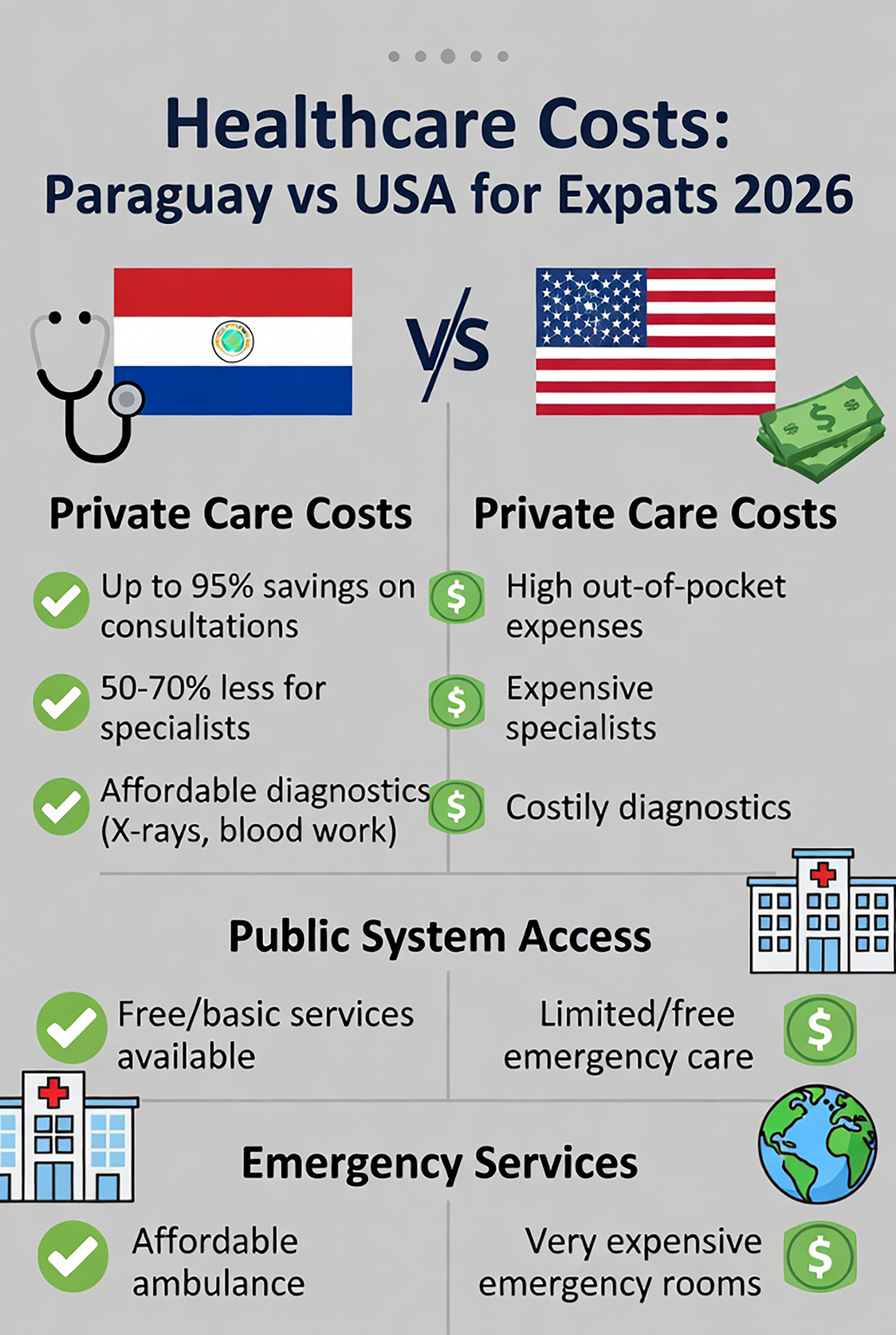
Private healthcare in Paraguay costs up to 95% less than in the USA—huge savings for expats, retirees, and families.
How Expats Use Healthcare Day to Day
Small Private Clinics: Neighborhood clinics (consultorios privados) handle:
- Minor illnesses
- Routine checkups
- Prescriptions
- Vaccinations
Visits typically cost $15–40, often booked via WhatsApp. Expats use them for quick, everyday needs without hospital-level formality.
Pharmacies: Pharmacies are central to healthcare in Paraguay for expats.
- Generics are widely available and inexpensive
- Pharmacists are knowledgeable and often provide advice
- Many medications are sold without strict prescription enforcement (though bring your English Rx for controlled items)
Expats stock chronic meds here affordably; 24-hour options exist in cities.
Specialized Clinics: For dental care, dermatology, physiotherapy, and women’s health, specialized clinics are common and affordable, typically $30–80 per session. Expats use them for ongoing or niche treatments.
Note: For healthcare access—your cédula de identidad (national ID, obtained after residency) suffices for full public/private use. Passport works for visitor emergencies; RUC (tax ID) is only for tax residency/business purposes.

Step inside Paraguay’s modern private hospitals – clean, calm, and affordable for expats.
Best Private Hospitals in Asunción for Expats
Advanced healthcare in Paraguay is concentrated in and around Asunción—for anything beyond basic care, choosing one of the best places to live nearby can make access much easier and more reliable.
Recommended private hospitals (frequently praised by expats for modern facilities, English-speaking staff in many cases, and reliability):
- Sanatorio Migone Battilana — Comprehensive specialties (cardiology, neurosurgery, maternity); modern Level III.
- Centro Médico Bautista — Family/pediatric/maternal focus; preventive care.
- Centro Médico La Costa — Premium; cardiology, neurosurgery; hotel-like amenities.
- Sanatorio San Roque — General/specialized; strong for planned procedures.
- Hospital Italiano — Oncology, diabetes; international standards.
Living near these facilities is strategic, not optional—especially if you’re prioritizing safety alongside quality private care.
Is Paraguay’s Healthcare System Actually “Good Enough” for Expats?
Healthcare in Paraguay for expats is good enough if—and only if—you plan around its limits.
The system excels at:
- Routine diagnostics
- Predictable treatments
- Preventive care
It reaches its limits with:
- Rare diseases
- Experimental treatments
- Highly complex or multi-disciplinary surgeries
This is not unique to Paraguay. It is a scale issue.
Long-term expats thrive by using Paraguay for what it does well and planning contingencies for what it doesn’t.
Where Expats Go for Serious or Complex Medical Conditions
For advanced or highly specialized care, expats may travel to:
- Brazil (São Paulo)
- Argentina (Buenos Aires)
- Chile
This is where insurance and evacuation planning matter most.

Emergencies happen – but private hospitals in Paraguay make fast response affordable and reliable.
Health Insurance for Expats in Paraguay: How to Think About It
Health insurance for healthcare in Paraguay for expats is context-dependent, not mandatory.
Insurance Decisions Depend On:
• Age and health history
• Risk tolerance
• Family situation
• Financial buffer
Local & Prepaid Plans:
• $50–150/month
• Covers routine care and limited hospitalization
• Suitable for low-risk residents (e.g., Asismed, Santa Clara)
International Health Insurance:
• $150–300+/month
• Covers international treatment and evacuation
• Better for retirees and families (e.g., Cigna Healthcare — www.cignaglobal.com; Allianz Care — www.allianzcare.com; Blue Cross Blue Shield — bcbsglobalsolutions.com)
How Expats Combine Insurance With Out-of-Pocket Care
The most common strategy:
- Pay cash for routine care
- Use insurance only for major events
Many expats combine modest insurance with Paraguay’s territorial tax advantages and easy residency pathways to protect against major medical events while keeping long-term costs minimal.
Do Expats Really Need Health Insurance in Paraguay?
Not always—but ignoring it entirely is risky.
Insurance is rarely used for:
- GP visits
- Specialist consultations
- Prescriptions
It is critical for:
- ICU stays
- Major surgery
- Medical evacuation
Healthcare in Paraguay for expats is affordable—but catastrophic events are not.
Emergencies, Rural Care & Planning Realities
- Emergency numbers: 911 or 141
- Private ambulances: $200–500 (faster than public)
- Rural healthcare: basic only; serious care requires access to Asunción

Routine check-ups in Paraguay: fast, professional, and easy on the wallet for expats.
Who Healthcare in Paraguay Works Best For
| Profile | Best Strategy |
| Retirees | Private care + international insurance |
| Digital nomads | Pay-as-you-go private |
| Families | Private hospitals in Asunción |
| Long-term residents | Local plan + public backup |
Final Verdict: Healthcare in Paraguay for Expats
Healthcare in Paraguay for expats is not perfect, but it is functional, affordable, and dependable when approached realistically. Private healthcare covers most needs efficiently. Public healthcare provides a safety net. Insurance protects against rare but serious risks. Expats who succeed here do not expect perfection—they plan for reality.
For a broader look at residency pathways across Latin America, grab our free Latin America Residency Map.
This guide consolidates the key realities of healthcare in Paraguay for expats—use it as a starting point, cross-reference with current sources, and consult professionals for your specific situation.
FAQs: Healthcare in Paraguay for Expats
Is healthcare in Paraguay free for expats?
Public care is free or low-cost with valid ID (cédula for residents; passport for visitor emergencies). Private care is paid.
Do expats need health insurance in Paraguay?
Not for routine care, but recommended for major events, evacuations, or peace of mind.
Is Asunción necessary for good healthcare?
Yes, anything beyond basic treatment; quality and specialists concentrate there.
What about wait times in public healthcare?
Often long (6+ hours emergencies; days/weeks non-urgent); overcrowding and shortages common.
Do I need a RUC for healthcare?
No—cédula suffices; RUC is for tax/business only.
English-speaking doctors?
Available in Asunción private hospitals/clinics; limited elsewhere.